







NPR president Katherine Maher on a year without federal funding
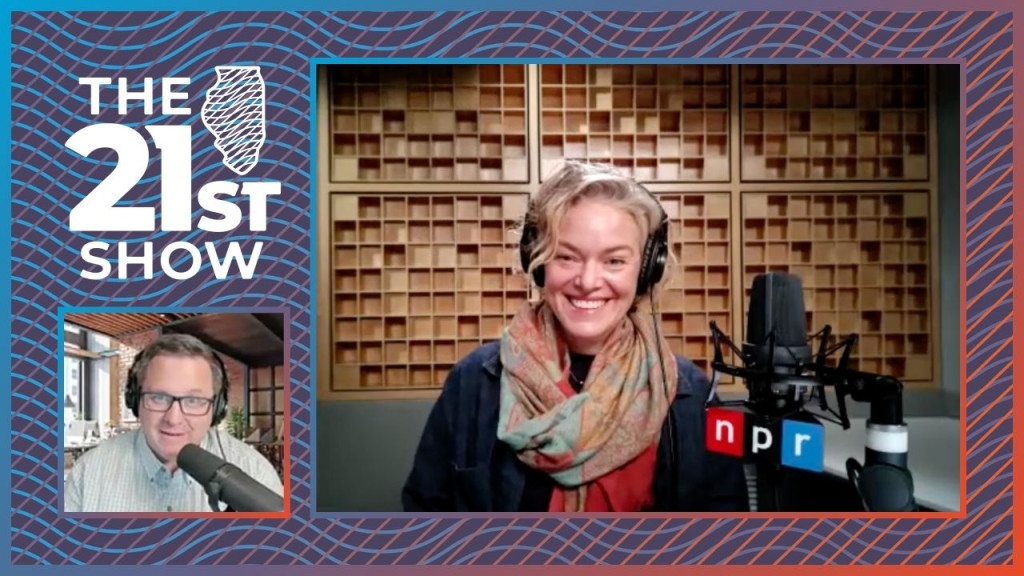
NPR president and CEO Katherine Maher spoke with Brian Mackey of "The 21st Show" from NPR headquarters in Washington, D.C. Illinois Public Media
// This is a machine generated transcript. Please report any transcription errors to will-help@illinois.edu.

[00:00:00]
Brian Mackey: From Illinois Public Media, this is the 21st show. I'm Brian Mackey. And a special welcome today to our new listeners on Tri-States Public Radio. We're excited to have Western Illinois, southeast Iowa, and northeast Missouri join our conversations. For years, public radio and television programs included messages like this.

[00:00:29]
Speaker 1: This program was made possible by the Corporation for Public Broadcasting and by contributions to your PBS station from viewers like you. Thank you.

[00:00:41]
Brian Mackey: Today, of course, only the second half of that statement is true. Listeners like you are an important part of how we continue our journalism and other programming, but the Corporation for Public Broadcasting is no more. The winddown began 1 year ago today, the federal fiscal new year, and it came after President Trump's administration and Republicans in the Congress delivered on a decades-long conservative goal to end federal funding of public media. That's how it started. Today, we find out how it's going. Later in the hour, we'll talk with leaders from public radio and TV stations across Illinois, and we also want to invite you to join us at 800-222-9455. That's 800-222-9455.

We are joined to begin the program by the leader of what we sometimes call the mothership in public radio. Katherine Maher is president and CEO of NPR. Catherine, welcome to the 21st show.

[00:01:35]
Katherine Maher: Thanks for having me. Glad to be here with you all today.

[00:01:37]
Brian Mackey: So I mentioned how it started, how it's going. How has the past year been for NPR?

[00:01:44]
Katherine Maher: A lot of change. Um, a lot of change for us, a lot of change for our member stations, uh, a lot of change — perhaps it's been felt more internally, hopefully, than for our listeners — but really what it has been about is adapting to this post-federal funding reality while trying to continue to maintain the level of quality of reporting and service and programming, um, across the entire country for our audiences who still rely on us. That nothing has changed about the needs people have from public media. So balancing the change that we're going through internally with that commitment that we still have to the public interest, publicly funded or not.

[00:02:23]
Brian Mackey: So some people will know, others may not, that public radio is a very distributed system, right? 400-something — you could probably tell me the exact number — independent stations, uh, and then the corporate, or you know, headquarters in Washington, which does not own the stations. Maybe you can talk a little bit about that relationship and how that may have changed in the past year.

[00:02:46]
Katherine Maher: Sure. It's, it's funny to hear you say headquarters. I think we would shy away from that word because we recognize that while we produce the programming that is consistent across all of our member stations — "Morning Edition" and "All Things Considered" and some of the other shows that you may hear, for example, on the weekends, maybe it's like a "Wait Wait... Don't Tell Me" or "Fresh Air" — the reality is that every station that carries that programming is totally independent. It has its own roots in its community, its own license, which allows it to broadcast over the air. It might have a PBS station or affiliate television station that it works with. Uh, it has probably a newsroom that goes ahead and focuses on the needs of its community and its own board of directors or trustees who make decisions in the best interest of that station in that community. So, while we work with all of those stations to think about, OK, how do we make sure that we're covering the things that matter nationally, we also work with stations to say, how do we make sure that we're serving your needs locally, uh, to the best of our ability. So that we are able to be in relationship with these stations in every state across the country and Guam. Um, and it's a complicated, ongoing conversation that is a little bit akin to herding cats, but, uh, hopefully the sum — the sum of all of our parts is stronger than each of us as individual organizations.

[00:04:07]
Brian Mackey: Herding cats is a good metaphor. I was also thinking about so many cooks in our kitchen, so many, so many kitchens. So let's talk about what have you been hearing from the various kitchens, so to speak, across the country about funding, right? You have big cities, you have small markets, community licenses, universities. Maybe you can lay that out for us.

[00:04:26]
Katherine Maher: Well, the beauty of public radio is that it can be a little bit like stone soup, if we're going to continue this kitchen metaphor, which is that, you know, we bring to it what we bring to it, and some of our stations with lots of resources are able to bring to it the ability to produce shows that can then get aired across the network, um, by other stations. And then some of our stations with fewer resources are able to really focus on what matters the most to their communities, um, whether that's local reporting. I'm a big fan of the public affairs call-in show like we're doing right here today. I think that that is sort of the most uniquely public media thing that we are able to do as organizations.

But what we've been hearing is that it's really different out there for everyone. This year, post-[defunding], we received an upsurge of donations across the network, and that was massively appreciated. It helped stations have a little bit more runway to think about what it was going to look like when federal funding went away. We were able to use those donations from individual listeners to expand out what we think of as the cliff when federal funding disappears and some hard changes had to be made. Um, which gave stations more time to plan. So hopefully we were able to think about pathways to sustainability, uh, the way that they were going to be able to maintain service to those communities, the shows that they were going to be able to put on air with fewer resources, just some of those difficult decisions that had to be made — more time to make them. And as we all know, when we have to go through change, more planning usually equates with a better outcome. Um, so that was enormous.

Unfortunately, that kind of crisis giving doesn't usually sustain at the same level, and so now we're in our second year without federal funding and we're seeing many people continue to be generous. And if that's you who's listening today and you continue to be a member or support your station, an enormous thanks to you. But we also recognize that the economy is tough. We recognize that people's needs and focus from a philanthropic standpoint, they change. Perhaps there's something else that's caught your attention, and so we're also adjusting to a sort of a gradual drawdown there.

What does that mean for stations? Some stations are taking on initiatives to merge their operations with other stations, perhaps in their region or their area. Other stations are looking at ways to reduce costs through perhaps shared services — like thinking about, well, you know, we all have to run payroll systems, maybe we can run similar payroll systems instead of individual contracting. Kind of the boring backend stuff, but all of those little changes add up, um, hopefully to better outcomes where we're able to keep that investment of our — of our operating really focused on the reporters in the field covering issues that matter, in the state house, and being able to air the sort of programming at the national level that people have come to depend on. So that's, that's sort of what we're hearing. It's different everywhere, but mostly everyone's thinking about the same thing, which is how do we keep this going in a way that serves our audiences what they expect.

[00:07:22]
Brian Mackey: All right, let me remind listeners — if you're just tuning in, we are speaking with Catherine Maher, who is the president and CEO of NPR. If you want to join us today, 800-222-9455.

How much are cuts going to be a part of the continuing story, right? I mean, our program — we had to say goodbye to a producer colleague who is, you know, technically part time but put in enough hours to contribute significantly, to the point we're now a four-day-a-week show instead of five. I know that there have been other programming changes. I saw "Code Switch" sunsetting, at least as a broadcast program. I don't know if you want to address that in particular, um, but you know, layoffs, buyouts, that sort of thing. Are there more cuts in the future?

[00:07:49]
Katherine Maher: So at NPR we did make a cut in our newsroom. It was a tough cut. It was less deep than we were worried about, but certainly anytime you have to say goodbye to colleagues is really hard. We offered buyouts to our employees. A number of people took those buyouts. That means that we were able to offer them, you know, more generous packages and the ability to leave if they were looking at doing something else or were towards the end of their career. But even with that, we still had to go through with involuntary layoffs, and that's painful. Um, we felt as though that was necessary in order to be able to do what we were hoping to do, which was to reduce our overall cost structure as the national organization so that we could also reduce fees to our members.

Uh, what that means is that across the board we took about $20 million out of our fee structure so that we could lower the cost of fees for stations so they could continue to air NPR programming. That was well received, but again, it comes with trade-offs because it's impossible to take money out of somewhere and not have to take it out of somewhere else at the same time.

At NPR, we don't foresee additional buyouts or layoffs based on the budget as we forecast into the future. We're making pretty big investments in sustainability right now and we think that that will come to bear, come to fruition over the course of the next 12, 24, 36 months. Um, and that is the hope — is to get everybody in public radio to a place of sustainability so that we can continue to be really as robust a network to our nation as we've been, um, all along. But, you know, it takes time and it's hard. I think across the network we're hearing that most stations have had to make the changes to get to financial stability — many of them have already done that work, and so hopefully we're all in a position now where we're looking forward as to how, you know, we build forward from here.

[00:09:38]
Brian Mackey: All right, let me remind listeners, if you're just tuning in, we are speaking with Katherine Maher, who is the president and CEO of NPR. If you want to join us today, 800-222-9455. We've also gotten messages from people in our texting group. Let me actually go to Christopher in Brimfield, who says it's an utter shame what this administration has done to NPR and PBS. I'm glad that members have stepped up to support NPR, and I hope the government turns around and realizes what a jewel NPR is.

I do hear this from people that, you know, maybe if there's a different power structure in Washington in the future, federal funding will come back. How would you rate those chances? How are you thinking about that for the future?

[00:10:19]
Katherine Maher: So, never, never an easy answer. Let me give you two thoughts on it. One is I also hope that federal funding resumes for public media, but I think it might need to look a little bit different. One thing that I will say — and I'm radio, but I want to see federal funding restored for children's educational programming. PBS and children's educational programming is a crown jewel for this nation and what it is that we provide to children across the country. That is so important. Nobody else can produce that work. That work does not make money. You do not want to run ads against children's programming, and so for the federal government to continue to fund that — it is a long-term investment in the health and well-being of our nation and our children, and that to me is tremendously important. I hope to see that restored.

Um, on the radio side, we know that smaller stations, rural stations are the ones that have been most affected by these cuts. They serve communities that for a variety of reasons didn't necessarily have their own financial infrastructure to be able to sustain a public radio station. The cost of running towers across, you know, our great Rocky Mountains, or I mean the Appalachian Mountains, it's expensive. The cost of being able to cover large areas in the heartland is expensive. These towers — you know, they also provide a public safety benefit. We know that that's the sort of thing, uh, in terms of universal service that the federal government is best positioned to provide, and we are optimistic that there's an opportunity to be able to find common ground from a bipartisan basis on restoring funding to infrastructure to ensure public safety and public well-being, um, and access to communications.

Do I think we're going to get funds back for producing programming? Truthfully, I'm not sure. And I have to say I believe that it's also important that we're not a political football, uh, as public media. We're more important than that and we're not a partisan issue. People across the nation, regardless of your background or your beliefs, should be able to turn to public media. And so I would be personally — uh, if we could see a compromise where we fund the infrastructure to ensure that across the nation we have universal service, and then we rely on our own innovation and creativity to be able to support programming, I think that might be a compromise that we could live with.

[00:12:26]
Brian Mackey: One of the big concerns now in public media is reaching newer audiences, right? You hear some people focused on younger listeners. Um, I certainly am also concerned about just — so many Americans have fallen out of the habit of news consumption with the decline of local newspapers, where I used to work. Um, how are you thinking about that? How is NPR thinking about trying to expand its audience, uh, since it's now more reliant than ever on its audience for its, uh, fiscal future?

[00:12:55]
Katherine Maher: Well, on the local news consumption side, we are 100% here at NPR to support local news even though we are a national news producer, and part of that is because we know that when people have access to local news, we just have better civic outcomes. The data is really clear at this point. As you said, we've lost so many of our newspapers across the nation, and so we're living in an experiment. Um, and unfortunately, the outcome of that experiment is that we've seen greater polarization, lower trust in civic institutions as a result of losing local news. We have less trust in one another as members of a community, less confidence in our neighbors, and where those institutions of local news exist, you see exactly the opposite. You see greater confidence, you see greater cohesion as a community. You also — and I love this one — you have better municipal bond ratings, because rating agencies take a look at that and they go, well, people are probably covering the issues that matter to that community. There's probably lower rates of corruption, greater rates of transparency, you know, more efficient use of, uh, of municipal dollars. So there's all sorts of benefits to having local news.

And so we start from the position as a national producer that we want to see that. We want to see people rooted in their communities. It also builds trust in the media, and there's, of course, there's something self-serving as the head of NPR to say we should have trust in the media, but we also want people to have confidence that the journalists who are out there covering stories on behalf of their community have their best interests in mind, have the public interest in mind. And when you're able to listen to your local newscast and say, actually that does reflect what I heard in my PTA meeting or my town hall meeting, that helps build that confidence that journalists really are here serving the public interest, and that helps translate to the statewide level and to the national level. So certainly all in for support of local news.

As far as NPR is concerned, the way that we're approaching this is saying, well, how can we support our stations in being able to continue to provide that as an offering? How can we make sure that your funds remain redirected to the things that matter most in your newsroom? How can we build out real newsrooms that allow for us to be able to support across an entire state what's going on, across a region that has, you know, common issues, whether that's extreme weather or thinking about agriculture? How do we make sure that those kinds of resources to cover common issues remain in play?

And then how do we bring younger audiences to becoming news consumers? And what we've seen — we've been doing this for more than 50 years — you know, people used to acquire a news habit around the age of 27. It's a little later now. It's like sort of in your early 30s because people's sort of indications of adulthood have also shifted back. You know, we don't buy houses. There's a crisis of housing, and if you're not thinking about what does an interest rate mean to me, or, you know, where am I setting down roots, you also maybe have less of a need for some of that local news consumption. But when you are able to tip into some of those markers of adulthood — you have your family, you have your home, you have your sort of long-term job — we recognize that people also start to turn to the news. So we want to be where people are when they have those needs. And before that, we want to be producing things that are relevant to them so they become familiar with the value of public radio. Maybe you first come to us through Tiny Desk, for example. It's music, it's entertainment, it's lifestyle, but we're also going to be here for when you have to know about what's going on locally or nationally to make decisions that affect your life.

[00:16:12]
Brian Mackey: And we're going to have to leave it there. Katherine Maher, president and CEO of NPR, thank you so much for being with us today. Appreciate your time.

[00:16:17]
Katherine Maher: Thanks

[00:16:18]
Brian Mackey: for having me. More to come after a short break here on the 21st show. We are talking about public funding of public media. Stay with us.
It's been one year since the Corporation for Public Broadcasting began winding down. That came after the Trump administration realized a longtime conservative goal of ending federal funding for public radio and television in America.
Since then, NPR has had buyouts and layoffs and programming changes, but CEO Katherine Maher says as difficult as that's been, she hopes it's not led to noticeable differences for listeners.
Guest
Katherine Maher
President and CEO, NPR