







Previewing a new series: ‘America at 250’
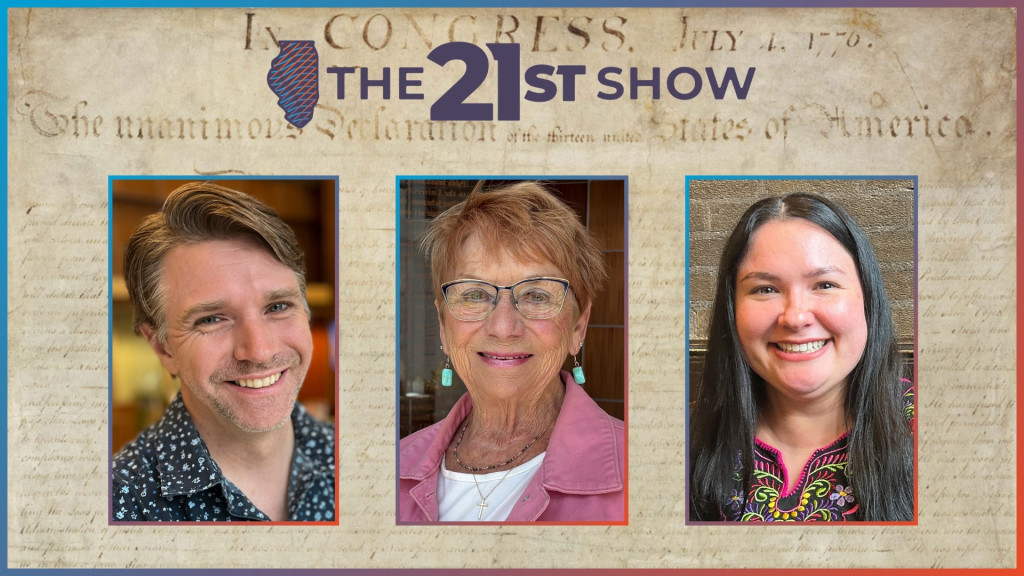
From left: Alex Wysocki, Kay Weidner and Hannah Velasco share what they think are the most important questions facing America at her 250th birthday. Portraits: Wysocki (Charles Ledford/IPM), Weidner (Annisyn Krebs-Carr/ISN), Velasco (Fernanda Romero/ISN); Declaration of Independence (National Archives)
// This is a machine generated transcript. Please report any transcription errors to will-help@illinois.edu.

[00:00:00]
Brian Mackey: It's the 21st Show. I'm Brian Mackey. The United States of America celebrates our 250th birthday this Saturday, July 4th. This milestone, like any other, is a time for celebration and reflection. And our home station, Illinois Public Media, is marking the occasion with a new series, America at 250, The Questions Before Us. It features the voices of your fellow Illinoisans sharing what they think are the most important questions facing Americans at this historic moment. So to close out today's show, we're going to hear from the first three voices in the America at 250 series. We begin with Alex Weissaki, a television producer, filmmaker, husband and father of three. During the COVID-19 pandemic, he and his wife Abigail moved to Champaign, where they're now raising their family.

[00:00:58]
Alex Weissaki: When I think about what America is, I think about it's, um, the only country that's ever been founded on a good idea. You know, it starts with "we the people." It's not about the ruling class. It really was about an egalitarian reboot of Western civilization. And it was about giving opportunities to people that historically never had them. I mean, that's the American dream, right? That you could come from nothing and through energy and through dedication and community, you can really build something that you would have not had otherwise.

I grew up in the '80s and I was a child of the '90s, and I think we really got to see this country in one of the most explosive phases of growth that we've ever seen. You know, things were good. And I think the reason that they were good was because of the huge investment that the previous generation made. And that thing you heard all the time of we want to give our kids a better life than we had. There were sacrifices that were made, there were future investments that were made. I remember the Earth Day campaigns that said like you're planting a tree, not because you want a tree today, but because you want a tree in 20 years. It was an idea of building something larger than yourself. And it was an idea of looking down the road and thinking, where do we want to be, not just what do we want now.

And I see the country really at an inflection point right now where we're choosing short-term gain versus long-term good. And people mortgaging their future for a short-term victory right now. And I mean from like the predatory payday loans of, hey, you want to get a fancy new car now, how would you get a loan against the next 20 paychecks you're gonna get? Or during the 2008 mortgage crisis when banks allowed people to take out credit way beyond their means. We're seeing it now politically. I fear that bad practices, government overreach, disregard for basic constitutional principles, a life where you're not worried that if you anger the wrong person that they can send soldiers to your house and escort you to jail. You can speak freely, you can have religious beliefs independent of the state. The government can't come in and just deprive you of property and life and freedom just because they feel like it in the moment. I mean, we take those things for granted now, because we've grown up through a beautiful era of, um, some of the most peace and prosperity that humankind has ever known. And we really, I think, view that as a given. And I think every day it is being slowly and slowly and slowly eroded. And if people do not step up and make a course correction on that, in the future we're going to be in a bad place and we're going to wake up one day and say, how did we get here? A lot like the frog being in water and you turn up the heat slowly, and the frog doesn't jump out because it doesn't notice the water is getting hotter.

We have the oldest constitution in the world. Now why is that? Why did it last that long? Well, it lasted that long because it was more than, quote, just a piece of paper. It embodied a whole sense of values and it's really hard to foresee major and catastrophic change in any direction, um, because people feel like no matter what happens, they're still going to go to their job, they're still going to have Walmart, they're still going to be able to put Netflix on, um, their kids are still going to have food, electricity is going to go on. But any collapse that the U.S. has in constitutional values and constitutional freedoms will be slow. And once it happens, once we've lost these basic freedoms to an idea of fascism and totalitarianism, you do not make up that ground. Um, so as Americans, the question before us is, are short-term political gains worth giving up the big picture of America.

[00:05:02]
Brian Mackey: That was Champaign resident Alex Weisaki. Up next, Urbana resident Kay Widner, who shares her perspective on patriotism and her concerns for the country's future.

[00:05:14]
Kay Widner: My name is Kay Widner. I grew up in Urbana, went to Urbana High School, was in Girl Scouts, track, in the band. I worked at the university for 20 years at the supercomputer department. Um, my family's all still here. That's exciting.

The most important question that's facing America now is who am I? Who am I? I can be this or I can be that. I could be a good person, I could be a bad person. I think we need to make positive decisions. Positivity would be immense if everybody was positive together and working together.

I love the 4th of July. Um, my birthday is the 7th of July, so we always go to the parade. You know, a couple of years ago during COVID when there was no parade, I sat on Lincoln Avenue with my flag for two hours. And people drove by thinking, well, there's some goofy person, but I love that parade. I don't think we missed hardly any parades my whole life.

I feel real patriotic. I really do. I feel real proud of the United States. I feel like I'm very lucky and very blessed to live in this country. The military is in my family. My husband was in the National Guard. My daughter's husband was a Marine in Afghanistan. My dad was in World War II. They call that the greatest generation — that they were, those people all went, they went and some did not come back. It was a time that they all stood up for America and showed their support and spirit and fight.

I think things have changed a little bit on that. I don't know about people wanting to run and jump in the military since then. There's been a lot of bad times like in Afghanistan, a lot of people killed, people come back that committed suicide. But I think now things are changing back to more support for the military. Trump has helped bring that back. He supports the military 100%. I'm terrified what's going to change when he's no longer in office. I don't see anybody that would step up like Trump did unless it's a Republican. But the other party are so different that I'm scared to death because I have children and grandchildren, and I don't know what this world's going to be for them when they grow up.

A few years ago, Biden was president and it seemed like the government wanted to cancel all the police. That was really wrong in my opinion. I have noticed positive changes since Biden. We're trying to get our police officers back and support our officers. Trump is trying to catch criminals and export people that don't belong here or people that have, you know, committed crimes on Americans that are illegal aliens. I think that helps. But I also do not appreciate some of the things that he says or the way he says it. Sometimes Trump comes across as a little cocky, I suppose, but I think I understand who he is and what he's trying to do. But if a [democra—unclear] got in, I'm going to be scared to death what they're going to do or take away from us. So sure, I'm fearful for my kids and grandchildren and on about people not following the rules and what it's going to be like then.

Rules mean to me just what you learn when you go to church, that you love one another. God made everybody, so God loves everybody and we need to love everybody. We need to be good to our neighbor.

[00:09:33]
Brian Mackey: Kay Widner of Urbana. Finally, let's hear now from another Urbana resident, Hannah Velasco. She shares her thoughts on who gets to decide what it means to be American.

[00:09:45]
Hannah Velasco: I think part of the Latin American experience is resiliency and it's very much like a story of survival, you know, regardless of where we're actually coming from. We don't have the same access to materials. We don't have the same access to spaces, so we learn skills to make things work for us and to kind of make the most of what we do have. And we eventually get really, really, really good at what we do and I think it's really beautiful.

My name is Hannah Velasco. My pronouns are she/they. I was adopted. My birth father is Mexican and my birth mother is Polish. So I'm like [Polexican], if you will. There's a lot of misunderstandings of what it means to be Mexican, how like you have to be connected to an immigration story and you have to only speak Spanish at home. And there's all of these like cultural expectations that people have. I try not to overly claim one side or the other side of my identity because I was adopted and I deal with a lot of [impostor] syndrome. And I think part of that is like any cultural experiences I had with my Mexican side, like it was never in my parents' house. It was always outside of the house. And then on my Polish side, I don't have any experiences with that apart from like Polish food.

I think part of being like — I don't want to say a good American because that feels really controversial — but like being able to acknowledge different families' histories, the effects of privilege, the effects of, you know, being historically oppressed, being accepting of that and acknowledging that is a huge part of being an American, at least it should be. Like, who are you to say who can and cannot be in this country? Like who the hell are you to say that? Don't tell me about the mission trips that your church is going on. Don't tell me about how you're raising money for charity if you don't give a [expletive] about people who already live in this country and are struggling to get by.

The Constitution applies to anybody within U.S. borders, so I don't understand why people are picking a fight with undocumented immigrants. I don't get it. I don't think I'm in a point where we can't be political. I think everything is political, but Trump being elected in 2016 really was when, like, fear, I think, started becoming very real for myself, for my spouse's family. It really, really freaked me out. It was really, really scary. And I know that there's kind of like always been like homophobia and transphobia and xenophobia here, but for some reason when he was elected, it feels like it really gave people like explicit permission to just go crazy. Like people are very, very open about being disrespectful now, like pretty ballsy about picking fights with people of color, picking fights with queer folks, with trans folks, with immigrants.

And it's just weird using the Constitution as a sense of morality, I think, is bull because it was written at a time when slavery was legal and there were people who, you know, tried to actively stop that from being abolished. I think is terrible. So I wish we could update the constitution so that it's more applicable to our times. Like the Constitution is a fluid document, like it's capable of being changed. It's not set in stone.

So, you know, my question is, was America ever great? Like if you benefit from the systems, it's great, but if you don't, it's really not a great place to live. I feel so bad because I never want to be ungrateful for anything because there's a lot of things where I'm like, yeah, that's OK, that's OK, that's OK. But I think white men need to be in time out for a long time and can stop talking for a little bit, and even performative ones. I'm like, yeah, no, shut up.

[00:13:53]
Brian Mackey: Hannah Velasco is a resident of Urbana. The stories you heard today from Illinois Public Media's new series, America at 250, were reported by [Annison] Krebs Carr, Fernando Romero, and University of Illinois journalism professor Charles [Stretch] Ledford, who also conceived of and produced the series. Special thanks to IPM student newsroom editor Christine Herman for helping bring this to the 21st Show. That's all the time we have for today. The 21st Show is a production of Illinois Public Media. I'm Brian Mackey. Thanks for listening. Happy Independence Day. We'll talk with you again on Monday.

[00:15:08]
Speaker 4: [bright—unclear]
To close out the show ahead of the Fourth of July, we're featuring the first three voices in a new Illinois Public Media series, "America at 250: The Questions Before Us.” It asks Illinoisans what they think are the most important questions facing the country at the United States Semiquincentennial.
Guests
Alex Wysocki
Champaign
Kay Weidner
Urbana
Hannah Velasco
Urbana
These installments were reported by Annisyn Krebs-Carr and Fernanda Romero of the Illinois Student Newsroom, and University of Illinois journalism professor Charles "Stretch" Ledford, who also conceived of and produced the series. Special thanks to Christine Herman for helping prepare it for The 21st Show.