








Rachel Bronson on U.S.-Iran deal: ‘We’re in a much worse situation’
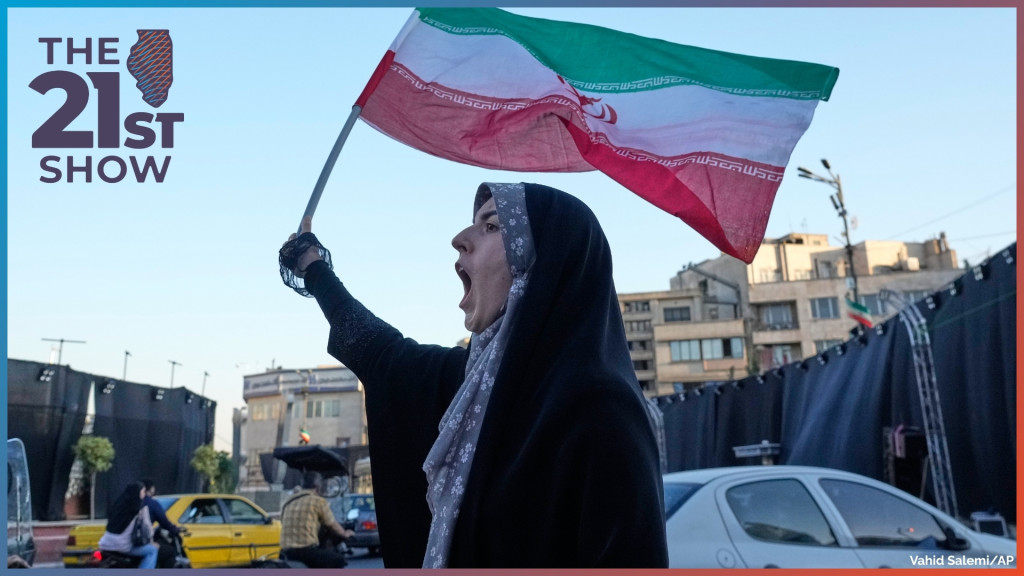
A woman waves an Iranian flags as she chants slogans against Iran and U.S. talks at the Islamic Revolution square in Tehran, Iran, Sunday, June 14, 2026. Vahid Salemi/AP
// This is a machine generated transcript. Please report any transcription errors to will-help@illinois.edu.

[00:00:00]
Brian Mackey: From Illinois Public Media, this is the 21st Show. I'm Brian Mackey. As of this taping, the United States and Iran have announced a preliminary deal to end nearly four months of war. But nothing has been signed, the text has not yet been released, and a formal ceremony is scheduled for later this week in Switzerland. Joining me to talk through what we know, what we don't know, and what it could mean for us here in Illinois is Rachel Bronson. She's a PhD political scientist who focuses on energy and geopolitics for the Chicago Council on Global Affairs. She's also a senior advisor at the Bulletin of the Atomic Scientists, where she was president and CEO for a decade, ending that tenure early last year. Dr. Bronson, welcome back to the 21st Show.

[00:00:51]
Rachel Bronson: Thank you. Glad to be with you today.

[00:00:53]
Brian Mackey: And I should say in order to make our schedules meet, we tape this conversation ahead of time on Tuesday afternoon. Because of that, no live calls today, but you can always let us know what you thought on our voicemail line, which is 217-300-2121. That's 217-300-2121. So, let's start with this deal — or alleged deal or supposed deal. What do we actually know about it right now?

[00:01:17]
Rachel Bronson: Well, we don't know too much, and we're getting drips and drabs on what it's about. It seems like there will be some formal signing ceremony at the end of the week. It's terrific that there's a signing ceremony, but it seems to be clear that the signing ceremony is to keep negotiating for at least 60 days. So everything's suspended while there's more negotiations over the next 60 days about what the terms of this deal will be. So it's a strange time to be signing something, but it does mark a period in this discussion — and perhaps certainly not the, I don't think it's the beginning of the end, but maybe it's the end of the beginning.

So what we are learning, or what we have learned, is that it seems that the Strait of Hormuz will open, that tankers will start moving in and out. We've gotten some early tests of that, and it seems to be happening. We are learning that in addition to the Pakistanis negotiating it, the Saudis and the Qataris have been very active. It seems that the UAE will be releasing several billions of dollars to the Iranians — presumably as some sort of incentive around their nuclear program — but nothing settled on the nuclear program. And that Lebanon is included in this, much to the chagrin of the Israelis, who don't feel that any goals have been achieved for them in Lebanon. They were clearly part of the initial fight, but they are not part of this phase of negotiations. So a lot of actors all trying to figure out what's happening, and even those closest to the deal in the region don't know the full extent yet of what has been agreed to.

[00:03:20]
Brian Mackey: What do you understand — or what do we understand — about what needs to happen between now and Friday for this signing to take place?

[00:03:28]
Rachel Bronson: Well, I think there's an element of ceremony in it, to be honest. The administration wants photo ops around this, and so they want to get this right and they want it to be very visible, and so they're setting that up. That for sure takes some time. I think they are still working out whether or not the details of this current phase of the fighting will hold. So whether or not these tankers will go back and forth, whether we're going to start seeing the ability of the Gulf states to come back online — and just for the kinetic part of this enterprise, this war, to be over. And so there's a testing on that. There's still clearly a lot of details that we're waiting to hear. I suspect there's still conversations about what this money that's being released is going to — how to package this so each side can present it as a victory — and what it'll mean for the future of tolling, or not tolling, as we've been hearing around the Persian Gulf. So I think there's still details.

President — uh, Vice President Vance has said that there are digital aspects of this that have been signed. So there do appear to be some agreements, but it's not clear yet that it's everything. I think they're still waiting to make sure that allies of the United States have their talking points in order and that everyone can get excited for this big photo op.

[00:05:10]
Brian Mackey: We've seen many, many announcements about ceasefires since this war started. I read — I can't remember where — but I think I saw one report that tallied more than three dozen such instances or leaks, not necessarily official pronouncements. But I wonder how you think about evaluating the truth claims of things like this in a situation like this.

[00:05:33]
Rachel Bronson: Well, I think we've been hearing, for example, that the deal will be signed tomorrow for a while now. This seems to — I think we can have some confidence in this because we're seeing the Iranians and others acknowledging that Friday something will be signed. So when it's not just one party to this, but the different sides, it does suggest that there is a real agreement about how to proceed from here.

But in terms of, you know, we've heard a lot from the president and the administration that it's over and we've won and it's a ceasefire, and then we've also seen fighting take place within hours of that, and the kinetics responding and escalating — and, quite frankly, the Iranian consulates around the world mocking it. It does take its toll. U.S. credibility has been very important in global affairs. There is a sense — we've heard it from some — of the madman theory of foreign policy: if your adversaries find you unpredictable, there's value in that. But that's a wasting asset, and I think we did waste a lot of that in this kind of back and forth of claiming victory and claiming cessation of fire where it just hasn't been true. But I do think there is a sense that there is something happening on Friday — both that kind of digital signing, but also just the fact that we're hearing it from partners in the region as well as, I believe, the Iranians as well.

[00:07:14]
Brian Mackey: How would you describe where things stood before this latest round of fighting? And by that I mean — you know, in February [it] began, right — in terms of the situation in the region, U.S. and Iranian relations. How much has this changed, I guess, is what I'm trying to get at.

[00:07:30]
Rachel Bronson: I think it's changed significantly in the politics of it, but not in many ways the goals of this war. And in fact, that's where it's been, I would say, so detrimental to the United States and its partners. And by its partners — you know, I don't mean to be elusive of that. I think, and I work a lot on the Persian Gulf, so I think about the GCC countries: Saudi Arabia, UAE, Kuwait, Qatar, Bahrain, Oman. And of course, when we're talking about partners in the region, Israel in particular, Jordan as well. But when I'm thinking about the partners right now, I'm thinking about the Gulf states.

I think where a high point for the United States was — and Israel as well, and the Gulf states to some extent — was really last June, when we had the American and Israeli strikes against the Iranians that really buried a significant portion of their nuclear program, and really took out scientists as well as centrifuges as well as buried the highly enriched uranium. They were at a significant moment. In addition to which, that was coming after a string of events in the region where Iran was kind of taking one loss after another — the fall of the Assad regime in Syria being the most visible, but the attacks against Hezbollah, the pushing back of Hamas. So the Americans and the Israelis and many of the Gulf states — I would say not that they were at a high point, but that Iran was really at a low point. None of their allies, their global regional partners, were coming to their advantage. They were very isolated and they were really on their back heels. And it was a pretty impressive and significant set of events leading up to June and the attacks on Iran, that I would suggest is probably the high point.

And we were in this position until the end of February when the second — you know, this most recent round of fighting happened. I think what we saw — and I think we may have talked about this last time, right — Iran was so back on its heels that its population rose up. And that was in December, where you have the people of Iran taking to the streets in Tehran and across the country. You saw global attention to what was happening, and everyone was kind of really taken by surprise. And we know that globally we were taken by surprise because the president of the United States said help is on the way, but we couldn't get help there for six weeks. From the moment he said help was on its way to the time where we got our two aircraft carriers positioned in the region — we moved around our air, our planes, we repositioned, pulling from both South America, where one aircraft carrier was operating near Venezuela, and another one was in the South China Sea.

In those six weeks, the Iranians, in kind of a last-gasp effort, murdered up to 30,000 of their own population and basically won in the short term. At that point, once they had — there's blood in the streets — the Iranian people came home. That's when America and Israel went, hoping, I think, against all intelligence, that the Iranians would come back on the streets. So at that point, when they don't, the United States is clearly in a bind. We clearly expected them to come on the streets. The administration expected them to come on the streets. Intelligence suggested they wouldn't. The Israelis thought they would come onto the streets. The Gulf states were pretty skeptical. But if we were going to go, we had to figure out how to get them back onto the streets, which we clearly didn't. And that begins this low point.

So I think — that was just a quick reminder of where we are — I do not think we're anywhere closer to meeting any of the goals that we set out for ourselves in late February, early March, right? Which is — we have all heard this repeatedly — it's the abandoning [of] Iran['s nuclear program], Iran abandoning their nuclear program.

[00:12:24]
Brian Mackey: Which was supposed to have been totally obliterated last summer.

[00:12:27]
Rachel Bronson: Exactly. And then making sure that their missiles were decimated and that they would no longer support proxies in the region. And then the president added regime change as a fourth. None of those have been achieved. None of those have been achieved. So at considerable cost, these four goals have not been achieved. We've expended considerable energy in the Gulf and haven't moved any of those forward. So I think we're in a much worse situation, and now we're just trying to figure out how to staunch that bleeding and to begin to figure out what this next stage looks like.

[00:13:08]
Brian Mackey: Would you add to the list of consequences that we have learned something about the Strait of Hormuz that either we didn't know or we didn't sufficiently appreciate?

[00:13:18]
Rachel Bronson: There's a lot of learning, yeah, for sure. For the Strait of Hormuz, we always knew that was a strategic choke point, but now we know — and the Iranians know — that they have considerable leverage over it, that they can close the strait at their whim. And they probably did not realize it would be as successful as it was, because we ultimately responded with our own blockade, but it took us a couple of weeks to do so, which was also somewhat shocking that it didn't immediately go into effect.

That being said, the Iranians have learned that they can do this, the world has learned that they can do this, and the world has learned that this kind of freedom of navigation that the U.S. has always [sought to] uphold is [now] compromised. So we've certainly learned that. But there's been a lot of other learnings. The Gulf states and really others around the world have learned — we knew but have now really learned — that choke points exist, and there's significant effort to diversify. That's not a bad lesson. The Gulf states had already been diversifying their energy assets, so part of the reason that the price of oil didn't spike even higher to $150 or $200 was alternative routes and pipelines that both the Saudis and the Emirates had built. They have now continued, along with the Qataris and others, to invest in alternative energy infrastructure globally to take the pressure off of the Strait of Hormuz. So they have learned — but so has the rest of the world — to diversify their energy assets, and there's a huge boom right now in energy infrastructure.

The world has also learned something we began learning in Ukraine, but we see now the potency of drones. These cheaper drones and vehicles are quite successful against very expensive defenses. We're learning how to defend against them more cheaply, but the prevalence and prominence of drones that the Ukrainians showed us in their theater of war — and are now advising Gulf states and us on — has been another technological learning. So there's been a geographic and economic learning, there's been technological learning, and that's true for every conflict. Everybody's kind of learning the same thing.

I would say finally, for the Chinese — actually,

[00:15:57]
Brian Mackey: Let me interrupt you right there. We need to take a break on the program. My guest is Rachel Bronson, who is with the Chicago Council on Global Affairs. We're talking about the Iran-U.S. ceasefire deal that has been announced. The details are still secret. It is scheduled for a signing this Friday in Switzerland. We'll continue this conversation after a short break. This is the 21st Show. Stay with us.

It's the 21st Show. I'm Brian Mackey. We're talking about the announced deal among the U.S., Iran, and regional partners, apparently ending this conflict — or at least the current phase of it. We still are very short on details of what is in this agreement, which is set to be signed Friday in Switzerland. We're talking about it with Rachel Bronson, a PhD political scientist who focuses on energy and geopolitics at the Chicago Council on Global Affairs. She's also a senior advisor at the Bulletin of the Atomic Scientists, where she previously spent a decade as president and CEO. In order to make schedules meet, we tape this conversation ahead of time, so no calls today, but you can let us know what you thought. Talk at [talkat21stshow.org]. Before the break, we were talking about some of the things we've learned through this conflict, specifically around global energy markets and the Strait of Hormuz. Dr. Bronson was just about to say what China has learned from this conflict.

[00:17:33]
Rachel Bronson: They've learned — they already knew that they were very dependent on, over-dependent on, energy — and they've been electrifying their grid over time so that they could be less dependent on oil and gas and rely on other sources of energy, whether it's coal in some cases, but more importantly wind, solar, geothermal, nuclear. They have learned that that's a great strategy and to invest even more. They are investing even more in the electrification of their economy, and others are learning the same thing.

We are slower to learn that, in part because of our own energy boom around gas and oil, but the rest of the world is looking for alternative ways to power their economy. But there is something I think really important that the United States has learned — and the rest of the world has learned — which is how important our energy dominance, in the terms of this administration, has been. Or how important the shale and fracking revolution that we've seen develop over the last 10-plus years in the United States [has been]. As everybody's looking across for reliable sources of energy, U.S. gas and oil has become a really important stabilizing input into the global economy, and we've been able to strongly support European allies, [and] began to redirect towards China. Energy-dominant Canada's energy has been very important and is continuing to — the Canadians are continuing to invest in it. But North American energy, which has always been a more important and strategic asset than we have tended to talk about, was really on display.

And now globally, what we're seeing is huge investments being made in our infrastructure — both because the administration is kind of demanding it from partners and allies, but also because there are elements of it that are really good business. So we're seeing a lot of Gulf money coming into the United States as a backup and to take some of the pressure off this choke point of the Strait of Hormuz, but we're seeing it in other areas as well. And so we know there are big investments going in in nuclear power here as yet another source of generation that the U.S. could be a dominant player in. And here in Illinois, that's particularly interesting — we're the home of nuclear power. But the U.S. role as an energy provider, which has always been important, really came into focus when the strait was closed. It won't go away when the strait opens, because demand will remain high, but it is a win for the United States in all of this. And there's not a lot of wins to go around, but this is one where the U.S. energy industry really delivered.

[00:20:45]
Brian Mackey: You know, it's interesting you bring that up, because it strikes me that this could be one of those things where people who pay a lot of attention to geopolitics and think about the global economy — as you do — see a win for the U.S., and yet we're in this populist moment, and a lot of people have been paying $5 a gallon for gas and cutting back on their summer vacation plans at the same time this is happening. So, what would it take for this sort of new strategic dominance of the U.S. in this one area at least to sort of trickle down — for people to actually experience this?

[00:21:21]
Rachel Bronson: Well, the fighting needs to stop and the energy has to start flowing back again through the Gulf. Businesses and consumers do better when there's stability and predictability. There is always this sense that, oh, the oil companies want this fighting, right? Because prices spike and they make a lot of money. They don't want this fighting, because what happens — and this is what we're feeling — there are spikes, and then there are steep drops. And so what people are watching right now — and we don't know how this is going to play out, and it's really tricky for business — is that as energy begins to move around, for example, China has — there's this concept out there about [demand destruction], right, that the demand just goes away. So China's taken a lot of [what's called] demand destruction. China's taking a lot of its industries offline — the energy-intensive industries. We've seen it in chemicals, where they're just not producing what they used to, and in other areas as well. And they've done that to try to conserve energy, and that's helped moderate prices to some extent.

But that demand is there. The Chinese are going to need to start producing again, and so for a while, demand is going to remain high and it's going to increase just as energy is coming back. So prices could remain high for some time. And what makes it difficult to invest in future energy is the worry that it will suddenly — too much energy will come on [line], demand will overdo [supply] and then it'll drop. And so it's the instability rather than the predictability that causes the economy to kind of seize up and go through peaks and valleys. And that's what is difficult for the American people — that's where prices [rise]. So it's a win for the United States in that we're getting a lot of money invested into our energy infrastructure. And that will, over time, presumably be a good thing, but not in the immediate term. In the immediate term, we have very high prices. We do know that oil futures are dropping, but for the American people to really feel the benefits of going back to business as usual, we're going to have to go back to business as usual, and it's going to take a long time for this mouse to go through the snake.

[00:24:04]
Brian Mackey: That's a picturesque metaphor right there. While we're on the subject of energy, you have argued that this conflict could accelerate the move toward nuclear energy adoption, even though it was ostensibly meant to prevent Iran's nuclear program. Can you talk about that and what the implications of that are for us here in the U.S. and in Illinois in particular?

[00:24:29]
Rachel Bronson: So I think it draws on exactly what we were talking about, which is every country now is looking for indigenous sources of energy. And one of the areas that they're looking at is nuclear power. This is very different than nuclear weapons programs. In a place like Iran, they intentionally obfuscate and say that their weapons program is actually civilian, but there's a real, big and obvious difference — starting with how much you enrich your uranium. You need about 3% to 5% enrichment for a civilian nuclear program. Iran is up at 60% to 80% enrichment, which is a clear [indication of] dancing around a weapons program. So there's a very, very big difference between the two. But the problem is when you get a country like Iran, who has a weapons program, to claim that it's civilian.

That being said, my argument is that countries are going to look for new sources of power, and there's a global renaissance underway for nuclear power. Still, the majority of new energy coming online is going to come from wind and solar. But what nuclear power can do — it's very expensive to build and it takes a very long time, 10 to 15 years — it's very reliable once you have it, and it's very steady, which is something that the renewables need. They need something to balance the grid when it's stormy or cloudy or windless. And so around the world, countries are looking at their ability to afford and [find] the partners to build nuclear reactors — in places like Rwanda, who are betting on a nuclear future, but throughout Asia as well. Turkey is about to go online in the Middle East, Egypt right after them. So this has just accelerated that, and the World Bank has actually changed their financing to make it easier for countries to pursue nuclear power.

So in many ways, it's very exciting. And we've seen here in Illinois, the governor has relaxed the moratorium on small modular reactors and now the traditional big water reactors. Illinois is very reliant on nuclear power. We get the most nuclear power of any of the 50 states in the United States — 55%. I'm here in Chicago, [where] 100% of our energy comes from nuclear power. So for many, we've kind of long awaited this moment.

What concerns me, though, is that in the midst of this transition back to nuclear acceleration, we're seeing countries shelling nuclear power plants. The United States and Israel targeted around Bushehr, which is Iran's civilian nuclear program. We've seen the Iranians target Dimona, Israel's nuclear [facility]. We know there's been targeting back and forth in [Zaporizhzhia], which is the largest nuclear reactor in Europe, in Ukraine. And we're going to see a proliferation of nuclear power plants at a moment when states are increasingly targeting them — making them targets of war, which we've never seen before. These power plants, they are very safe, and the waste around them when buried is safe, but there are pools of waste that are in between — before you can actually bury them — which is not [as safe]. And they're not really designed to be repeatedly targeted. So that's what concerns me: the recklessness of making civilian infrastructure targets of war — which is against humanitarian law — for really the first time brazenly, but now including nuclear power plants, which we've never seen before, both as a kind of terrorist operation, but also in cases where there are pools of waste, a serious and real risk.

[00:29:07]
Brian Mackey: And you combine that with what we've seen in terms of what you were talking about earlier — the cheap drones. Ukraine had this remarkable attack where — and unless I'm misremembering, they were attacking military targets — where they had these drones delivered in box trucks, right? And then there was a drone attack. How worried are you? You were with the Bulletin of the Atomic Scientists for a long time. You have the Doomsday Clock. How worried should we be about all of us being more on the front lines with vulnerable infrastructure, especially nuclear, as you were just saying?

[00:29:44]
Rachel Bronson: Yeah, there's no question that war is changing and the technology of war is changing faster than our governance structures globally, as well as our ability to understand and counter them. So, what we've seen around drones in this war and in Ukraine is teaching the American military and others significant lessons about the offensive advantage of cheap drones, and so there's significant work being done to counter them. But we're also seeing AI being used to a greater extent than ever before. I was just in a conversation earlier this week about future technologies they're looking at around the world, and some who are very close to it are saying [these technologies] are basically four or five years away from where AI is now. So war and warfare — how we fight it — is changing significantly.

What we can control, and what is so shocking, is the deliberate targeting of civilian infrastructure, whether it's through drones or good old-fashioned airplanes. It's the targeting of civilians, which was very much protected since World War II. [The] norms — again — and rules against targeting are dissipating or weakening. We've certainly seen it in the way the Russians fight their wars, but we've always had a sense, well, that's how the Russians do it. We would never do that. But clearly now we're doing that. You heard the president talking about targeting civilian infrastructure in a way that no American president has so brazenly. And so it's the combination of how we're fighting the wars and the new technologies that are available to us that are really changing what the future of warfare is going to look like.

[00:31:52]
Brian Mackey: As we're coming to the end of our time together — just about a minute left — what are you going to be watching for in the coming weeks, and I guess years, as we're living and reckoning with this new world?

[00:32:04]
Rachel Bronson: Well, going back to the Gulf — most immediately, we absolutely need to be eyes on how we and our allies, with this new understanding, navigate the Iran nuclear program. We know what the Iran deal, the JCPOA signed by the Obama administration, was, and it's hard to imagine getting more than that. But the question is, how much less are we going to get? So the Iran nuclear program — watch for that.

I think we have to continue to watch how Iran supports its proxies. Israel's in a tough position. If Hezbollah and the Houthis continue to target them, it's going to be hard for them not to respond. It's existential for them, a bit less for us — it's more of regional allies struggling — but they've got a lot of skin in this game and it's not clear how this settles out.

And I think the energy story continues to be the story, and the supply chains and the processing — the mining, the refining, the minerals and everything that goes into it — is really the story of the 21st century, and I think this war has just accelerated that.

[00:33:21]
Brian Mackey: Rachel Bronson with the Chicago Council on Global Affairs and the Bulletin of the Atomic Scientists — thanks so much for sharing your knowledge with us on the 21st Show.

[00:33:29]
Rachel Bronson: Thank you, Brian. It was a pleasure to be with you today.

[00:33:32]
Brian Mackey: Coming up after the break, high school courses can be tricky enough. Now imagine taking enough college classes that you graduate with not only a high school diploma, but also an associate's degree. We'll talk with two Southern Illinois teenagers who did just that. This is the 21st Show. Stay with us.
The U.S. and Iran say they've reached a deal to end nearly four months of war — a war the president said was meant to end Iran's nuclear program, gut its missiles, cut off its proxies, and topple its government.
"None of those have been achieved,” says Rachel Bronson, who closely follows the region from her base at the Chicago Council on Global Affairs.
“I think we’re in a much worse situation, and now we’re just trying to figure out how to stanch that bleeding and to figure out what this next stage looks like.”
Background
- The Economist: A deal is only the beginning of the end of the US-Iran war
- Bulletin of the Atomic Scientists: The war on Iran will speed the transition away from fossil fuels and toward nuclear energy, creating strategic challenges for the United States
- Chicago Council on Global Affairs: Beyond OPEC: The Geopolitical Earthquake Reshaping the Middle East and Its Neighbors
- Salon: AI data center push is fueling new nuclear threat
Guest
Rachel Bronson, Ph.D.
Lester Crown Nonresident Senior Fellow for Energy and Geopolitics, Chicago Council on Global Affairs
Senior Advisor, Bulletin of the Atomic Scientists (former president & CEO, 2015–2025)
“Thicker Than Oil: America's Uneasy Partnership with Saudi Arabia” (Oxford University Press 2006)