







Route 66 in Illinois: How a small town became a mob hub during Prohibition
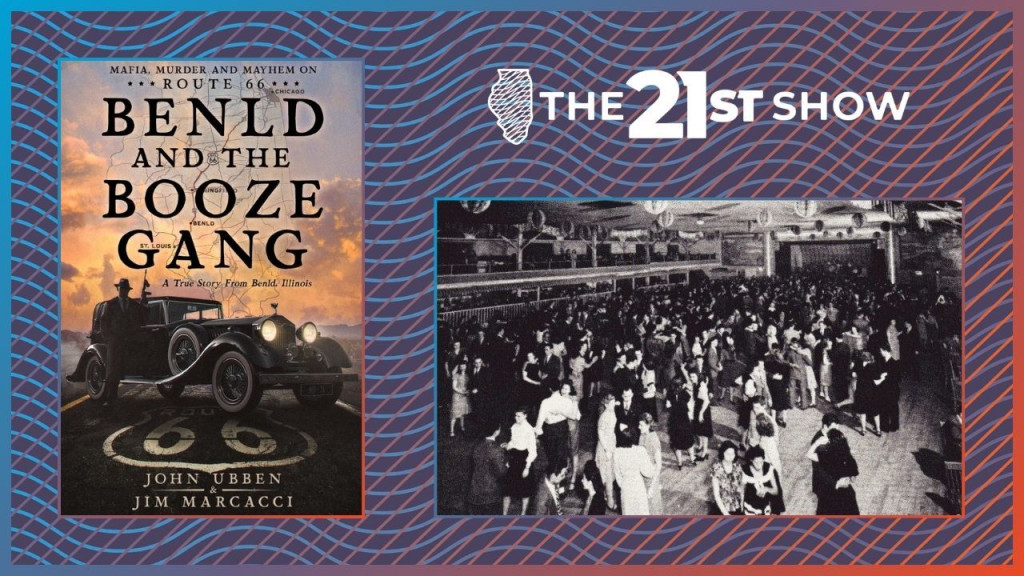
During Prohibition, Benld's location on Route 66 made it a hub for mob bootlegging activity. The city's Coliseum Ballroom (pictured here in 1949) became a little Las Vegas in that era. Courtesy of Jim Marcacci
// This is a machine generated transcript. Please report any transcription errors to will-help@illinois.edu.

[00:00:00]
Brian Mackey: It's the 21st Show. I'm Brian Mackey. At 12:01 a.m. on January 17, 1920, America entered a new era. That's when the Volstead Act went into effect, prohibiting the manufacture, sale, or transportation of intoxicating liquors for beverage purposes. Although many states beat America to the punch, or maybe I should say pouring the punch down the drain, that was the moment we became a dry country. At least that was the idea. But prohibition, as the era came to be known, did not end alcohol consumption, nor the manufacture, sale, and transportation of alcohol. Rather, it was a business opportunity for many, including the mob.

Today we're talking about that through the lens of [Benld], Illinois. It's a town of fewer than 1,500 people these days, but its location, roughly halfway between St. Louis and Springfield, and the coming of Route 66, made it a hub for the mob's bootlegging operations. My next guest today, Jim Maracci, spent years researching this area along with John Uben, who died in 2024. They both grew up hearing stories about [Benld] back in the day, moonshine and Al Capone and so on, and they wanted to separate the fact from the lore of their region. The results of that work have been collected in the book, "Benld and the Booze Gang, Mafia, Murder and Mayhem on Route 66." Jim Maracci joins us today from Gillespie, just north of [Benld]. Jim, welcome to the show.

[00:01:37]
Jim Maracci: Well, thank you for having me, Brian. Glad to be here.

[00:01:40]
Brian Mackey: And listeners, you can join the conversation throughout the hour today. 800-222-9455 is the number. 800-222-9455. Maybe you have some memories or family memories of [Benld] and the bootlegging that happened during prohibition. Let us know that story, 800-222-9455.

All right, Jim. So Benld — and for people who may not be familiar, I should say that's spelled B-E-N-L-D, apparently for Ben L. Dorsey, one of the early settlers to the region. It's established enough for its own post office in 2004. What is the origin story of this town?

[00:02:20]
Jim Maracci: Uh, Benld came about because of the Chicago Northwestern Railroad, which traversed the great northwest from Chicago, and they were looking for coal that would run their locomotives. They had been getting their coal from mines in Iowa, but when they discovered that [Macoupin] County coal was getting them twice the mileage out of a ton of coal, uh, they quickly put together a railroad down to Benld from Pekin, Illinois. And, uh, around — they needed — they sank three mines, three of the largest mines in the world at the time. And in the center of those three, Benld was located so that the people working in those mines could walk to any one of those three mines. And again in 1916, uh, the fourth mine was sunk because of World War One, and uh, Superior Coal Company ended up with four coal mines.

[00:03:22]
Brian Mackey: And uh, let's put a pin in that and remind listeners that — number four coal mines — that's gonna come into the story a little later as we go on. So, you know, by the year 1911, there are 1,900 people in Benld. It's a largely immigrant population. Uh, more than 25 saloons, you say in the book. What is the reputation of Benld in the years before prohibition?

[00:03:46]
Jim Maracci: In the years before prohibition, it was recognized in many newspaper accounts as a frontier town.

[00:03:56]
Brian Mackey: What does that mean exactly? Yeah, let's put a fine point on that.

[00:04:00]
Jim Maracci: Tombstone, Arizona, Dodge City, those type — Deadwood. That's the kind of town Benld was in the early days prior to prohibition. It grew exponentially. In the early years, they advertised in all the big city newspapers in the area, St. Louis, Springfield, and they took out half-page ads and they begged for druggists and butchers and [clothiers] to come to Benld to help this town grow. Well, the good business people were not the only business people reading these papers. And uh, both St. Louis and Springfield had fairly substantial size Italian groups living there, and they read the papers, and uh, a lot of them came here to work the mines, but some came here to, uh, work the people — extort, extort money. Exactly, extort money. To prohibition — go ahead.

[00:05:01]
Brian Mackey: I was gonna say, tell me about the Black Hand, 'cause like, I, you know, these are — it sounds like something out of a Marvel comic or, you know, with a name like that. But this is — I mean, gangs of that era, they were using names like this.

[00:05:14]
Jim Maracci: Right. The Black Hand is a name given to the people in Sicily. So this goes back years and years before they came to America, and they were extorting money from wealthy Sicilians. And when the influx of Europeans came over to the United States, particularly the Italians in the late 1800s and early 1900s, along with all the good people came the Black Handers, as they were called. And uh, they came to St. Louis, they came to Springfield, and made their way to Benld. Um, so the Black [Handers] are a precursor to the Mafia. When prohibition came into being, that's when the term Mafia, an Americanized name, came into being to, to uh, point out the Italians and the uh, liquor business that they got into, and the gambling and the numbers games, all, all the numbers games.

[00:06:17]
Brian Mackey: Yeah, so it really is an immigrant community. You talk about Lithuanians and others, and, but it was predominantly Italian. What is the journey that gets people from, you know, Sicily or northern Italy — for people who are into mining and doing railroad tunnels through the mountains there — what is the journey to get someone from Italy through, you know, in many cases, Ellis Island to tiny towns in rural Illinois?

[00:06:43]
Jim Maracci: Actually, it was word of mouth, uh, that — it was — there was a network, and they wrote letters to their families. And uh, they, they, they came to Louisiana, they came to the coals in West Virginia and coal mines. And when they discovered that [Macoupin] County, with these three — at that time, three large mines — had 7-foot ceilings, which is great for the miners to work in, it didn't have much methane gas, and they were relatively dry. It just drew them like a magnet to [Macoupin] County and in particular the Superior coal mines in and around Benld.

[00:07:22]
Brian Mackey: All right. So let me remind listeners, this is the 21st Show. We're speaking with uh, Jim Maracci, uh, co-author of "Benld and the Booze Gang, Mafia, Murder and Mayhem on Route 66." If you wanna join us, 800-222-9455 is the number. 800-222-9455.

All right, Jim, remind us of the forces that led America to, uh, take on the — what was it — the noble experiment banning alcohol?

[00:07:51]
Jim Maracci: Yes, the noble experiment. Uh, it wasn't much of a — it wasn't a very successful experiment. Uh, I, I will get into what you're asking me in just a minute, but right now what came to mind was this unknown author during prohibition came up with this about prohibition. [He] said prohibition wasn't really all that bad — the only thing worse would have been no liquor at all. So that kind of tells you that prohibition was like a salve, right?

Some of the forces that came to be that eventually led to prohibition — and there had been two or three forces of this nature prior to the Volstead Act of 1919, and about every 10 or 15 years there was a bigger attempt, a little bit bigger attempt — the Women's Temperance Union, the — what brought it to a head, what really made it succeed was the Women's Temperance Union in concert with World War One, with this hatred of Germans and what they brought to the table. And as far as liquor was concerned, anybody who ever had a six-pack would know that Anheuser-Busch, Schlitz, uh, all the other breweries were all of German origin. So that there was that component to it too, and there were other uh, things that led into prohibition, but those were the [two] major uh, forces that forced the government into saying, OK, no more liquor.

[00:09:38]
Brian Mackey: All right, so you have these major forces. How does, uh — and I guess, you know, Benld is, uh — you have this line in the book that Benld was ready for prohibition. Let me, let me read here from a news brief you, uh, include in the book. I think this was in the Rockford newspaper, but the dateline's been held. July 16, 1920. So this is six months after the Volstead Act went into effect. It says prohibition enforcement officers from East St. Louis who conducted a raid here today arrested 16 saloon keepers, confiscated six stills and 500 gallons of whiskey, and destroyed 800 gallons of raisin mash. The prisoners were taken to Springfield for trial. How unique is Benld's booze production in these early days of prohibition?

[00:10:29]
Jim Maracci: Very, very unique. Um, not only did they make alcohol, they made it in large quantities. Uh, the coming of prohibition wasn't a secret. Um, if, if they had only just heard of the Volstead Act being passed in 1919, they had roughly a year to, uh, get their stills ready. But, uh, the winds were blowing long before that, so I'm sure that uh, when Dominic Tarro [⚑ Verify spelling: "Terrell," "Tarro," "Tarro," or another spelling], who is the linchpin, the king of the booze gang in Benld, when he and his brother Ben got wind of the potential for a prohibition, they started a grocery store. Actually started out before that with a butcher shop, and then when they heard about prohibition, they expanded into groceries because it takes yeast and it takes corn sugar, and they're not made of meat, so they uh, uh, became the wholesalers for all the ingredients necessary for uh, making the whiskey. And that's what these stills were making. These stills were making 190-proof whiskey, which is basically — if people are familiar with Everclear, it's about as pure as you can get. It's 95% alcohol. And it's top shelf, top-grade alcohol. With the machinery that they used in these distilleries — these large distilleries — there were probably 50, 60 to 120 smaller ones producing 100 to 200 gallons a day, and that's pretty large. But the largest — go ahead.

[00:12:18]
Brian Mackey: Well, I just say, I mean, for, for, you know, none of us really lived through this era who are listening today. So what is it actually — how, how do you get from, you know, the sugar, the grain, this raw material to something, something, you know, something that people would actually be consuming in a speakeasy or, you know, at a friend's house or something like that?

[00:12:37]
Jim Maracci: OK. To make it whiskey, you need a lot of water. And Benld had [Cahokia] Creek on its east flank, and that's where um, some of the larger stills were, and some are on the west side where we had some good creeks. But uh, we need yeast to help ferment the, the uh, sugar that's in the cracked corn or the corn sugar and the water, and you set those in concrete vats. And depending upon how large your business is, the, the bigger the vat, the more you can produce. So, uh, if you're running a small operation, two or three vats might be only necessary. But if you have a very, a very large production — like the largest ones that we had around here — you needed up to six vats. For example, the largest distillery in the United States that was captured was captured right by Benld, and it had four smaller vats and two larger vats, each containing 50,000 gallons of fermenting mash. So that's 100,000 gallons. And they had — they were, they were pumping out 2,000 gallons of 190-proof whiskey every day, seven days a week, 365 days a year. And that's out of one distillery. The, the feds didn't want to call it a still because it was actually, it was a full-blown distillery, and they found several of them.

[00:14:21]
Brian Mackey: I say it's still — yeah, "still" implies like that thing, uh, people remember the TV show M*A*S*H, you know, that Hawkeye had in his tent, right? So, you know, OK, so this is — we're getting to this idea. The Superior Coal Company has four large mines. This is mine number five, I think you're referring to, euphemistically titled, um. What, what's happening with these, you know, just endless gallons of booze that are being produced here?

[00:14:49]
Jim Maracci: Well, uh, there were two Mafia organizations that had hands-on operation during prohibition, the Springfield Mafia and the St. Louis Mafia. But the controller of the distribution of all this liquor — and I will tell you, very briefly, about at a minimum 150,000 gallons of illegal whiskey was leaving [Macoupin] County every month. Now that's a very conservative estimate. I bet it was closer to over 200,000 gallons every month. But anyway, Al Capone — and before that, Johnny Torrio — were distributing this. And, and to Al Capone's credit, he was an expert at distribution networks. And he had all this liquor going to big landlocked cities that didn't have the advantage of having it unloaded off a boat on a coastline or coming across the border. In fact, Chicago was next to Canada, naturally, still is, but they were getting their liquor from Seagram's and Hiram Walker's and other liquor makers across the border that weren't experiencing prohibition, so they were getting labeled stuff. Uh, they — I'm not gonna say they never drank any Benld stuff, but uh, they had the labeled stuff on their shelves, um, driving it across the frozen lakes in the winter and across boats in the summer. But, uh, he distributed it and uh, that's where it went. It didn't stay in Benld. Uh, probably all of the liquor from the monster — what the feds called monster stills of Benld — uh, was, was leaving town.

And one of the things people have asked [is] why Benld? Why was Benld chosen? Well, they had Route 66 on Benld's west flank. They had [Cahokia] Creek on its east flank. They had the railroad coming through to deliver the raw product — the corn, the corn sugar and the yeast. And they had a strong Italian population so that the language wasn't a barrier where it might be elsewhere.

[00:17:00]
Brian Mackey: All right, Jim, I'm gonna, I'm gonna interrupt you. We're on a fixed clock. We need to take a break. We will continue talking about Benld and Route 66 and the prohibition era here on the 21st Show. If you want to join us, 800-222-9455. That's 800-222-9455. We'll be back after a break.

This is the 21st Show. I'm Brian Mackey, and we are talking today with Jim Maracci, uh, who is the co-author — with, uh, the — uh, excuse me, I should say John Uben, his late co-author — of "Benld and the Booze Gang, Mafia, Murder and Mayhem on Route 66." It's about how this very small town in central Illinois, about halfway between Springfield and St. Louis — it's Benld, B-E-N-L-D — was a hub for mob liquor production and distribution in the prohibition era. If you want to join us, 800-222-9455 is the number.

And let's, let's go now to the phones. We have Charlie calling in Savoy. Charlie, you were given a warning about Benld many years ago.

[00:18:24]
Charlie: No, not, not quite. Uh, it's just recounting a family tale. So my great-grandparents, um, immigrated from northern Italy, um, probably around the turn of the 20th century. Um, my grandfather — and they immigrated to Benld, or to the [Macoupin] County area, to work in the mines. Uh, my great-grandfather passed away in the mines in an accident. Uh, my grandfather also worked in the mines. Um, and the story — I could tell a lot of stories from family members and cousins who still live in that community. Um, but the one I wanted to share was one I'd heard from my uncle, who also lived in that community, lived in Carlinville, the seat of [Macoupin] County, um, about when he was very, very young and driving through Benld with his grandmother, um, who was the northern Italian immigrant whose husband died in the mines. Um, and they drove by a house, um, on their way to St. Louis, presumably, and she pointed at the house and in very broken English told them that he would never ever go to that house, and he should never ever let anyone take him to that house, or if anyone tells him to go to that house, he should never go there. Um, and the legend would be that that was likely Mafia-affiliated, possibly, um, like bootlegging or prostitution. Um, no way to confirm that, um, but that's just a small connection that I have, uh, to that history with that community, and it was so fun to hear that that was a topic on the show today.

[00:19:45]
Brian Mackey: All right, Charlie, thanks for the call. I appreciate it. Jim, I, I don't suppose — uh, I know you've spoken to a lot of people with, uh, ties to Benld who have, you know, generations' worth of stories like that. I don't know if any of that rings a bell for you.

[00:19:58]
Jim Maracci: Oh, yes. I, I — you know, I couldn't point out what house he was talking about because there were about six of them on Route 66. Uh, the Coliseum Ballroom had one to the north of it, just north of it, one just south of it, south parking lot, and one across the street. So when you left the Coliseum, you could, uh, continue your fun at any one of those three places. One was called the Spot, one was the Windup, and one was the Twins. Uh, Dominic Tarro [⚑ Verify spelling], who was the king of the booze gang, also owned the Coliseum Ballroom.

[00:20:35]
Brian Mackey: Yeah, well, let's get into that. So tell, tell me more. Who is Dominic Tarro [⚑ Verify spelling]?

[00:20:39]
Jim Maracci: Dominic Tarro [⚑ Verify spelling] uh, moved from Ironwood, Michigan down to, um, Carlinville, because Benld hadn't been invented yet. And then eventually when Benld got its legs moving, uh, he and his family, in fact, moved to Benld and uh, wanted to be a part of Benld growing up. Uh, he and his brother Ben, uh, owned — there, like I told you previously — the butcher shop. They also had a small dance hall skating rink, uh, in town, made of wood, naturally at that early age, and uh, it burned to the ground in 1923. So in 1924 — well prior to that, he said, I'm not going to build this one out of wood. I'm going to build out of brick. It'll never burn down. Well, in 2011 it burned to the ground. But anyway, he did — he went out to Route 4, which would eventually become Route 66, and uh, built a 10,000-square-foot Coliseum Ballroom. It was called Tarro's [⚑ Verify spelling] Ballroom at the beginning, and he uh, had a 10,000-square-foot dance floor, the largest in between St. Louis and Chicago, and it had a balcony. It had three bars during prohibition, and they didn't just serve soda. And they had one on the north side, one on the south side, and one up in the balcony. And they, they had over a 1,000-square-foot uh, stage, and it drew all the big names from all over America. Chicago was a big spot for music. Capone took a lot of those musicians under his arm and gave them their, their due and gave them their popularity.

And on opening night — and we don't know this to be true or not, but it is rumored that he sent Frank Westfall to open up for the Coliseum Ballroom on Christmas night in 1924. Frank Westfall was the rock star of the 1920s. And uh, there's also rumors that Al Capone contributed to the building of the Coliseum. I doubt it. By 1924, Dominic Tarro [⚑ Verify spelling] had amassed enough of a fortune to build four or five coliseum ballrooms.

[00:23:01]
Brian Mackey: $50,000. Can you remind me what that is today? You know, $50,000.

[00:23:05]
Jim Maracci: It was like, oh — a couple of million dollars, I think. Yeah, I, I, I mean —

[00:23:12]
Brian Mackey: That gets the idea — in, in — that's extraordinary. You can't, can't imagine someone today spending, you know, millions of dollars.

[00:23:19]
Jim Maracci: He did make it out of brick, but it, it had a, uh, it had a roof that caught on fire, and that just destroyed the whole place.

[00:23:27]
Brian Mackey: Yeah, just in 2011.

[00:23:28]
Jim Maracci: Uh, 2011, right?

[00:23:30]
Brian Mackey: It was an antique mall, although there was a concert also happening there that night.

[00:23:34]
Jim Maracci: Yeah, the, the, the band that [practiced] there would uh, give them a free concert once a month.

[00:23:41]
Brian Mackey: Yeah. Uh, what, uh — so Dominic Tarro [⚑ Verify spelling] — he is, you mentioned, groceries, he's supplying, uh, this still. He gets called at one point to testify, or to, I guess, give testimony in Springfield. What, what happens to him? What's the end of his story?

[00:23:56]
Jim Maracci: The federal government was very interested in Dominic Tarro [⚑ Verify spelling] because they've been chasing his tail for 10 years. They could not figure out who was supplying all of these [large stills] with all the whiskey and all the corn sugar and all the yeast that they needed. So, uh, when they finally discovered who it was, they indicted him. He had to post bond. In [19]30, early 1930, he left his lawyer's office, was never seen alive again. In fact, it wasn't until May 5th that his body was discovered. He had been wrapped up in, uh — it was found in the Sangamon River, wrapped up in wire. Not barbed wire, as some rumors have it, but in wire. And they were able to recognize him by some of his articles of clothing that he had and also dental records, supposedly one of the first attempts at identifying somebody with dental records. I don't know if that's true or not, but that's — I'd read it in a couple of different accounts.

[00:25:04]
Brian Mackey: So you mentioned earlier, uh, before the break, um, the quantity of alcohol that is being produced. I think you said 150 — possibly your estimate — 200,000 gallons per month. I did a little quick research. If you picture one of those tanker trucks that we see on the highway, like the kind that delivers gasoline to a gas station, those hold about 9,000 gallons. So we're talking, you know, at least 15, maybe 20 or more tanker trucks' worth of liquor a month. How is it actually getting out of Benld without anyone, you know, being able to intercept it?

[00:25:44]
Jim Maracci: Well, they put the whiskey in 5-gallon tins. And there were innumerable — I couldn't tell you how many trucking companies were in, uh, that transported those 5-gallon cans to various destinations across the Midwest — St. Louis, Springfield, Kansas City, Peoria, and Oklahoma City, to name a few. Uh, there, they were — there was a constant stream of trucks leaving Benld. Benld had a brick Central Avenue, which led to the outskirts, and if they could get the booze to Central Avenue, it went west to Route 4, which was on the outskirts just bordering Benld, and Route 66 slash state Route 6, you know, Route 4. But if they [could] get it there, then they could transport it just about anywhere they wanted. But there, there was a steady flow of trucks all night going down Central Avenue.

Now you may ask, well, didn't the police recognize that? Of course they recognized it, and they had their backs to Main Street when all this was going on. Uh, in fact, the chief of police, uh, Nick Bellini — if that name rings — you know, may not ring a bell, but you know it's Italian — uh, he said if the feds want these stills raided, they can raid them themselves. So they weren't getting any cooperation at all. Another guy down in Staunton, his name was Mike, uh, uh — anyway, I can't think [of] his last name, but he owned all of the jukeboxes and the one-armed bandits and uh, other machinery used in the taverns. And he told me — uh, he didn't tell me, he told his grandson in an interview in 1985 — if you paid off those city officials enough, you could name your chief of police. So, Mike Capella — I'm sorry, I was drawing a blank — Mike Capella out of Staunton.

[00:27:56]
Brian Mackey: Well, so let's, let's skip forward to the end of the story, or toward the end of the story. Then there it does become a, a new sheriff in town — Frank — I don't know if it's [Fries or] Freeze, um — Frank Fries, uh, you, you quote him, um, in, in an interview that he gave many, many years later, in 1973. He says, "The first night I was in office, they tried me out. Frankie Arguso, who was a Capone lieutenant from Chicago, pulled out an envelope with $10,000 in it. That would be $190,000 today." He says all they wanted was to stay in Benld, and they'd quit their killing, and I knew that was a load of bull. So, uh, he, you know, he slowly starts taking it apart. Yeah.

[00:28:40]
Jim Maracci: Yes, he did. Frank Fries was an honest sheriff. He, he certainly was, and he did his darndest. Uh, he was just, he was just overwhelmed. He, he came into power — he became sheriff in 1930. Prohibition ended in 1933, but he did his best to do what he could do. Uh, it's the feds that, uh, in concert with Frank Fries, that really started nailing these big distilleries towards the end of prohibition. But yeah, he did his job.

Another guy who was a very popular guy around the area — his name was Paul Bertico [⚑ Verify spelling]. He started out as an attorney, then he became state's attorney, then he became a circuit judge, and he lived in Benld and he made sure that he would terminate the last house of prostitution in 1960.

[00:29:34]
Brian Mackey: 1960. Wow. So, uh, yeah, so I guess just, just a couple of minutes left in our time together. Um, talk a little more about — since we are, you know, our theme this week is Route 66 — how important is Route 66 to this story, to Benld's rise, and, you know, what eventually becomes of the town after prohibition?

[00:29:55]
Jim Maracci: As important as the railroads were in delivering the product, Route 66 was equally important in distributing the product. Uh, if you didn't have a hard road, you would be shutting down your distilleries for the winter and spring because you didn't drive in mud. So it was one of the key ingredients for a successful mid-Illinois booze operation that went undetected for the better part of 10 years. I consider this to be one of the best-kept secrets in Illinois prohibition history. None of the people that I talked to prior to writing this book who had written about prohibition knew anything about Benld. They swore that Al Capone never even knew about it. He knew about it. Anybody who has 150,000 gallons of liquor going out every month — that kind of an investment — he was down here, and we have some accounts in the book that more or less proved that he was here. They didn't put it in the paper, "Hey, Al Capone showed up this weekend," so you don't have any of that confirmation, but we have some pretty, pretty good information that he was here.

John — John Uben — I should give John Uben credit for wanting to start this book, Brian, because had he not done it, I don't think I would have, because I grew up with these rumors and about my number five — we're going out and played in the vats when we were kids. But John, he thought there was something there and he started gathering information. I started saving information and he got into the book, but got sick, couldn't finish it, and I promised him I'd finish the book for him. And I need to mention Kathy Zarr, who isn't one of the authors, but she found so much information. She's one of my researchers. She did so much to make this book possible. All I did was put the words into an organization that I would hope would be readable.

[00:31:54]
Brian Mackey: Well, Jim Maracci, uh, along with John Uben, uh, are the authors of "Benld and the Booze Gang, Mafia, Murder and Mayhem on Route 66." You can find it — just Google the title. We'll put a link to the Amazon page on our website, [21stshow.org] [⚑ Verify URL: audio unclear]. Jim, thanks for sharing the product of all your research with us today here on the 21st Show.

[00:32:14]
Jim Maracci: Hey, thanks for having me, Brian. I really appreciate it. I enjoyed the time very, very, very much.

[00:32:28]
Brian Mackey: That is it for us today. We continue our journey on Route 66 tomorrow with a visit to the Ace Sign Museum in Springfield, and we'll be talking about another Route 66-adjacent community, Brooklyn, Illinois, known as America's first Black town. The 21st Show is a production of Illinois Public Media. I'm Brian Mackey. Thanks for listening. We will talk with you again tomorrow.
On January 17, 1920, the Volstead Act went into effect — prohibiting the “manufacture, sale, or transportation of intoxicating liquors for beverage purposes.”
But Prohibition, as the era came to be known, did not end alcohol consumption — nor the manufacture, sale and transportation. Rather, it was a business opportunity for the mob.
A book released earlier this year explores this through the lens of Benld, Illinois. It’s a town of fewer than 1,500 people, but it’s location is roughly halfway between St. Louis and Springfield — and the coming of Route 66 — made it a hub for the mob’s bootlegging operations. The author of “Benld and the Booze Gang: Mafia, Murder and Mayhem on Route 66" joins the program.
GUEST
Jim Marcacci
Author, “Benld and the Booze Gang: Mafia, Murder and Mayhem on Route 66”