







The future of voting rights in Illinois
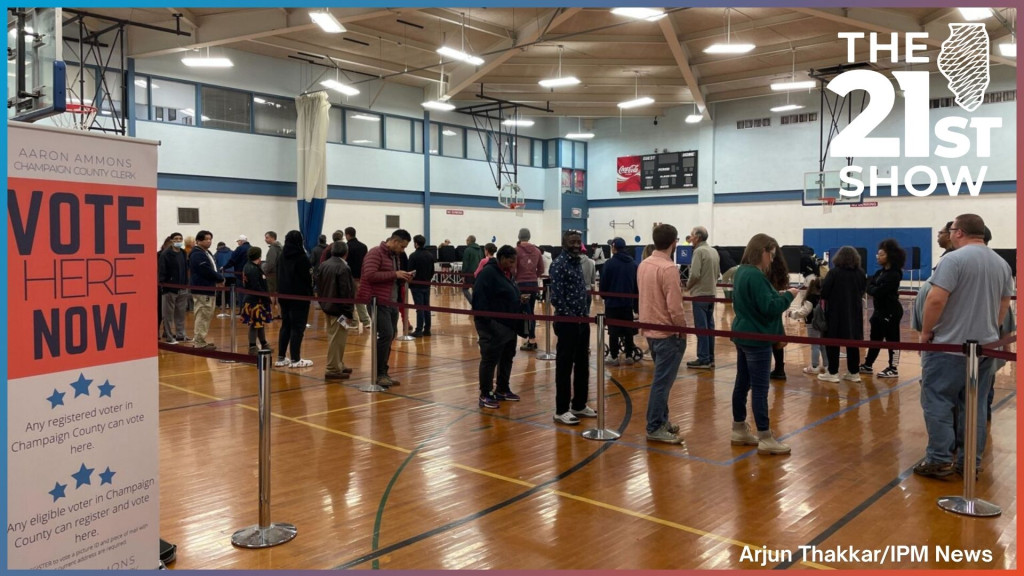
People in line to vote at Brookens Administrative Center in Urbana during 2024 presidential election Arjun Thakkar/IPM News
// This is a machine generated transcript. Please report any transcription errors to will-help@illinois.edu.

[00:00:00]
Brian Mackey: Today on The 21st Show, the U.S. Supreme Court recently weakened yet another part of the Federal Voting Rights Act. Now a former Republican state lawmaker, Jeannie Ives, is suing Illinois over its voting rights law.

[00:00:15]
Jeannie Ives: The maps in Illinois, the Democrats have not a leg to stand on because they are hugely gerrymandered, and I think it's wrong.

[00:00:21]
Brian Mackey: We'll talk with Ives and others about the future of elections and representation in the 21st state. I'm Brian Mackey. That's all coming up today on The 21st Show, which is a production of Illinois Public Media. [Airing] on WILL in Urbana, WUIS in Springfield, WNIJ in Rockford DeKalb, WVIK in the Quad Cities, and WSIU in Carbondale. But first, news.

From Illinois Public Media, this is The 21st Show. I'm Brian Mackey. Late last month, the U.S. Supreme Court significantly weakened another part of the Federal Voting Rights Act of 1965 in the case Louisiana v. Callais. At issue was Section 2 of the law, which says that states cannot discriminate on the basis of race or color in voting. That's applied not just to the act of voting, but to other procedures and practices that could limit the rights of minority voters, which meant even Republican-led states would draw majority Black districts. But the U.S. Supreme Court has now placed significant limits on Section 2, the latest in a long line of cases that have weakened the Voting Rights Act. That in turn set off a new round of partisan redistricting.

15 years ago, Illinois created its own Voting Rights Act, which requires legislative districts in the 21st state to be drawn in such a way that minority voters have a meaningful voice in elections for Congress and the General Assembly. Now that law is being challenged by a conservative legal group arguing that Illinois' Voting Rights Act is unconstitutional because it requires consideration of race in creating legislative districts. Later in the hour, we'll hear from the named plaintiff in the Illinois lawsuit, Jeannie Ives, a former Republican state legislator and candidate for governor. But we're going to spend most of today talking about what all of this means.

Kevin Anderson is a professor of political science at Eastern Illinois University. He's also the co-author of the book "State Voting Laws in America, Historical Statutes and Their Modern Implications." Professor Anderson, it's been a while. Welcome back to The 21st Show.

[00:02:48]
Kevin Anderson: Good morning. Thank you.

[00:02:50]
Brian Mackey: Ami Gandhi is at the Chicago Lawyers' Committee for Civil Rights. She's the director of two programs there, Strategic Initiatives and Midwest Voting Rights. Ami Gandhi, welcome to The 21st Show to you as well.

[00:03:04]
Ami Gandhi: Thank you so much for having me.

[00:03:06]
Brian Mackey: And Chika Okafor is an assistant professor at Northwestern University's Pritzker School of Law. His focuses include constitutional law and civil rights. Professor Okafor, welcome to you as well. Thank you for having me.

Listeners, you can join the conversation throughout the hour today by calling 800-222-9455. What questions do you have about the Supreme Court's decision? How concerned are you about rolling back voting rights here in Illinois? And should Illinois redistrict to counteract some of the Republican states that have gerrymandered their maps? Again, you can join us at 800-222-9455.

All right, Ami Gandhi, I'm going to start with you. Say more than I did in the introduction there about Section 2 of the Federal Voting Rights Act — you know, how it's worked, how it's enabled Black, Latino, and other minority voters to gain political power through the decades.

[00:04:07]
Ami Gandhi: Section 2 of the Voting Rights Act, which has unfortunately been recently eviscerated, has been absolutely critical to communities being able to have a say about who represents us and to have some mechanism to hold elected officials accountable to make the kind of changes that all community members need and that communities of color, particularly Black voters and other voters of color, have fought to secure. The Voting Rights Act has long been hailed as the crown jewel of the civil rights movement and has been foundational in the creation of the democracy we have today. That's far from perfect, but that is a multiracial democracy with even more of a need for progress from here on out.

And bringing it to Illinois in particular in this discussion — in several parts of Illinois, through the enforcement of Section 2 of the Federal Voting Rights Act, we have seen the improvement in Black, Latino, and Asian American communities being able to elect the candidates of their choice because of that enforcement and because of voting rights laws having teeth. This recent court decision threatens to take us back and is permitting states to, instead of having to follow those rules, instead being able to use partisan gerrymandering or even be blocked from using race in ways that respect people's civil rights, as the new way of operating when they draw the lines that determine who people can vote for.

[00:06:01]
Brian Mackey: Professor Anderson, maybe you can pick it up from there because I think, as we just heard, people have this idea that the Voting Rights Act — you know, its most significant effect is in Southern states, which had Jim Crow for decades. But talk more about what difference the law has made here in Illinois.

[00:06:21]
Kevin Anderson: Well, one of the things that was sort of fascinating about the adoption of the Voting Rights Act was the fact that it did not institute sort of a national standard for voting. So each state had the ability to sort of craft rules about voter registration and all that type of thing themselves. And part of the reason why these recent court deci — well, I guess the Shelby decision was a while ago — but part of the reason why these decisions were so impactful was because when the Voting Rights Act was passed, you had the provision that we refer to as preclearance. It said, you know, states with a history of discriminatory behavior had to make sure that any changes that they were going to implement in their voting laws had to be approved by the Department of Justice. Well, a state like Illinois could craft their voting laws in such a way as to ensure minority access to the ballot, things of this nature, and they wouldn't necessarily have to worry about preclearance. You know, my beloved home state of Arkansas did have to worry about it.

But once you sort of grant states some authority — you know, the famous phrase, "laboratories of democracy" — what you're going to get is a lot of different interpretations of what is necessary for registration, how elections are going to be held, and rules regarding absentee ballots and all this kind of thing. And so in a state like Illinois, you didn't necessarily have an overly complex set of rules going forward post-Voting Rights Act. So once you start making changes, this does two things. One, it creates a little bit of confusion. But the second thing it does, and probably the most kind of public thing it does, is it stirs partisan conflict. Because anytime you make changes, the party that's out of power is assuming that they're going to be disadvantaged by it. The party in power is looking to hold on, entrench their power and their authority. And it creates both legal and political issues that are extremely difficult to kind of untangle.

[00:09:11]
Brian Mackey: Professor [Chika] Okafor with the Northwestern Law School, let me bring you into the conversation now. We heard reference there to Shelby County and the sort of long, slow — I almost said death, but I guess it's killing — of the Voting Rights Act in the past few decades. Talk about how the courts have stripped away parts of the Voting Rights Act over the years.

[00:09:32]
Chika Okafor: All right, so Section 2, which is what Callais was basically focused on, has been narrowed through a series of Supreme Court decisions. As Kevin mentioned, Shelby County v. Holder back in 2013 gutted the preclearance requirement under Section 5, and that provision was what required states with histories of discrimination to get federal approval before changing their voting laws. And so that left Section 2 as like the primary remaining tool when it came to the Voting Rights Act and responding to practices that might have been happening in particular states with legacies of restricting voting opportunities for minorities.

And so in 2021, there was Brnovich v. DNC, which made it significantly harder to challenge voting restrictions — and these were restrictions like ballot collection bans or out-of-precinct rules — and it made it harder to challenge them under Section 2. Then, the same year that the affirmative action decision came out in 2023, Allen v. Milligan provided a floor for voting rights protections, which the court seemed to uphold, with Section 2 in the redistricting context. And that basically required Alabama to draw a second Black opportunity district. But then that floor collapsed with the recent Callais decision from April of this year, which was just three years later.

And so now we're in a situation in which Callais has made it much harder to use Section 2 to challenge discriminatory maps. And, you know, just [Monday] the court sent two cases back to lower courts that could eliminate private right of action under Section 2 entirely, which basically means the ability for ordinary citizens to bring cases in response to presumed or accused voting rights issues. And so each decision over the last decade-plus has narrowed a different dimension of the same law, and what's left is a protection that's increasingly difficult to actually invoke. It's increasingly difficult to win voting rights cases, and it may soon even be impossible to enforce them without the federal government actually cooperating. And so in very important ways, Section 2 has become a bit of a lock without a key.

[00:12:07]
Brian Mackey: All right, let me remind listeners this is The 21st Show. We're talking today about the state of voting rights in Illinois after the U.S. Supreme Court ruling on the Federal Voting Rights Act last month.

We asked members of our texting group how concerned they are about voting rights here. Lloyd in Danville said, "I'm very concerned — primarily because it's racist. Secondly, minimizing democracy is a threat to national security." He says, "In the minds of Republicans and Christian conservatives, too much political bias is based on Chicago politics and JB's political wealth interests are driving much of the disdain. Why are white nationalists so concerned about minority engagement in world affairs?" he asks. "America is only as strong as the least among us. Voting is everyone's right, right?" he says.

Our guests today for this conversation are Professor [Chika] Okafor with Northwestern University's Pritzker School of Law, Ami Gandhi with the Chicago Lawyers' Committee for Civil Rights, and Professor Kevin Anderson, who teaches political science at Eastern Illinois University.

In a few minutes — and Ami, I'm going to come back to you — in a few minutes we're going to hear from the Republican activist who's filed a lawsuit against Illinois to try to get some of its redistricting requirements declared unconstitutional. Maybe you can set this up for us by just explaining what the 2011 Illinois Voting Rights Act does.

[00:13:37]
Ami Gandhi: Absolutely. The 2011 Illinois Voting Rights Act came at a unique moment in time and is a law related to the creation of particular types of districts when the state legislators are going about their once-every-10-year duty of redrawing the district lines based on population and demographic changes.

And it's important to remember that, despite its name, the 2011 Illinois Voting Rights Act does not share any provisions that are the same as either the Federal Voting Rights Act that was just weakened by a court decision, as we've been discussing, or the modern state voting rights acts such as those that are in discussion and under consideration currently. In 2026, there's a bill called the Illinois Voting Rights Act of 2026, Senate Bill 3170, that's under consideration by the Illinois General Assembly. And although this law is named a state voting rights act, there is still a lot that hasn't been done yet at the state level, at least in Illinois, to robustly protect voting rights. And [I] look forward to digging in more to discuss the recently filed lawsuit as well.

[00:15:15]
Brian Mackey: Yeah, and we need to take a break in just a couple of minutes here — we're on a fixed clock — and then we'll hear from Jeannie Ives about that, and then I'll come back with the panel and talk about it. But maybe you can just talk a little bit more about that 2011 law here in the couple of minutes we have before the break. You know, it talks about crossover districts, coalition districts, influence districts. What does that mean?

[00:15:39]
Ami Gandhi: It's a good question. And in my experience as a voting rights and redistricting attorney, including advocating with and for communities of color during two redistricting cycles in Illinois, I can tell you that although there are some important aspirations in the state law from 2011, it has largely been a statement of aspirations that the state government has, which — while we would appreciate that as civil rights attorneys — it's not something with a strict enforcement tool or mechanism. It is a set of guidelines.

As far as the specific terms you mentioned: crossover, coalition, and influence districts is language about what state legislators can and should do, according to that law, in combining populations in order to draw district lines that hopefully strengthen or protect community members' ability to elect the candidates of their choice and to guard against the district lines, for example, cracking communities — Black communities and communities of color — through district lines in a way that could otherwise dilute their voting power. And so we've heard on the news examples in other states about how there can be good or bad done by district lines. And when district lines crack important population centers, for example, in the state's Black communities —

[00:17:16]
Brian Mackey: I'm sorry to interrupt you. We're going to have to take a break and we will pick this up after we hear from Jeannie Ives. We taped that conversation yesterday. More to come after a break. This is The 21st Show. Stay with us.

It's The 21st Show. I'm Brian Mackey. We're talking today about the rollback of the United States Voting Rights Act and the consequences of the U.S. Supreme Court's recent ruling to limit part of the law in the case of Louisiana v. Callais. We'll come back to our panel in a few minutes, but we're going to turn now to a case filed in the central Illinois district of the U.S. courts earlier this month. This was brought by the Public Interest Legal Foundation, a conservative group that brings cases over election laws — from allegations of non-citizens voting to challenging mail-in ballots. In this particular case, they're seeking to have the entire Illinois Voting Rights Act of 2011 overturned as unconstitutional.

Plaintiff in that lawsuit is Republican Jeannie Ives. She served for six years in the Illinois House of Representatives. In 2018, she ran in the Republican primary for governor, coming within just a few points of defeating the much better-funded incumbent Bruce Rauner. He, of course, went on to lose to JB Pritzker that fall. In 2020, Ives was the nominee in the 6th Congressional District in Illinois, but that election went to the incumbent Democratic Congressman Sean Casten.

Today, Ives is co-hosting a radio talk show, "The Real Story." It airs on the Chicago talk station WIND AM 560, a conservative station known as the Answer. It's on — well, it's on right now, 11 a.m. — which is why we taped this conversation on Tuesday afternoon. Because of that, no calls for this part of the show, but if you have thoughts or questions for when we are back live, you can call 800-222-9455.

Jeannie Ives, welcome back to The 21st Show. Thanks for being with us.

[00:19:12]
Jeannie Ives: Thanks for having me on about this issue.

[00:19:14]
Brian Mackey: So you're seeking to have the entire Illinois Voting Rights Act declared unconstitutional. Tell me about the case — on what grounds?

[00:19:23]
Jeannie Ives: Well, after the Supreme Court decided Louisiana v. Callais, it became very apparent to the lawyers in this case — the Public Interest Legal Foundation — that Illinois has one of the most race-based, map-making, gerrymandered laws in the country. And so they approached me and I said, of course, I agree to be the plaintiff in this case. [The] Illinois Voting Rights Act, as you have already explained, does require that you build coalition and influence districts based off of race. It literally uses that as a criteria in the law, and that is now abundantly clear that it is patently unconstitutional.

[00:20:04]
Brian Mackey: What do you say to people — especially, I'm sure we're going to hear this from Democrats — who say that the decision in Callais is going to set back minority representation in politics?

[00:20:13]
Jeannie Ives: Yeah, I just don't agree with that at all. Look, we're still going to be heavily Democrat when it comes to representation. It's just that those districts are not going to be gerrymandered on race. They're going to be basically gerrymandered on politics, which has always been found to be constitutional. And I'd like to point out to your listeners that when Republicans in Wisconsin gerrymandered their own maps up there, the Democrats challenged them, and I signed on to an amicus brief back in 2017 saying that's not fair either. So I don't agree with any sort of gerrymandering, but certainly ones based off race are wrong.

[00:20:52]
Brian Mackey: That's interesting. So, you mentioned the U.S. Supreme Court — it was years ago that they found that political gerrymandering was OK. You think that was ultimately wrongly decided, or at least in principle is not something we should do?

[00:21:06]
Jeannie Ives: Well, look, even Governor Pritzker agrees that in principle we should have an independent commission draw maps, and he ran on that in 2018, only to sign some of the worst gerrymandered maps in the country in 2021. After promising an open process, the Democrats built those maps in 2021 — first off of faulty data that got rejected by the courts — but then they still built it off of politics behind closed doors, literally splitting precincts to draw incumbent Republicans out of their own precinct, drawing their homes into a different precinct, forcing a potential move for people who own homes in Elmhurst. They did that famously. And so look, the maps in Illinois — the Democrats have not a leg to stand on because they are hugely gerrymandered, and I think it's wrong.

If you look at the maps in Iowa, pretty much square — they go right along county lines. They don't split precincts, counties, cities. Look, ours are by far the most gerrymandered. I think of our 17 congressional districts, 7 of them have a portion of Chicago, and 9 of them have a portion of a single county — only Cook County — in their district. That just doesn't make sense.

[00:22:24]
Brian Mackey: You know, one thing I've heard from Democrats is — you look at the 13th Congressional District in central Illinois, it connects parts of Champaign-Urbana, Decatur, Springfield, and then goes down to the Metro East, and it's largely Black communities in those towns, not exclusively, but those Black communities in those towns are connected. And I think what you hear from Democrats is, look, the Black community in Springfield probably has more in common with the Black community in Champaign-Urbana and Decatur than they do with the people, you know, a mile away in Springfield. What do you say to those arguments?

[00:22:54]
Jeannie Ives: Well, say what you will, you can't build a district based off of race, and everybody knows that's what they did. Even the legacy media up here has admitted that Districts 12 and 7 are built for Black representation. And District 3 in 2021 was wholly created for a Hispanic district, and in fact it's something like 46% Hispanic — so it's a plurality of Hispanics. And District 4, which is Chuy Garcia's district, that was built for Hispanics a long time ago. So everybody knows that they're building it based off of race, and it's just unconstitutional — you can't do it.

At the same time, we have Black representatives that represent 63% white districts, and that would be Lauren Underwood. She represents the 14th Congressional District. She had no problem getting elected and then re-elected in a district that is 63% white and only 9% Black, and she is a Black congresswoman. So, or you could look at Texas — you could look at Wesley Hunt. He's been very outspoken about this racial gerrymandering, saying he has no problem competing on the ideas and the policies, and he doesn't need race to have a gerrymandered district to win a congressional seat.

[00:24:14]
Brian Mackey: Well, as you well know, the primary voting has already happened in Illinois. People are into the general election campaigning now. What is your sort of best-case scenario? What's your hope to come out of this lawsuit?

[00:24:24]
Jeannie Ives: Well, again, this lawsuit doesn't challenge the maps per se. They challenge the Illinois Voting Rights Act. And once that is found to be unconstitutional — which I am confident it will be — then the next step would be to force the legislature to actually do a remap. That is not going to happen in 2026. We weren't anticipating it happening in 2026, obviously, but in future mapmaking exercises, they certainly cannot consider race as they have done so in the past.

[00:24:58]
Brian Mackey: Well, I know this — you've mentioned this lawsuit is not about the maps. And you did talk though about the districts that are already existing. There are people who want Illinois Democrats to go even further than they already have in terms of gerrymandering, right? A sunburst of districts that could connect Chicago and Effingham, and Chicago and Cairo, and Chicago and Quincy, and Chicago and Galena. What do you think of that? And I should say that is in response to what we're seeing Republicans doing in other states, particularly in the South.

[00:25:26]
Jeannie Ives: Well, they can go ahead and try, but I don't know how much more gerrymandered you can get. We are a 44-55 split [Republican-Democrat] district — or state, rather — when you look at presidential voting habits, and yet only about 18% [Republican] congressional representation. And, of course, [Democratic] supermajorities in the state House. So I don't know how much more they can gerrymander. They certainly will try. I guess they're allowed to do that.

I think that the fact that this lawsuit is still [pending is] beneficial because it puts them on notice. I'd like to remind your listeners as well that the Texas remap did not come because they just felt the need to go ahead and build more [Republican] majorities for the midterms. There was actually an earlier court case in the 5th [U.S. Circuit Court of Appeals]. And they determined that Texas had used racial preferences in building their map, and they were told that they had to remap for that purpose. So they did take it upon themselves to do that remap beginning last year, which is why the Texas Democrats fled up to gerrymandered Illinois to protest it — but in fact it had been part of a court decision, and a lot of people don't understand that that happened. What they're more familiar with is the Louisiana case that went all the way up to the Supreme Court, that also came through the 5th [U.S. Circuit Court of Appeals]. But it could have easily been a Texas case that had gone up to the Supreme Court for the very same reason. So the mapmaking — the remap mania that's occurred — started out with a Texas case where the maps were built on race.

[00:27:18]
Brian Mackey: Also probably doesn't hurt that President Trump really wanted this, right though? I mean, he has been pushing it. Yeah.

Um, you know, you mentioned Illinois — 44, 45% Republican. That's true in U.S. Senate elections, gubernatorial elections, presidential elections, as you said — 55% Democrat — but much smaller in terms of how the congressional districts and the General Assembly districts are drawn. We also see that in Republican states in reverse though. Do you think — is there a national solution, a bipartisan or nonpartisan solution that you see that could diffuse this situation? Because I do often hear — and you've heard Democrats saying — look, the states where we tried to do nonpartisan commissions, it's kind of hurt that party, and Republicans haven't done that in states that they control. How do you sort of do a national arms-control effort on this?

[00:28:09]
Jeannie Ives: Yeah, it's a really good point. I mean, I think some of it goes back to also incorporating some election integrity issues like voter ID, only citizens vote, checking your citizenship. I think that would go a long way to maybe cleaning up some of the election — I would say imbalance — that we have in certain states. But I do say that you have to look at the Northeast, which — they arguably have 25%, 30%, 40% Republicans, and yet their entire congressional delegations are all Democrat. So they're even gerrymandered worse than what you would consider some of the Republican gerrymanders. But yeah, should there be fair maps? 100%. I signed on to legislation to demand such in Illinois, and again, like I told you before, I signed on to a [Democratic] court lawsuit against the Republicans in Wisconsin when they gerrymandered. I just don't believe in it.

[00:29:09]
Brian Mackey: Jeannie Ives, former state representative, former candidate for governor, and as well as Congress. Currently, you can listen to her — well, I guess if you tune away from us and you're in the Chicago area — on WIND AM 560, the Answer. The show is "The Real Story," 11 a.m. Monday through Friday. Thanks for being with us.

[00:29:29]
Jeannie Ives: Thank you for having me on.

[00:29:31]
Brian Mackey: All right, if you're just joining us, this is The 21st Show. I'm Brian Mackey. We are back live now and we're going to return to our panel as we continue talking about voting rights in Illinois. With me are [Chika] Okafor, Northwestern University Law School; Kevin Anderson, political scientist at Eastern Illinois University; and Ami Gandhi with the Chicago Lawyers' Committee for Civil Rights. If you want to join us, 800-222-9455. That's 800-222-9455.

[Chika] Okafor, I'll come back to you. How does what we heard there — the characterization of what the Supreme Court said last month, you know, building districts based on race is unconstitutional — how does that line up with your read of what's happened?

[00:30:16]
Chika Okafor: Yeah, so I think that the Illinois case is important because, as was described by Jeannie, it's not just challenging one district or one map — it's challenging the state law itself. And my read is that the complaint argued that the Illinois requirement that the map makers create crossover, coalition, or influence districts improperly made race central to redistricting. That's like the claim from Jeannie as a plaintiff.

And it looks like the Illinois law was designed to protect communities whose voting power might otherwise be weakened, even when they're not large enough to form a majority-minority district. And so if the law is struck down, it can become a template for challenging every state's Voting Rights Act around the country. And this is obviously in a context in which the federal protections for voting rights have already been narrowed. And so I view this as not just a fight over lines on a map — it's about whether states can actually still design voting systems with minority political power in mind.

And so many people do believe that color blindness automatically leads to fairness, and in my role as a professor, my peer-reviewed economics research shows that that premise is wrong in certain contexts. And so in my research, I originate this concept called social network discrimination. The basic insight is pretty straightforward: opportunity flows through relationships — through who you know, who refers you, who tells you what's possible. And because people naturally connect with others like themselves, belonging to a larger group winds up with one having more connections and more opportunities. Minorities, simply by being a smaller share of the population, receive systematically fewer of these opportunities. It's not about malice — it's about math.

So when you combine this finding with other research, it suggests that this would compound in politics. Partly due to social network discrimination, minorities are less likely to form the connections to run for office. Even if they do run, they're less likely to successfully fundraise. Even if they do fundraise, they're less likely to mobilize enough votes. Even if they mobilize votes, they're less likely to actually build an effective governing coalition. And so social network discrimination compounds at every stage.

And so when we think about districting — and particularly majority-minority districts — that the Supreme Court said could not be constructed in the same way moving forward, this type of district is one that is a direct tool to counteract socioeconomic discrimination and how it fosters unequal political opportunity. And so though the court's decision in Callais dramatically narrowed that tool, there's a broader conversation about when it comes to the legality — the court has said that states can use partisan methods when they're redistricting, relying on Rucho v. Common Cause. And they very much restricted the capacity for states to use race when they do decide on creating or trying to create majority-minority districts. And so the legal landscape has shifted, but I think there are also broader questions about the extent to which [redistricting is] actually fostering the political opportunity [of voters] across different communities in our state.

[00:33:48]
Brian Mackey: All right, we're going to have to take another break here. We'll continue this conversation when we come back. Before we do, let me share a couple of messages we got from people in our texting group about this — and specifically on the idea of gerrymandering, which is obviously a big part of this discussion here. Christopher in Brimfield says, "I don't think any politician should be able to make maps. Voters choose the representative. Politicians do not choose their voters." And we also heard from Kevin in [Faria], Illinois, who said, "We need to get rid of the Electoral College, allowing the majority rule to stand." And he also says, "Voting districts should be created by using arbitrary boundaries such as county and township lines."

All right, thanks for your messages. If you want to join us today, 800-222-9455. We will continue talking about the future of voting rights in Illinois, given the U.S. Supreme Court decision, given a lawsuit that's challenging Illinois's law, and given a proposal to enact some further laws here in Illinois about this. It's all coming up after the break. This is The 21st Show. We'll be right back.

It's The 21st Show. I'm Brian Mackey. Our subject for the hour today is the state of voting rights in Illinois. We're also going to be talking a little bit in the time we have remaining about gerrymandering here. My guests are Professor [Chika] Okafor with Northwestern University's Pritzker School of Law, Ami Gandhi with the Chicago Lawyers' Committee for Civil Rights, and Professor Kevin Anderson, who teaches political science at Eastern Illinois University. If you want to join us, 800-222-9455. That's 800-222-9455.

Kevin Anderson, let me ask you to pick up there on this idea that — one of the things we heard from Jeannie Ives is that she doesn't think the Supreme Court decision would set back minority representation in politics. She pointed to the district of Lauren Underwood. I wonder what you say to that, you know, specifically and in a more general way.

[00:36:05]
Kevin Anderson: Well, I say two things. One, there is an element of truth in what she says, just in the sense that a lot of the framing around this assumes that in minority districts there's this sort of monolithic voting — or ideological bent — you know, that all African Americans or all Mexican Americans are going to think the same and vote the same. That is definitely not true. So there's a small element of truth to what she said.

However, there is an academic theory called linked fate, meaning that people, often in minority groups, rather than vote based on their individual circumstances, they tend to vote thinking in terms of the group — you know, what is best for African Americans, or something like that. And that has had a fairly good record of predicting how people vote. And so oftentimes when you're drawing lines, what you do is you look at it and you say, OK, there are a large number of African Americans in this city, in this district, etc. And if they are using this idea of linked fate and they're saying, OK, what is good for my community — not necessarily what is good for me — then they are much more likely to say, hey, I'm going to vote for the candidate who's going to push access to health care or increase funding for public schools, etc. So the idea that you can take away this ability to choose representatives that might speak out on behalf of the community, as opposed to individual ideology — to me it's a little incomplete. I mean, again, I understand the point, but history doesn't necessarily back that up.

And I'll just add this one other thing. Very early on in the late 1800s, when a lot of laws were put in place — especially in Southern states but across the country — that wound up disenfranchising a lot of African Americans, the thing was, those laws almost never specifically targeted African Americans. They were done and framed as laws that spoke to election integrity. That's why you had grandfather clauses — cause that was the test of the character of your family. That's why you had literacy tests — you needed to be literate in order to understand the issues going on, things of this nature. They disproportionately wound up impacting African Americans. And so what happened was the legal strategy shifted, so that the legal strategy wasn't to prove discriminatory intent — it was to prove discriminatory impact.

And what has happened in both the Shelby County and the Callais case is that the Supreme Court has kind of taken the legs out from under the legal argument of discriminatory impact. It becomes incredibly difficult because the flip side of what we heard [from Jeannie Ives] — she says, oh, well, you're doing this to increase minority representation — the defense is simply going to be, no, no, no, we're doing this to increase Democratic representation. And even if you think that that's wrong, the court has consistently upheld that that is legal. And that then creates an issue. So it's a soothing argument, but it's historically a little bit incomplete.

[00:40:03]
Brian Mackey: Well, related to that point, Ami Gandhi, I'll come back to you. We got a text message from a listener — didn't give a name or location — but it says, "Why is it fair that minorities get laws that favor them when it puts me as a voter with no representation, as we in rural areas get lumped in with Democrat voters, so we can never have a say in anything." I think this is what you hear, you know, where you look at the voting preferences of statewide elections — they tend to go 55% Democrat, 44% Republican, give or take a few points here and there. But that's been true for a decade now. And yet for congressional representation, there are just three Republicans, which is like 18%. How do you respond to that?

[00:40:49]
Ami Gandhi: Unfortunately, to this day, even in Illinois, even in 2026, there still is racial discrimination against Black people and other people of color, including in the voting context. We see that at all levels of the election system in our civil rights work — from barriers that people face at the polling place on Election Day to issues at a more systemic level that prevent Black people and other people of color from being able to elect the candidates of their choice and to have a vote that really counts and makes a difference in who's elected.

In office, regardless of any background that someone is coming from — racially or otherwise — all voters should have their rights respected, including the voter who shared that input that you read. And it's important to know that in a state like Illinois, just because a district or a larger scheme favors one political party does not mean it necessarily protects the interests and preferences of Black communities and other communities of color. To know that really means that we have to talk to voters themselves about their preferences and not just go by either the headlines or the talking points from the legislators and politicians. And I say this from a nonpartisan perspective: attacking the rights of a racial group of voters — for example, Black and Latino voters — is not the way forward. It is not a just way to try to address political circumstances and barriers in Illinois or beyond.

[00:42:34]
Brian Mackey: Another comment from a listener — this one from Anne in Urbana — says, "If a state uses political parties to gerrymander, and that state ends up with no minority representatives, isn't that de facto racial gerrymandering?" And maybe Kevin Anderson, I can come back to you on this, because I was reading something the other day — I can't remember who wrote this — but basically said that's kind of why the Republican Party has worked so hard to not be the party of Black people, by basically sort of forcing that racial polarization to match up with the political party preference. You can say we're doing partisan gerrymandering when it's really racial gerrymandering, if that makes sense.

[00:43:17]
Kevin Anderson: It does. And one of the key issues with that is — not just in terms of voting but it becomes a much bigger issue in terms of policy — you know, what type of public policy is going to be advocated. You know, is a party going to worry about criminal justice issues? Are they going to worry about business development issues or environmental issues, etc., if they don't have to take into account minority voters and minority voter interests?

One of the sort of deeply problematic elements of this is that, again, leading into the Voting Rights Act, a lot of the litigation going all the way back to a case called Smith v. Allwright — which Thurgood Marshall wins, that invalidates the all-white primary — you get to this idea of saying, I can't just point out and say this is discriminatory intent. I have to show you this is the impact, this is the effect of this. And not only — as the texter said — in effect, the impact of this is that we're using political identification as a proxy for race. And the court has consistently held that political identity and political gerrymandering is legal, without considering that broader impact. You know, it's a little bit like you're supposed to walk six blocks and then you walk three and you go, OK, that's enough, I'm tired, I'm going home. And it's like, no, this is the result, this is the impact that we're looking at. But right now, the argument is — the court has kind of said — we don't see that yet. And that's the political issue we're dealing with.

[00:45:45]
Brian Mackey: All right, let's get an actual caller on the line here. We have Ray calling from Rockford. Ray, thanks for calling in.

[00:45:52]
Ray: Certainly. My question is, in particular for Professor Okafor — the last Northwestern graduate to serve on the U.S. Supreme Court, of course, was John Paul Stevens, and he's written a book about 15 suggested constitutional amendments, one of which addressed gerrymandering, and I wonder if the professor — I assume the professor is aware of that — but what their thoughts are about that amendment, which asked for very contiguous districts, and [it] seems [it] would even [have addressed] Jeannie Ives and satisfied the issues that she brought up.

[00:46:41]
Brian Mackey: All right, Ray, thank you for the call. I appreciate it. Our time is tight, so, Professor Okafor, I'll come to you — just a couple of minutes left — but if you want to respond to that.

[00:46:51]
Chika Okafor: Thank you for that question. I'm not familiar with Stevens' book, but I guess a couple of things that I think are important when it comes to how we think about gerrymandering is that at least there are kind of two questions. The first is whether Illinois should have a more transparent or independent redistricting process, which might be what is covered in the book as far as the constitutional amendment — and that's a legitimate debate. And then there's a second question about whether the state can actually try to protect minority voters from having their votes diluted. And I think it's important not to use frustration with partisan gerrymandering as a reason to dismantle protections for minority voters, and so that's something that we should all be considering.

[00:47:49]
Brian Mackey: Ami Gandhi, last question — in just about a minute left, and I'm going to have to hold you to it. How does this changing landscape affect your work as a voting rights attorney, a civil rights attorney?

[00:48:02]
Ami Gandhi: Voters are up against many barriers, and we at Chicago Lawyers' Committee for Civil Rights are here to help as we can in this changing landscape. Voters can reach us at 866-OUR-VOTE so that we can assist, especially during elections. And we do want to underscore that nothing in the Callais Supreme Court decision, nothing in the Ives lawsuit in Illinois, disrupts the long-established power of the states — like the state of Illinois — that have the power to prevent racial discrimination through race-neutral means. There still is a path forward, including through a modern state Voting Rights Act that could be enacted in Illinois in 2026 or beyond. And Senate Bill 3170 is a very important tool for the state of Illinois to consider, to take it from here in protecting voters' rights at the state level when the federal protections have crumbled.

[00:48:59]
Brian Mackey: Ami Gandhi is with the Chicago Lawyers' Committee for Civil Rights. We've also heard from Professor [Chika] Okafor with Northwestern University's Law School and Professor Kevin Anderson, a political scientist at Eastern Illinois University. Thank you all so much for being with us and sharing your perspectives with us today here on The 21st Show. Thank you. Thank you.

That is it for us today. Coming up tomorrow, imagine a time in America when conservatism was on the rise, and yet Democrats made a populist case that resonated with working-class voters. This happened a few decades ago, and it's the subject of a new book by historian Corey [Haala]. It's called "When Democrats Won the Heartland: Progressive Populism in the Age of Reagan." We'll talk with him about that coming up tomorrow.

We would love to hear from you about today's show or what we're talking about in the future, or if you have suggestions for future programs. You can find our email address at our website, twentyfirstshow.org. You can also find our voicemail line there, social media, and every other way to contact us. Again, twentyfirstshow.org.

The 21st Show is a production of Illinois Public Media. I'm Brian Mackey. Thanks for listening.
After the U.S. Supreme Court weakened part of the federal Voting Rights Act last month, a Republican politician is mounting a legal challenge to Illinois’ Voting Rights Act.
She joins the program to discuss the case along with experts, who weigh in on voter representation in different areas and the political and legal aspects surrounding voting rights.
GUESTS
Kevin R. Anderson
Professor, Political Science, Eastern Illinois University
Ami Gandhi
Director, Strategic Initiatives, Midwest Voting Rights, Chicago Lawyers' Committee for Civil Rights
Chika Okafor
Assistant Professor of Law, Northwestern Pritzker School of Law
Jenne Ives
Former Illinois State Representative
Host, “The Real Story”