







When geese became a menace, Moline turned to the ‘Goosinator’
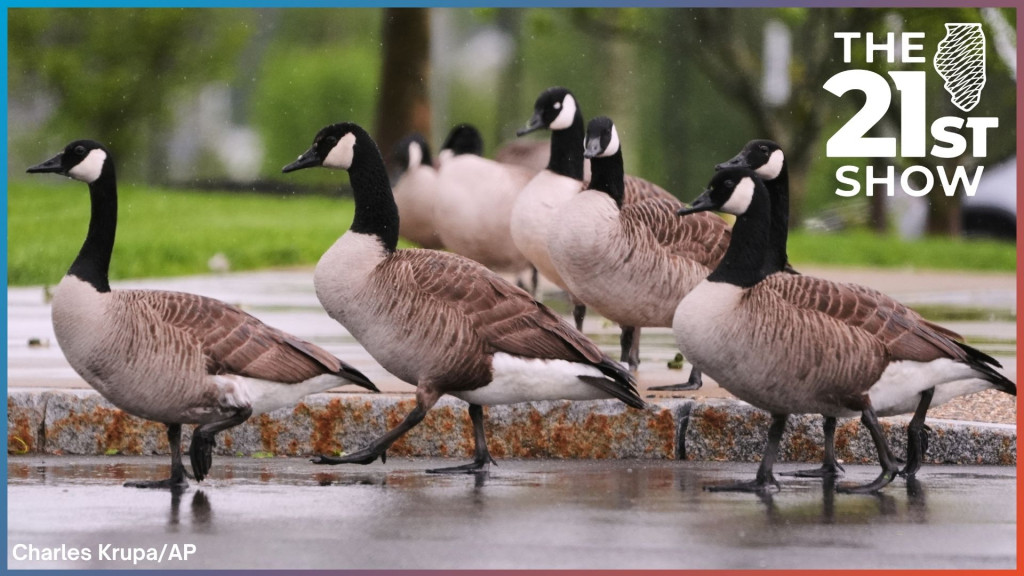
Honk. Charles Krupa/AP
// This is a machine generated transcript. Please report any transcription errors to will-help@illinois.edu.

[00:00:00]
Brian Mackey: From Illinois Public Media, this is the 21st Show. I'm Brian Mackey. When you hear this sound, what comes to mind? Maybe we should have put a trigger warning on that. Anyway, maybe you think they're cute and misunderstood, or maybe you think they're a nuisance or invasive to property. No matter how you look at them, Canada geese have made Illinois their home, and they can be found everywhere: in parks, lakes, golf courses, your own backyard perhaps. Maybe in the spirit of our current politics, we should rename them America geese or Illinois geese. Regardless of what you think, there are some places that would just be better off without them, such as public parks and golf courses. That is where the Goosinator comes in. It's a machine that's designed to drive geese away and make them stay away. More on how it works in a bit. For now, communities and organizations and companies have bought this to help control their geese populations, including in Moline, Illinois, which started using it last fall. That's when we spoke to the founder and inventor of the Goosinator, Randy Clawson, and to Eric Griffith, director of Parks and Rec for the city of Moline, about its deployment. Because our program's on tape, no live calls today, but you can always let us know what you thought by emailing us. Our address: talk@21stshow.org.

[00:01:42]
Brian Mackey: All right, Randy, I'm going to start with you. Where did the idea for the Goosinator come from?

[00:01:48]
Randy Clawson: Well, truthfully, it came from my brother-in-law at the time who worked at a golf course. And, you know, I asked him, "Hey, how's work going?" He goes, "You know, we..." — this is late fall going into winter at this golf course. I'm like, "What kind of maintenance do you have to work on right now?" And he told me, he goes, "You know what we're doing right now is we're mostly chasing geese, and we chase them in our carts. And we try and get them off of the grassy areas because that's what they obviously like to eat. But then when we chase them, they just go into the water, and then we have to wait until they come out of the water before we can go chase them again, and that's what I've been doing all day long."

And so, in so doing over time and him knowing my background — which I'll go into in just a little bit — he asked me, he goes, "Is there anything you can come up with that would get these geese away?" And I just thought to myself, you know, and I'll just say this: my background is I ran a radio-controlled hobby shop that specialized in mostly airplanes, helicopters, some ground vehicles, that kind of thing, some boats, trains, that kind of thing. And I did a little work for the government back then before there were drones to just put a digital camera in an airplane and then go take some photos at an archaeological dig up in Wyoming. And so I had to custom-build this airplane to be able to do that.

And my brother-in-law, knowing that, said, "Is there anything you can design that would get rid of these geese?" And so I thought to myself, "Well, sure, I'll come up with something real inventive and I'll come up with a predatory bird like [a] hawk or eagle, and I'll just... what I'll do is I'll come out to your golf course and I'll just fly over their heads, and of course they'll just all fly away." OK, well, I had to learn that — I did do that and went out there, and guess what? None of them flew. All they did is hunker down tighter. They just stayed down on the ground and they didn't go anywhere.

[00:04:09]
Brian Mackey: So this is where the Cornell study comes in, right? Tell me about the Cornell study.

[00:04:14]
Randy Clawson: So yes, my brother-in-law said, "Let's do some research on this." And so Cornell University did [a] study back in, I want to say, 2010 or 2011, and when I was doing this, this was in 2012. And we looked at the study and saw all the characteristics that geese hate the most, essentially. And when you go through them — and I will real quick — but what you find is [they're] characteristics of their natural predators, which are like coyotes and foxes. They don't like big eyes, they don't like big teeth, they don't like the colors reds or oranges, they don't like anything reflective, so they don't like silver.

And so what I did is I took all these characteristics and put them into a body that had all those characteristics: big eyes, big teeth, swept-back ears, and all of the features that they said. And then what I did is I accentuated them. I tried to make it a bright orange, tried to make [them] really big eyes and really big teeth and that kind of thing. And I got out there with it, but I learned that it had to be a ground craft, OK, like a dog, like a coyote, that kind of thing.

But the problem with any kind of dog — and the goose control companies that were out [there] use dogs — but because geese are protected, you have to use... you can't use your own Labrador. You have to use a trained dog. And what "trained" means is it has to be able to pursue, but then you've got to be able to call it back before it grabs one. You're not allowed to have your dog grab a goose because they're protected. And so they end up being highly trained border collies that cost at that time, you know, $5,000 to $8,000 buying them pre-trained, and then you had to have a handler run them.

So my goal was to take all those characteristics, put it in something that a person can control and run all over any place a goose can go. So of course on the ground, on the grass, in the sand, and all those kinds of places. But then where do geese go? Where's their sanctuary? Where's their refuge? It's always the water. They can get away from any predator by going into the water.

[00:06:38]
Brian Mackey: Maybe that's a good spot to pause. We've sort of teased what it is. We'll talk about how it works in a moment. Let me bring Eric Griffith into the conversation from the city of Moline, director of Parks and Rec. Talk to me about the geese problem in Moline.

[00:06:52]
Eric Griffith: Yeah, so I came to the city of Moline back in 2020, right a week after the pandemic started. And when the pandemic started, people started going outdoors. So parks became one of the only things that people could still do while the nation was shutting down.

And a decade prior to that, the park board and the city council had had several discussions on what to do about the geese population. And — and I'm sure Randy could give a little bit more detail on it — but every seven years, the amount of geese in your area double. So I've been here coming up on six years, and we've seen, you know, that almost double since I've been here. And we're sandwiched in between two rivers: the Rock River and the Mississippi River. We also have a really nice park that has a three-acre fishing pond sandwiched in between a lot of green space and parkland. And so with the riverfront and that park only being a couple blocks away, we have hundreds of geese that like to be on the bike path. And, you know, they've swam in our swimming pool, they've chewed up the outfields of our softball complex, our baseball complex that's there.

And it's always been a discussion, but no one's ever wanted to make a decision on it.

[00:08:21]
Brian Mackey: What's the problem? What harm do the geese cause? I mean, they just get in people's way. I mean, what's the big deal about that?

[00:08:28]
Eric Griffith: Right. Yeah, so we've seen geese chase children, dogs, humans on our bike path. We've seen them cause accidents. Like, we have two roads that go through Riverside Park. We've seen where they're crossing the road and they won't... they'll go across the road, but they will not move out of the way for vehicles. And so those vehicles have stopped, and we've seen fender benders from there. We've seen where they've been in our swimming pool, and we've had to shock it because of the geese droppings. They just... they create a nuisance, pretty much, just to be [honest].

[00:09:05]
Brian Mackey: Just to be clear, you mean shock it with chemicals for safety, not electroshock the geese, before we get any letters?

[00:09:13]
Eric Griffith: Yes, the chemical in [the] pond.

[00:09:17]
Brian Mackey: OK, so Randy, let me bring you back in. So we just sort of described what the Goosinator looks like. It's supposed to operate on land, on water. How does it actually run? What is the sort of mechanism?

[00:09:29]
Randy Clawson: So first of all, it's electric. It's battery-powered, and the implement that it's closest to — you can kind of say that — that everybody uses now would be like a weed eater, a line trimmer. So it has [an] electric motor that turns a propeller, but not a propeller like a boat down in the water. It turns a propeller like an airplane motor propeller up front. So it's kind of like... I knew that if I was going to come up with a predator that could go anywhere a goose could go, it would have to be almost like down in Louisiana, like they have those swamp buggies, you know, that go out and they have an airplane engine on it and it takes you all over the place. But they are kind of tall and narrow and they only work in water.

So I took that concept, made it more stable by splitting the hull into two, and so it has two floats underneath it so it can go over all the terrain that geese do. [It] can go in the grass and on the sand, can go out in the water. And then where you guys are and where I am in Denver, it gets cold in the winter and it freezes over. Well, that doesn't bother the geese. So this craft had to be able to go up onto the ice, back into open water, anywhere a goose goes, and basically say that "I'm a new predator that has moved in and lives here."

And what you end up doing is you define your territory — that you're a predator. And so you just tell the geese where they can't go. You basically say, "Hey, I don't care where you go, but not anywhere within these borders in this lake or in this area and that kind of thing."

And see, the problem is geese are the smartest waterfowl bird out there, OK? And wherever a goose is born, if they have a nest and they're born there, they want to return to that very same place to rear their young. And what I've learned is the only thing they respect... they don't respect people. The only thing they respect is an actual something that they see as a predator. And that's the only thing they'll listen to is something that they see as a predator.

And so you simply say, "Hey, I'm [an] all-terrain predator that has moved in." They don't know it's under man's control. So it's controlled by man that can patrol all the way up to anywhere a goose is on your property and teach them to basically... really, what you want them to do is to nest elsewhere, and then you can keep from doubling the population, at least in that area.

[00:12:12]
Brian Mackey: So, Eric, let me ask you: what sort of measures had Moline tried, if any, prior to the Goosinator?

[00:12:19]
Eric Griffith: So we did a lot of research [on] what we could do. You know, with our riverfront, we couldn't, you know, grow tall grasses, which geese like to see if a predator is coming. So that really wasn't an option. We researched some type of chemical that you can actually spray on the grass that, to [a] human eye, it doesn't look like anything different, but it makes the grass kind of look spotted to what the geese see. And when they try it, it upsets them, and then they won't want to eat it anymore.

Our riverfront park is over two miles long, and we would have to treat that four or five times a year, and the amount of chemical... it is safe to use around, like, the Mississippi River, but the amount of cost for that was astronomical, and we'd have to do that every single year.

We wanted to rent a dog from the Chicagoland area, like what Randy was saying that's trained to do that, and unfortunately, the waiting list is so long and the cost is so much more that it just wasn't something that we could afford at the time. And so the staff that was here before me actually looked into the Goosinator back in 2018 as part of the research.

And then, you know, ever since I've been here, we don't get a lot of complaints about our park system, but if you added up all the complaints, we probably get more about the geese than any other... of all the other complaints combined is the geese.

[00:13:55]
Brian Mackey: Wow, that's amazing. All right, so we have about two minutes until we need to take a break. So Randy, how does it work? Let's say, you know, a park district comes to you, says "We want to engage a Goosinator." Are they buying one? Are they renting one? What is the actual... do they need somebody to operate it? Is it autonomous, AI-powered Terminator? Yeah, go ahead.

[00:14:16]
Randy Clawson: Yeah, well, according to the regulations, guess what? It's not allowed to be. In other words, a human has to be... for it to be considered humane, a human has to be involved. So I would like to make it automated, but for now, a person has to run it.

And to answer one of your questions earlier real quick: what is the problem with geese? You know what the big problem is? Now think of this: a goose poops 28 times a day, OK? And the problem is now that we've worked through COVID, it's in their stool. They obviously make a big mess that people don't want to walk through. And they carry E. coli is a big one, botulism, other viruses and different things from park to park to park. So it gets to where it's unsanitary.

Most of the people that purchase a Goosinator from me address complaints like Eric said, but then mostly try and sanitize the place, keep it clean, because otherwise, if you let them go... you know, each goose, and you have hundreds of them pooping all day long, it just makes a huge mess that, you know, our kids are going to be playing soccer in and football and all those kinds of things. And so just from a sanitary standpoint, they need to clean it up.

[00:15:39]
Brian Mackey: No doubt. Twenty-eight times a day. What a remarkable stat. All right, we need to take a break on the program. When we return, we'll have more from my conversation with Randy Clawson, founder of the Goosinator, which is an anti-goose device designed to humanely encourage them to vacate your neighborhood. We'll talk about how it actually works in practice. We'll also hear more from Eric Griffith, director of Parks and Recreation at the city of Moline. This is the 21st Show. Stay with us.

[00:16:18]
Brian Mackey: It's the 21st Show. I'm Brian Mackey. Today we're listening back to our conversation on the Goosinator, which is a device aimed at driving geese away and making them stay away. It's been employed by the city of Moline, where Eric Griffith is director of Parks and Recreation. When we first spoke with him last October, we also had on the program the Goosinator's creator, Randy Clawson. Because the show's on tape today, no calls, but our voicemail line is always open. The number for that is 217-300-2121.

[00:17:09]
Brian Mackey: All right, Randy, before the break, we were talking about some of the problems of geese and how, you know, how you designed this machine to be sort of a... appear to be a predator to them. You said it has to be operated by a person. What does it actually look like when this thing is operating? Can people be around, or would this be terrifying to humans and small children as well?

[00:17:29]
Randy Clawson: Yes. No, no. My design goals were to make it obviously effective so it works, but more than that, super easy to operate. So I had at that time a nine-year-old, and my goal was to get her to be able to run it. I tried to make it very, very simple.

And what you do, as I tell everybody — and I've even kind of told Eric that — is they see it as a predator, so you want to act like a predator. So the Goosinator doesn't chase after geese. What it does is it does what a predator does, which is stalk them.

So when you run this, you take it out, and let's just say to the typical golf course, I tell them: start in the grassy areas where the geese are, wherever the grassy areas are. You start there, and then you get them to fly away, and then where do they fly? They fly to the water, right?

Well, to get them to fly, what you do is you just simply move it a little bit up to the left side or right side of a bunch of them feeding. Now, here's an interesting part of geese, OK. Out of every 10 geese, what you'll find is eight or nine of them will have their heads down eating, but there's always one or two sentries — or centurions — kind of like [a] security guard, that has their head up and they're looking. And when they see the Goosinator just come into their view, they basically say, "Hey guys, hey guys, get your heads up, get your heads up. I think this is a predator. I think this is a predator." And so what they do is they help herd them.

So what a predator does is he stalks them, herds them all together, OK, and then [he] hes[itates]... towards them, kind of like a sheepdog. And that's what you do with the Goosinator. You go back and forth showing them the ugly characteristics, the big eyes and the big teeth. When the Goosinator's coming straight at you, it's kind of narrow. There's not much to look at. So I always tell people: show the side. You're showing them that a bully has now moved in and doesn't want them there.

And you slowly go back and forth, and it doesn't take long and they all take off. And then where do they go? They go fly to the water where they think they're safe. And then you take the Goosinator over to the water, put it in the water, and guess what? You do the same thing in the water. You slowly go off on their left side, then you go to their right side.

And once they have to fly from water... you and I know they can get up and fly out of water, but it takes more effort. And no natural predator ever makes them fly from the water. So when this one does, and them being the smartest waterfowl bird out there, they remember it, and they remember properties almost like GPS. They know properties that are good for feeding, good for nesting, good for playing, that kind of thing.

And what you want to do is you want to say, "No, now I live here. I moved in, no different than a pack of coyotes, but I moved in here. I live here, and you're not welcome. You need to leave."

And I'll just tell you: I've come up with a two-week chasing protocol that basically says, "Hey, clear them out first thing in the morning, come back, put the first battery on the charger" — and it comes with two batteries — "but be on the ready with the [second] and have all your people around the lake kind of on alert so that if Martha on the south side of lake number two says, 'Hey, a dozen geese just flew in by my house,' then somebody's got to grab the Goosinator, go to that place and roust them out of there."

So the geese say, "God, we can't go back to that property for even 10 minutes and that thing's going to come after us." And then you teach them to just avoid your property to a point where, when you do it for, let's say, two weeks and you clear them out of there, then the only thing you have to do after that is try and keep it visible, OK?

Because what geese do is if they like a place, they'll leave, and then they'll send a small number of scouts 20 or 30 minutes later. They just fly over. They won't land or anything. They just fly over and [try] to see if that predator is still there. Now, if they don't see it anywhere, they go back to their flock of whatever, their group of 50, and they go, "Hey guys, coast is clear. We can go back in there and feed for a while." Whereas if they see it down there... and so most golf courses just put it in the back of one of the maintenance carts that's out on the course. So it's just out there somewhere. And when [they] see that, they go back and they go, "No, he's still there. Looks like we have to go elsewhere, guys."

So that's kind of the game you're playing. Does that make sense?

[00:21:54]
Brian Mackey: It does. So Eric Griffith with Moline Parks and Rec, talk to me. Have you been able to put this into use? What have the results been so far?

[00:22:04]
Eric Griffith: Yeah, so we've pretty much done exactly what Randy [said], maybe just a little bit different. But so we've done it for a couple of weeks, not as much this week just because we have some staff off. But those first two weeks, you know, we were having, you know, two [or] 300 geese a day between the two locations. And, you know, we have not completely eliminated all of our geese, but now we're down to like 20 or 30 between the two locations. And, you know, it's just... it's crazy how we'll take [it] there. We take it... we ride around on a Gator, like a side-by-side. And as soon as the Gator pulls up and we kind of turn the Goosinator on, it's not that loud, but it's just loud enough that the geese know, and then they take off.

And so it's funny because some of the staff really didn't think it was going to work because they don't even move for a, you know, a big truck or SUV that's on the road. Why would this seven-pound Goosinator work? And the first time we tried it, there was about 40 or 50 geese all in an area, and I was the one that got to try it first. And I couldn't even get 20[–]30 feet away from them, and they saw it coming and they flew. They didn't just fly to the pond that was in Riverside, they flew to the Mississippi River, which was a couple blocks away, so they didn't even feel safe going to the pond in Riverside.

So that was pretty... that was the first time we had tried it. And now, I mean, we used to go out for about an hour, and now staff are coming back after a half hour going, "Yeah, we're not really seeing a whole lot out there," which is a good thing. That's what we're trying to achieve.

[00:23:47]
Brian Mackey: Interesting. Well, just about a minute or so left. Randy Clawson, what would you say to people who say, you know, this might be potentially illegal, right? Canada geese are protected under the Migratory Bird Treaty Act of [1918]. How did you think about that?

[00:24:01]
Randy Clawson: Yeah, they are. So the only thing you are allowed to do is a term that they call "haze," and hazing is just harassing them, showing them ugly characteristics, ugly sounds, that kind of thing. And so this also works... they dislike the look of it, but they also hate the sound of it. As Eric was saying, when you plug it in, it makes four beeps. They already start getting alert. And the electronic sound of the motor and the propeller is not that loud to us, but right in the frequencies that all animals hate.

And I'll just tell you: I've sold this all over the place for geese, but I've also sold it for white pelicans up in the Colorado mountains and for deer and elk up in the Colorado mountains where they have too many deer eating the grass off of their golf [courses]. They use it to keep those animals just away. And what you're doing is you're saying, "Hey, I'm a predator. I moved in. I live here. You're not welcome. Move off." And they learn to do that.

[00:25:12]
Brian Mackey: Randy Clawson is the creator and founder of the Goosinator. Eric Griffith, director of Parks and Rec with the city of Moline, which bought a Goosinator, has been using it to chase some of the geese out of its parks. Thank you both so much for sharing your stories with us today on the 21st Show.

[00:25:27]
Randy Clawson: Very good. Thank you very much. I appreciate it, Brian.

[00:25:30]
Eric Griffith: Yeah, thanks for inviting us.
Today's show included a rebroadcast of the following "best of" segment first aired October 23, 2025: When geese became a menace, Moline turned to the ‘Goosinator’.