







Why do scams work? An Illinois accountant explains
Courtesy of Kelly Richmond Pope
// This is a machine generated transcript. Please report any transcription errors to will-help@illinois.edu.

[00:00:00]
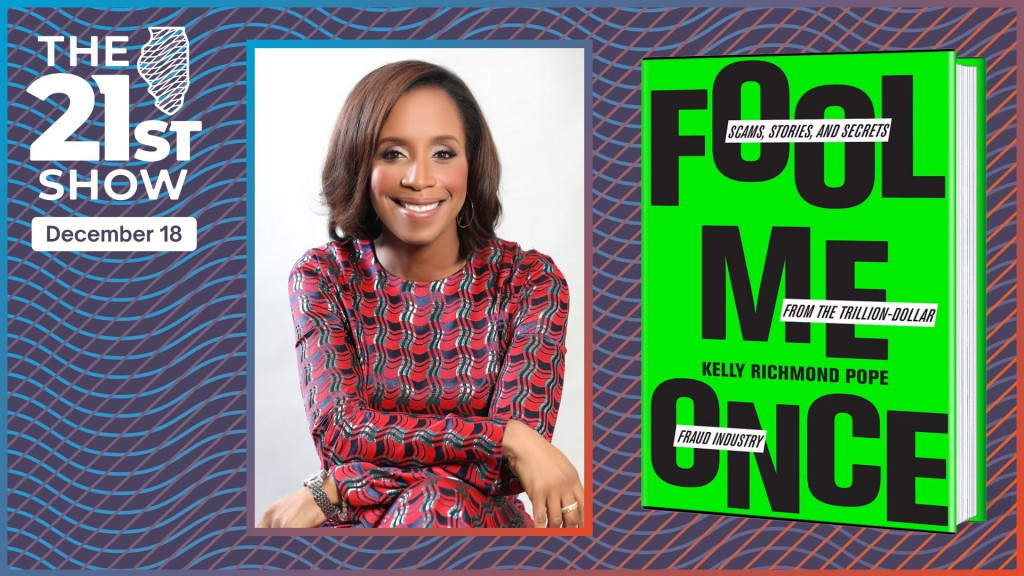
Brian Mackey: Today on the 21st show, scams and fraud are all around us, from pyramid schemes to spam calls. We'll talk with Kelly Richmond Pope about why people do it and how we can better avoid being taken in. She's a professor of forensic accounting at DePaul and the author of "Fool Me Once: Scams, Stories and Secrets from the Trillion Dollar Fraud Industry."

[00:00:24]
Kelly Richmond Pope: I think that it's OK to trust people, but do your due diligence. Do both. You can do both. You don't have to do one or the other. So you can do both. So if you were to — if a check came in your mailbox today with your name on it, you're not just going to take it to the bank and cash it. You're going to ask some questions. Who's the sender? Is this legitimate?

[00:00:48]
Brian Mackey: I'm Brian Mackey with Kelly Richmond Pope today on the 21st show, which is a production of Illinois Public Media. But first, news.

From Illinois Public Media, this is the 21st show. I'm Brian Mackey. When was the last time you experienced a scam? Maybe you saw a yard sign promising thousands of dollars a week for working from home. Maybe you've gotten spam calls on your phone lately, asking about an extended car warranty. And the infamous Nigerian prince scam is still making the rounds after all these years.

Fraud is everywhere in society, and it can be extremely costly. The Association of Certified Fraud Examiners estimates more than $5 trillion a year is lost to fraud around the world. And for those hit by it, the aftermath can be painful. Take for example, this retiree who spoke to CBS News in 2024 after losing millions of dollars and her home to a romance scammer.

[00:01:56]
Speaker 2: You know, it's not the material items that make a difference for me. It's the fact that I don't have any freedom. I don't have freedom anymore to go out with my girlfriends, have dinner. I don't have freedom to go do this or this experience. It's not that I don't have, you know, money or drive a new car or blah, blah, blah — it's the fact that I have no freedom. I'm very limited because of this scam.

[00:02:32]
Brian Mackey: Forensic accountant Kelly Richmond Pope makes the case that it could happen to any of us. Not just in terms of falling for it, but also committing fraud ourselves, whether we mean to or not. A few years back, she wrote about all this and what it can take to not get scammed yourself in a book called "Fool Me Once: Scams, Stories and Secrets from the Trillion Dollar Fraud Industry." It's available from Harvard Business Review Press.

Pope is also a filmmaker, as we'll get into later, and she's based in Illinois as the Dr. Barry J. Epstein endowed professor of forensic accounting at DePaul University. Kelly Richmond Pope joined us for the hour in a conversation that first aired October 2025. That also means no calls for the program today, but let us know what you thought. Our email address, talk@21stshow.org.

[00:03:21]
Brian Mackey: All right, as you talk about in the book, you've been interested in fraud for a long time. Maybe you can remind us what happened in Dixon, Illinois, in the northern part of the state that sort of took your interest to the next level.

[00:03:33]
Kelly Richmond Pope: Well, um, what started the whole movie journey for me was what happened in Dixon, as you say. The city comptroller by the name of Rita Crundwell had embezzled $53.7 million over a 20-year period. And I was blown away when I read the headlines — the headlines in the Chicago Tribune said "city comptroller embezzles $30 million." So that was the headline. We hadn't even reached the $53.7 million level yet. And I remember reading the paper because I actually had a physical copy of the paper in my hand, and I said, who steals that much money and no one knows that it's gone?

And so I just started researching where is Dixon. And I'm not originally from the Chicagoland area, so it was three hours west of where I was reading the paper, which was downtown Chicago. And I, at the time, was doing on-camera interviews with white-collar felons, whistleblowers and victims of fraud. And I got my team together and I said, we've got to hit the road. We've got to go to Dixon. We've got to start talking to people. I want to understand what is the tone in the town. What are people saying about it? So I wanted to be there. So we started going back and forth to Dixon, doing man-on-the-street interviews and talking to key people that were around the fraudulent situation. And 5.5 years later, I had a documentary called "All the Queen's Horses" that really changed my life because how many accounting professors do a documentary that then ends up on Netflix and still now today lives on Amazon Prime.

[00:05:22]
Brian Mackey: Yeah, and you know, it's interesting — you mentioned, I think in the intro to the book, you say, you know, you do what any good accounting professor would do. I made a documentary. I'm not so sure how universal that sentiment is, but, you know, I wonder what it says to you that this story provokes so much intrigue, not just for you, but I mean, it's really captivated people across the country.

[00:05:43]
Kelly Richmond Pope: Well, and I think it captivates so many people because Dixon represents any town USA. So you think about population around 16,000 people, a place where you don't even think you need to lock your doors. Everyone knows everyone. So it's this place that gives the perception of safe. And so when you disturb that type of perception, everyone is intrigued. And so I think that's why so many people just latched on to the story.

And then when we look at the perpetrator, Rita Crundwell is not who you would think would pull off this type of caper. You just wouldn't think that someone — you know, born and raised inside Dixon, everybody loved her, trusted her, knew her — you wouldn't think that that is the profile of a white-collar felon, but it was. So I think that people were just intrigued. It was like the perfect storm of all these variables coming together in this one fraud story. Then you throw on top of it that she was one of the number one quarter horse breeders in the world — that just made it even juicier.

[00:07:02]
Brian Mackey: And apparently she was — just to remind people — she was one of the people whose sentence was commuted. She was transferred to home confinement during the pandemic, and I guess her sentence was commuted in December by President Biden.

[00:07:14]
Kelly Richmond Pope: That is very true. And you know what's really interesting — when that happened, because I've stuck with this story since I started working on the documentary — I remember when she was released under the COVID protocol, under the compassion release program. I remember when that happened and I was really surprised that that happened then. And when her sentence was commuted, that was just like the second blow, but not the first blow. I think the first one was the gut blow for me. And then when she was released, when it was commuted, I was like, yeah, OK. I'm not surprised that happened.

[00:07:53]
Brian Mackey: All right, so maybe we need for the rest of our conversation to sort of establish some basics here, and maybe we can start with a working definition of exactly what is fraud.

[00:08:04]
Kelly Richmond Pope: Hmm, fraud is the intentional stealing of something that doesn't belong to you. Let's keep it very, very simple. I'm not a lawyer, so I won't use the legal definition, but taking something that doesn't belong to you that you didn't have permission to take. And so we can keep it that simple, and I like the simplicity of that definition because stealing time from your employer — that doesn't belong to you — there's a lot of things that fall under that umbrella.

[00:08:33]
Brian Mackey: Watching those SNL clips on YouTube during the workday —

[00:08:39]
Kelly Richmond Pope: I mean, you know what, that's called expense fraud. You know, that's fraud. It is.

[00:08:43]
Brian Mackey: What about getting that extra handbag that you might have ordered?

[00:08:48]
Kelly Richmond Pope: Yes, getting an item that you did not pay for is fraud.

[00:08:55]
Speaker 3: So, talk to me about the moral dilemma of that, right? Because this could happen to anybody. So in that definition of fraud, it's not just the Rita Crundwells and the Bernie Madoffs and the people like that. It's — I'm not going to say on air whether I've, you know, watched a YouTube video and then, you know, for work, which we do a lot, right? We're following the news and then maybe I get recommended another one and click on that, and oops, didn't clock out for that time, right?

[00:09:25]
Kelly Richmond Pope: Yeah, you know, one of the things that I wanted to do with the book "Fool Me Once" was really open the world to fraud, to let everyone know that it's not them, it's us — it's all of us. All of us can fall victim to a scheme, but we also can engage in one willingly or unwillingly. It can happen to any of us, and that's what I want people to really understand — that any one of us can commit a fraud.

[00:09:54]
Brian Mackey: Well, and you talk in the book about how you got swept up in some fraud yourself, albeit on a smaller scale compared to some of the other stories you tell. Can you talk us through that experience?

[00:10:05]
Kelly Richmond Pope: Well, are you talking about my handbag story?

[00:10:10]
Brian Mackey: Um, well, yeah, so — there's, not that one. I'm trying to think of the details here.

[00:10:18]
Kelly Richmond Pope: Because you said I got swept up into some frauds. I'm like, OK, what do you — maybe —

[00:10:22]
Brian Mackey: — that's — let's say the IRS, the IRS. Yes, yeah, so —

[00:10:27]
Kelly Richmond Pope: So, just for those that are listening, I got swept up in being victimized.

[00:10:32]
Brian Mackey: Yes, yes, yes, yes. OK, fair — very fair distinction. I can see that now.

[00:10:39]
Kelly Richmond Pope: So that's — I'm like, what did I do? But OK —

[00:10:43]
Brian Mackey: — so in case anyone's listening — God knows in this era — yes, yes.

[00:10:47]
Kelly Richmond Pope: So, the IRS one day called me — and if you could see me, you would see me doing air quotes around "the IRS" — because what I thought was a call from the IRS, which again was my first pink flag, because the IRS doesn't call you. But when I got the phone call saying that you need to make a payment today, I thought to myself, OK, well, I haven't filed yet, so perhaps this could be true. But then I look at my phone and I noticed that it's from a phone number with a similar area code as my phone number. So that didn't add up. So I was like, hmm, this seems a little bit fishy.

And so I didn't think — after talking to them — I didn't think it was the IRS because I could hear that it was a person that was in a loud room. You could hear other people in the background talking. The person had a very distinct foreign accent — and not that that could not be a person living within the United States, but it just, between all of the other things — the accent, the loudness of the room, the phone number — it just all didn't add up. So at first I thought it could be real, but then as he started talking, I realized it's probably fake. So then I just said, you know, I'm going to have some fun with this now because I really think this is a fraudulent call. So I played along, and the person on the other end said, well, if you give us your credit card number or your bank information, we can settle this right now. And I said, you think I'm really going to do that?

But anyhow, so while I was having this conversation, I sent a text to one of my friends and said, I want you to join the call and tell them you're my attorney. And so I told the person to hold on — the "IRS agent," in air quotes — said please hold on. And so my friend joins, and she says, I'm an attorney. I'm Professor Pope's attorney. I have a couple of questions for you. And you could tell the person started getting really, really nervous.

And before my friend joined, they said if you don't make this payment, we will send officers to arrest you immediately. And I said, come on now, I mean, this is just a mess. But what's really interesting is because my radars went off, I knew — after a while, I knew — it was a scam. But think about somebody that might be in their late 60s or 70s or even 80s that got that call. They might not know that and might be very willing to open up, give their checking account, give their credit card number, and boom — they've been defrauded. So it's so easy to happen because it can sound and feel so real. And we often want to be very compliant with the laws and any rules. So if someone says you owed something that you didn't pay, you're more likely to doubt yourself first than to say, I did pay it. So I almost fell victim to a scam, but of course I didn't — but I almost did, I almost did.

[00:14:07]
Brian Mackey: Why is it — why do we say, and you often hear this, right, that it's an age thing, that people who are older are more susceptible? Is this just about technological literacy, or is there something else going on there?

[00:14:19]
Kelly Richmond Pope: I think, as we age — and I'm in the era of aging, too — we tend to doubt ourselves more. So your memory goes away a little. You don't feel as spry as you might have felt when you were in your 20s or 30s. So you're more likely, I think, to say, I probably did something wrong, before saying something else is wrong.

So I think the elderly community is a target, one, because they tend to doubt themselves quicker. They also tend to have more resources — so they've saved up, they're not working anymore, they have more money available than, say, someone in their 20s or 30s. And oftentimes if they are living on their own, they may be too prideful to tell someone if a mistake has been made. So they are a really, really easy target, but I think the forgetfulness — how we become as we age — is one of the key reasons why I think they're such a good target for a scammer.

[00:15:27]
Brian Mackey: All right, let me take a moment to reintroduce our conversation. This is the 21st show. For the hour, we're listening back to our talk about fraud — from how it works to how it affects our lives collectively, to the tune of billions, if not trillions, of dollars. Illinois-based forensic accountant Kelly Richmond Pope wrote about all this and more in her book, "Fool Me Once: Scams, Stories and Secrets from the Trillion Dollar Fraud Industry."

I want to share a few texts we got when we first aired this conversation in October 2025. Christopher in Brimfield wrote, "You have to be on guard all the time, and it's also very important to keep your BS meter on full alert." And Lloyd in Danville said, "Fraud appears to be a new problematic way of modern life. People fall because society relies on communication and information — true and false, sadly. With government infringing on our privacy, government does have a role in slowing down the infringing of fraudulent activities."

You can join our texting group and have your say on what we talk about on the show. Do that by sending the word talk — T-A-L-K — to 217-803-0730. Again, text the word talk to 217-803-0730. We'll continue with Kelly Richmond Pope after a short break. This is the 21st show. Stay with us.

It's the 21st show. I'm Brian Mackey. We're listening back to our conversation with Kelly Richmond Pope, author of "Fool Me Once: Scams, Stories and Secrets from the Trillion Dollar Fraud Industry." She's also a forensic accountant and a professor at DePaul University. No live calls today, but you can still leave a voicemail at 217-300-2121.

[00:18:00]
Brian Mackey: You know, so many of us have witnessed what you might call everyday fraud, right — work-from-home scams, the callers, you know, saying you need to send $2,000 in Google Play gift cards to take care of your IRS debt or whatever. But a lot of what you focus on in the book is fraud at a much larger scale — hundreds of thousands, even millions of dollars. What are some of the common threads you find in how people are able to pull off this sort of thing?

[00:18:25]
Kelly Richmond Pope: So one of the things I wanted to do with my book is really organize it from the perspective of perpetrators, victims and whistleblowers. And what I wanted to do with the perpetrators was really break them into different categories. You can be an accidental perpetrator, you can be an intentional perpetrator, or a righteous perpetrator. And I categorize those because depending on what category you fall in, it really impacts the type of organization that you're in.

So take, for example, an intentional perpetrator. They can be in really any size organization — small, medium or large — because they are a person that notices that there are weaknesses within an organization and they figure out a way to exploit those for personal gain. And that could be anybody at really any level.

But compare that to the righteous perpetrator. Typically, someone that I categorize at the righteous perpetrator level is someone that is very senior in an organization because what they do is they take their power and their privilege within that organization and extend it to somebody else to help someone from the outside. So that typically would require somebody to be pretty senior within the organization, or even one of the rainmakers.

And the accidental perpetrator — that person is like your middle-level employee, middle-level manager, who finds themselves following the so-called boss's orders, and following those orders without doing your proper due diligence could land you in a fraudulent situation.

So I wanted to introduce those categories because the themes, or the commonalities between the cases that I study — not only write about but use in my classes with my students — they tend to fall in those categories. Because if it's a larger organization, typically when you see a righteous perpetrator committing some type of crime, it is a place where people have entrusted a leader, entrusted a senior person. The person doesn't feel like the rules that have been put in place even apply to them, and so they are sort of above the law. Well, that takes somebody that has seniority within an organization to even feel that way. So the commonalities for me really depend on the type of story or the type of case that it is.

[00:20:54]
Brian Mackey: So that's the how. What are some of the reasons why people do it? Is it really about the money? Is it about something else?

[00:21:02]
Kelly Richmond Pope: You know, it's interesting you ask that because one of the things I try to do in my classes and even in trainings that I do is I try to stay away from con men, or con people, type stories because I find that the con man kind of person does it for the thrill of the game, and that's a little bit harder to dissect. I try to use more of the things that can happen to just anybody on any given day.

So take, for example, one of the stories out of my book. Her name is Kayla, and Kayla was an attorney — a very senior-level partner with a law firm. What happened with Kayla is she saw an opportunity to help her husband because her law firm was looking for vendors to do some of the litigation support work. And so she said to her spouse, you know, if you were to set up a company, you could probably be one of our preferred vendors. And there was no anti-nepotism policy within her law firm, so her husband set up a company and became one of the vendors. Well, fast forward a year — he started submitting claims for work that had not been done yet.

Now, the firm had instituted a policy where they were trying to prepay some of the invoices so they could spend down some of the budget they had left over. So what ended up happening is the firm started paying some of the invoices that her husband had submitted, and he hadn't done the work — and he never did the work. And so when she realized that the work had not been done, she found herself in an ethical dilemma: Do I go and tell my partners that this is the situation I've created, or do I try to fix it on my own? And so she tried to fix it on her own and it didn't get fixed, and they ended up being indicted for just over $8 million in embezzlement as a result of her husband submitting these invoices and never doing the work.

So she found herself in a really bad situation that just kept showing itself up over and over and over again, which is how she got to the $8 million level of this theft. When I think about Kayla's case, she was somebody that was the rainmaker in the organization — she was very senior, everybody trusted her, no one suspected her of ever doing anything wrong — and yet she found herself in that situation.

So I think the common thread here is trust. We all trust somebody, something, some process, and when we tend to put all of our trust in anything, it allows us to not use the internal control procedures or processes that help us protect ourselves and our organizations.

[00:24:20]
Brian Mackey: Interesting you talk about that because I talk with a lot of political people, political scientists, public officeholders. And one of the recurring things we talk about is the lack of trust in America these days — sort of in institutions, in government, in your fellow Americans, writ large. But we do still often have this trust for our coworkers, perhaps unearned, right? And you write about even one of your own former coworkers at DePaul, where an episode like this happened. How do you sort of reconcile that individual trust with the bigger story of declining trust in America we've seen?

[00:24:54]
Kelly Richmond Pope: You know, I think that it's OK to trust people, but do your due diligence. Do both. You can do both. You don't have to do one or the other. So you can do both. So if you were to — if a check came in your mailbox today with your name on it, you're not just going to take it to the bank and cash it. You're going to ask questions. Who's the sender? Is this legitimate? Do the due diligence process that makes you not susceptible to fraud. You don't want to just take that check from an unknown sender and deposit it into your account and then be contacted by the bank to find out that that was a fraudulent check and now your account is flagged. I mean, we all need to do the appropriate due diligence, and we can still trust. There's nothing wrong with doing both of them at the same time.

[00:25:43]
Brian Mackey: Trying to think what that was — didn't Citibank accidentally send them like $800 million a few years ago? OK, OK. You know, one of the things you also touch on in this book is the idea that fraud, when we do experience it, it can really have a tangible effect on our bodies and health — especially even when we're doing the fraud ourselves. Say more about that.

[00:26:07]
Kelly Richmond Pope: Well, you know, lying is very stressful. And if you really think about how difficult it is to maintain a financial fraud, it's hard. I mean, I'm an accounting professor — you said it in the intro — so I've got to put a little accounting in here.

One of the things, if you have ever taken an accounting class, one thing that you learned was the accounting equation, which is assets equals liabilities plus stockholders' equity. And what we know about the accounting equation is that it must balance. So if you take something off the left side — if you take something from the asset side, which could be cash — you then have to balance that out with something on the right side, which is our liabilities and our equity.

So when you think about stealing from an organization, you first have to have access to manipulate the system so that your books, or those financial statements, will ultimately balance. That is extremely stressful. I mean, if you've ever told a lie, one of the things you have to keep up with is who you told the lie to, what the lie was, and then all the pieces in the story that have to make the lie legitimate. That can be very taxing on anyone's body.

One of the very first interviews I did was with a woman by the name of Diane [Kitani]. One of the things she talks about — and she's in my intentional perpetrator chapter in the book — is how her health declined during her fraud because she was lying so much. She was manipulating so many people around her that it ended up taking a toll on her health. So I think there are two things at play here: it's the stress of it, and it's the stress that the lying creates. It's not easy on us, because I don't think that's naturally our disposition — to just make up stories, make up entries, make up fraudulent checks, and make the whole thing just balance. That's not natural. So I think it just takes a toll on us.

[00:28:15]
Brian Mackey: Does it matter if the person is a malignant narcissist? I mean, are there people who actually maybe don't experience it the way others do, and they enjoy it?

[00:28:23]
Kelly Richmond Pope: That's an interesting point, and I do think that there are people who have psychological disorders that allow them not to feel that. So we're not talking about the sociopaths of the world, because I think that they don't respond in the way that many of us do. But, you know, most of us don't take pride in figuring out a way to steal $1,000 from you — we don't take pride in that — but there are people that are not moved by that.

And so again, what I try to do when I'm bringing a case to class or a case to training, I try to find the cases that are relatable. A case that we just talked about in my intro to fraud class at DePaul was the Charlie Javice case. And so you might have seen this in the news. Charlie Javice was the founder of a company by the name of Frank, and Frank was trying to make the financial aid process for students a little — a lot — smoother. She ended up selling her company for hundreds of millions of dollars to JPMorgan. And one of the reasons why she was able to sell it for such a large amount of money is she said that her user base was so high. Don't quote me here — I believe she said her user base was 3 million users, and she might have had 300,000. So there was a huge discrepancy between what she told the buyer, which was JPMorgan, versus what she actually had.

And so after JPMorgan acquired her company and they started sending out emails to that customer base that they thought they acquired, those emails were either unopened or they bounced back, and JPMorgan started asking questions. Well, what Charlie Javice and her chief operating officer did is they used an algorithm to generate fraudulent emails. Now, you would think that is a really, really dumb crime because if you send out an email and it never gets opened or it bounces back, of course that's a huge red flag immediately.

So I try to use cases like that — where people just make silly mistakes that we can learn from — as opposed to the person that takes pride in or doesn't have any feeling about the hurt or harm they're causing people, because I don't think people can relate to that type of behavior in the way that they can relate to the mistakes that a Charlie Javice made.

[00:31:00]
Brian Mackey: All right, let me remind people we're talking with Kelly Richmond Pope on the 21st show today — a Chicago-based professor, forensic accountant who's written about the ins and outs of scams and fraud in her book "Fool Me Once: Scams, Stories and Secrets from the Trillion Dollar Fraud Industry."

And I want to get to some points raised by our listeners from our texting group. We'll start there. Brandi in Urbana texted to say, "As a bank employee, I see people fall victim to fraud frequently. Some people are particularly vulnerable, and those are the most common targets I see. I think right now the proliferation of AI into that space is even more concerning. AI voice is so advanced, it can really sound like an actual person, which might expand the pool of who might be vulnerable to certain scams. As a society, I think we should talk more openly about fraud. People are embarrassed to admit they've been scammed, so we should work to break that down to encourage them to report." End quote.

Thanks for that message, Brandy. Kelly, there are really two points I want to get to here. One is what Brandi mentioned about AI. You came out with this book in March of 2023, just a few months after OpenAI released its first sort of public version of ChatGPT. How has AI changed the way fraud works?

[00:32:13]
Kelly Richmond Pope: Wow. AI is the fraudster's dream because, as Brandi mentioned, the deepfakes — how you can disguise how someone could sound like me. You might not even be talking to me. This might be AI Kelly for all you know. You could probably find my voice and answer a question, and it sounds just like me. And so it's really made, I think, fraud creation quicker and fraud detection better. So we have to — I think we can use the tools to help us, but they also make it so much easier to create fraud. So it's this balance: as it's being created faster, the tools will help us detect it better. So maybe it's a wash.

[00:33:07]
Brian Mackey: I also want to bring up something else Brandi mentioned, which is this idea that we should talk more openly about fraud. We need to take a break in another minute or so here, but how do we navigate the obstacles around doing that?

[00:33:18]
Kelly Richmond Pope: You know, fraud is that dirty F-word. It's something that people don't want to share that they were the victim of. They definitely don't want to share if they were the orchestrators of it. And they often are demonized or humiliated if they're the whistleblower of it. So it's been a very hard topic to talk about because of all of the negative connotations around everybody involved in it.

And so I think we have to change the narrative around a few of those variables. So if you think about the perpetrator — the perpetrator is going to have negative connotation just by the nature of them being the perpetrator — but the victim experiences a level of shame that they are not openly going to share, especially in the area of romance scams. If a person has been defrauded that way, the likelihood of them wanting to share that on a public forum is a little bit different.

[00:34:22]
Brian Mackey: All right, we have to take one more break on the program. When we come back, the conclusion of our conversation with Kelly Richmond Pope. Her book, it's called "Fool Me Once: Scams, Stories and Secrets from the Trillion Dollar Fraud Industry." This is the 21st show.

It's the 21st show. I'm Brian Mackey, and our guest for the hour has been Kelly Richmond Pope, a Chicago-based professor at DePaul University, where she's a forensic accountant. And she's also the author of the book "Fool Me Once: Scams, Stories and Secrets from the Trillion Dollar Fraud Industry." We first aired this back in October 2025, so no live calls for the show today, but let us know what you thought. Our email address, talk@21stshow.org.

[00:35:32]
Brian Mackey: One of the other things we also heard from some listeners about is this idea of cryptocurrency. John in Rockford asks, how does your guest feel about the legitimacy of cryptocurrency? In my view, it's a modern version of the old Dutch tulip bulb mania. Kelly, this comes up at the tail end of your book. I don't know how much has really changed in the last two years in terms of this stuff. What do you think of crypto?

[00:35:58]
Kelly Richmond Pope: So I have a colleague, Professor Lamont Black — I don't know if he's listening — he is my cryptocurrency king here at DePaul University. But I'll tell you this: I don't understand it. I mean, I understand it in theory, but I don't understand any type of unregulated market that deals with money. And so it's an industry that I think has developed with mystery around it, which makes me feel uncomfortable.

And I know that there have been some big winners with Bitcoin, and if you're one of the early people that got out and got your money, you're probably very, very happy. But to me, I just don't understand that it's this digital currency that I still have to convert into money to actually live off of. And so the unregulated function of cryptocurrency just makes me uncomfortable.

And I was — at the end of my book, I talk about being in this movie called "The Highest of Stakes" about this gentleman by the name of Richard Hart, who at that time developed one of the fastest-appreciating stablecoins called HEX. I don't know where HEX is today, but I do know that there are a lot of people that lost a lot of money investing in HEX. And so I'm a skeptic when it comes to cryptocurrency. That's my feeling on it.

[00:37:41]
Brian Mackey: I just did a quick search — apparently HEX, this is according to a website called CoinGecko, so take that for what you will. HEX is valued at $0.00219. That's $0.00219. Um, so, yeah, I gotta say, maybe we'll get some somebody complaining about this, but I don't get it. I know that paper money is sort of an abstract concept as well and it's not backed by gold anymore, but it really strikes me as a lot of nothing.

[00:38:13]
Kelly Richmond Pope: You know, we might just be dating ourselves here. Maybe that's it. Maybe that's it.

[00:38:19]
Brian Mackey: Yeah. All right, so you were mentioning whistleblowers before the break, and that's a big part of the book. Talk to me about that and the importance of it — and you know what, what motivates people to actually drop a dime on that. Yeah.

[00:38:37]
Kelly Richmond Pope: You know, what we were talking about before the break was how do we change this narrative so we can have more positive conversations around fraud and talk about it more openly. And what we were saying was the perpetrators, of course, have a negative connotation. The victims, of course, are shamed and take on a negative connotation. But then whistleblowers — now whistleblowers should actually be the shining light, our heroes in these situations. But yet we don't feel that way about somebody that is willing to come forward with truthful information that we all should know but don't know.

And so I did a TED Talk years back entitled "How Whistleblowers Shape History," and it lives on the TED website now. But the original title of my TED Talk was "Why Do We Hate Whistleblowers?" — and that was my question: Why do we hate a person that is willing to put their bravery out there and blow the whistle, or share some information that we don't know? Why would we ridicule that person? Why would we call them a snitch? Why do we do that?

So I think some of the bravest people that I have met have really been the whistleblowers. When I think about the people that I often interview — the perpetrators, the victims, and the whistleblowers — I think the whistleblowers are the ones that I often leave my interviews with feeling like, wow, I wonder, do I have the bravery and the courage that they have? Because they're often taking on an issue or a topic, and oftentimes destroying their lives to do it. But they have this sense of right and wrong that maybe all of us need to have, but they're the ones willing to come forward with it. And yet it's a really, really, really tough road for them. So we need to change the narrative around somebody that's willing to share information to save us. We need to change that.

[00:40:56]
Brian Mackey:: You know, I wonder if the reason — one of the reasons — that people hate whistleblowers, to take the original title of the TED Talk, is — I'm reminded of that line from Henry the Fifth, right? He's rallying his troops to the Battle of Agincourt, and he says, you know, gentlemen in England now abed shall think themselves accursed they were not here, and hold their manhoods cheap. I mean, are we thinking like, boy, I'm angry at you because I wouldn't have the courage...

[00:41:26]
Kelly Richmond Pope: I think so. I think absolutely. I think that although it is a very admirable act, it's an admirable act that we can't do or we won't do. So then we almost gaslight the person because we couldn't do it. And so we turn our admiration almost into anger that they're willing to come forward because we couldn't do something that they did.

So it's this weird relationship we have with, I think, loyalty and truth. It's a very weird relationship that we are grappling with in our country — between, I'm going to be loyal versus I'm going to be truthful. And I think you can be both.

[00:42:16]
Brian Mackey: You know, we're — So one of the other things I wanted to ask you about is sort of the practical applications, right? One of the things you talk about in the book is minding your business. You mean that in a different way than how we tend to talk about that.

[00:42:31]
Kelly Richmond Pope: Yeah, I do. You know, it's funny — that was almost one of the titles of the book, "Minding Your Business," but we went with "Fool Me Once." But you know, "mind your business" means to pay attention to what is actually happening in your business. Pay attention to it. We have to, because no one cares more about your money than you do. And you have to remember that. So you need to give the perception that you care. And that perception can be a low-cost internal control procedure, which is opening the mail. And I didn't say read the mail, I said open the mail. Let your accountant or your bookkeeper within your organization know that you are paying attention.

Because what often happens is we will outsource the person that manages and oversees our money. And when we outsource it, we just pay attention to the end result, but we don't pay attention to the process. We're not willing to learn the process, and that's what makes us vulnerable. And we don't want that to happen, which is why I say everybody needs to take an accounting class. That's a life skill that everybody needs to have.

[00:43:46]
Brian Mackey: You know, what about minding other people's business? I had this experience — I'm going to keep the details intentionally vague because I might have misinterpreted it, as we'll hear. But I was in a business I've been to a number of times. I'm reasonably friendly with the owner. I heard them on the phone with somebody who had a foreign accent, and it seemed that this person's accounts were locked up based on the context, and this conversation kept going on and on. It was on speakerphone, so I was overhearing it. But I kind of felt like, should I say something? Is there something nefarious going on? Was this person being subject to ransomware or something like that? I ended up not saying anything. I still wonder if I did the right thing there. How do you advise people when they suspect somebody may — you know, maybe not — maybe I would have embarrassed myself in that case. But how would you think about that?

[00:44:36]
Kelly Richmond Pope: I think if I am in your universe — I'm near you, I'm talking to you, I'm having lunch with you, if I'm close enough to overhear or be a part of your life — then I feel obligated to say something if I see something wrong. And if I'm going to lose a friend over it, but I saved you from something, I'm willing to do that. Because being an accountant, being a CPA, understanding auditing, understanding enough tax to be dangerous — I don't know that everybody has that type of knowledge. So if you hear something, then I think it's your obligation to say something, because fraud is one of those things that it's upon us to really stop it.

You quoted the ACFE research in our open today, and one of the things that the ACFE historically has shown us over the past 10 years with their research is that whistleblowing — or whistleblowers — are the No. 1 way that frauds are detected, not from internal auditors, not from external auditors, not even from any kind of technology. It's from people. And so if we are not willing to be accountable to each other and say something if we see something, then I think it's just perpetuating that fraud cycle. And that fraud cycle perpetuating could be — maybe it's not me, but maybe it's my brother, maybe it's one of my children, maybe it's my grandmother. So we have to protect each other. That's all we have.

[00:46:16]
Brian Mackey: Do you think we're in an era where fraud is being — I don't know if "encouraged" is the right term, but — you think about inspectors general who have been dismissed from the federal government. These are the people that whistleblowers would theoretically go to. We've seen foreign governments giving our president the gift of a private jet, which apparently he gets to keep after leaving office. There are these meme coins, Bitcoin — even, I was reading where Barron Trump, a 19-year-old sophomore at NYU, is reportedly worth $150 million thanks to the family's crypto business. And I should say, prosecutions are being, you know, taken away from white-collar crimes and put more on immigration enforcement. Um, so I mean, are we in an era where fraud is going to be on the rise? How do you think of that?

[00:47:05]
Kelly Richmond Pope: You know, it's a very interesting question. I think we are in an era where, for some people, they can engage in fraud in the open day and not be prosecuted. But for the masses — for most of us — if you commit insurance fraud, tax fraud, Ponzi schemes, you're going to jail. And so I think the best way for us to navigate what we're seeing is to recognize that there is a difference between how some people are able to navigate and operate and how others cannot. And there are more of us in the "cannot commit fraud" category than the ones that are going to be able to commit it.

So it's a very, very, very dangerous time that we're living in, because we have to realize that we — the everyday working person — can and probably will go to jail if there's a prosecutor that can do the case, because they haven't gotten fired yet. But those protections typically don't apply to us, and we have to remember that. So don't go out and engage in insurance fraud. Don't go out and engage in tax fraud, because the likelihood is that you will get caught — and your defense can't be, well, the powers that be did it, so I can do it too. That's not going to be a defense for you.

[00:48:35]
Brian Mackey: Yeah. No, that's a good lesson. Just because you see people doing it on TV — whether it's committing fraud or making racist remarks or whatever it would be — doesn't mean that you're going to get away with that in your workplace now.

[00:48:50]
Kelly Richmond Pope: You know, not to bring reality TV into the fold — but bringing reality TV into the fold — one of the things that's in the news cycle right now is a couple from the "Real Housewives of Potomac" that were indicted for insurance fraud. I mean, people are paying attention to what others are doing. You can't engage in things like this because the likelihood is high that you will get caught, especially if you're a higher-profile person like that. So it's — you can't do it. Don't do it.

[00:49:26]
Brian Mackey: Good advice. Kelly Richmond Pope is the author of "Fool Me Once: Scams, Stories and Secrets from the Trillion Dollar Fraud Industry." You can find that from Harvard Business Review Press. She's also the director of "All the Queen's Horses," documentary about Rita Crundwell of Dixon, Illinois. You can find that on Amazon Prime. And if you want to take one of her accounting classes, you can enroll at DePaul University, where she is the Barry J. Epstein professor of forensic accounting. Kelly, what a great conversation. Thank you so much for your time today. I really appreciate it.

[00:49:59]
Kelly Richmond Pope: Thanks for having me. This was a lot of fun. It really was.

[00:50:03]
Brian Mackey: And that's it for us today. The 21st show is a production of Illinois Public Media. I'm Brian Mackey. Thanks for listening. We'll talk with you again tomorrow.
Today's show included a rebroadcast of the following "best of" segment, first aired October 16, 2025: Why do scams work? An Illinois accountant explains.