







Celebrating “Father of American Opera” Carlisle Floyd at 100
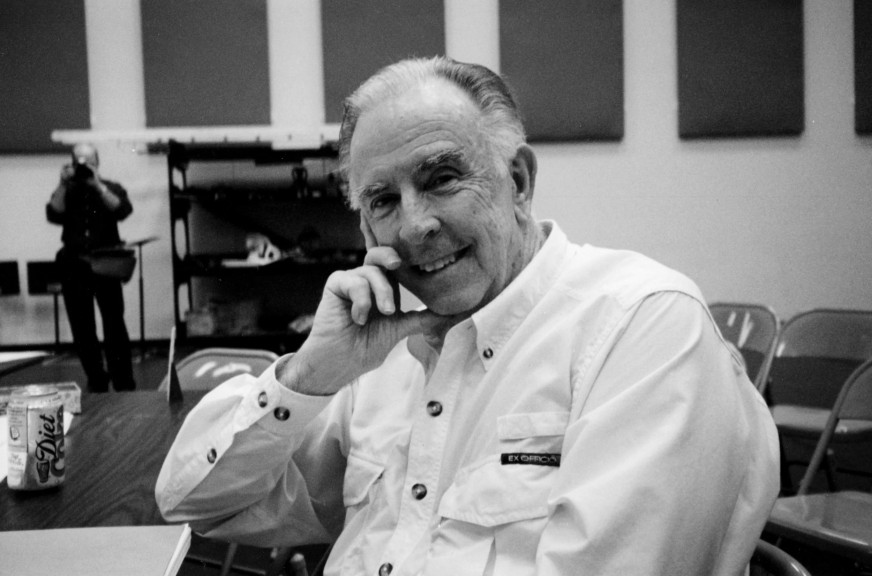
Composer Carlisle Floyd carlislefloyd.org
“With a commitment that rivals Smetana's in Bohemia or Britten's in Britain, [Floyd] has striven to create a national repertory … He has learned the international language of successful opera in order to speak it in his own accents and to enrich it with the musical and vernacular idioms of his own country.” — Andrew Porter, The New Yorker
June 11, 2026, would have been composer Carlisle Floyd’s 100th birthday. The late composer, who died on September 30, 2021, at age 95, was a defining figure of 20th-century American opera, making his mark as both a composer and a librettist with operas that champion rural American themes, characters, and vernacular music. Read on to learn more about the “Father of American Opera” in his centenary year and to listen to select excerpts from his operas.
Carlisle Floyd was born on June 11, 1926, in Latta, South Carolina. As a child, he moved around to various small towns in South Carolina with his itinerant preacher father. This upbringing inspired many of his operas, both in terms of their thematic content and integration of musical idioms from the American South. His mother was also an influential figure, acting as his first piano teacher and encouraging his love of writing.
He studied piano with Ernst Bacon at Converse College in Spartanburg, South Carolina, and later followed him to Syracuse University, where he subsequently earned his Bachelor of Music and Master of Music degrees. In 1947, Floyd was appointed to the piano faculty at Florida State University, where he taught piano and eventually composition for the next 30 years. He later taught at the University of Houston from 1976 to 1996. During this time, he and David Gockley co-founded the Houston Grand Opera Studio, a young artist program that has trained generations of singers, conductors, directors, and composers.
He initially trained as a pianist but became interested in composition while at Syracuse University. Having won a competition for one-act plays as an undergraduate, he was especially drawn to opera, which blended his dual love of music and writing. His breakthrough came in 1955 with his third opera, Susannah, which has since become one of the most frequently performed American operas of all time.
Susannah is loosely based on the Apocryphal story of Susanna and the Elders from the Book of Daniel. In his libretto, Floyd transfers the story from ancient Israel to a small town in the hills of Tennessee. The opera is about a beautiful young woman named Susannah who is unjustly accused of promiscuity by her community. Olin Blitch, a traveling revivalist preacher who has whipped the town into a religious frenzy, comes to pray for her soul but later rapes her. He begs for forgiveness, but she refuses. When Susannah’s brother, Sam, discovers what happened, he kills Blitch. A mob of townspeople comes after Susannah, but she fends them off with a shotgun, effectively isolating her from her community.
In writing the libretto, Floyd drew on his upbringing as the son of a Methodist preacher and the religious bigotry he encountered. As he told the New York Times in 1998, “The thing that horrified me already as a child about revival meetings was mass coercion, people being forced to conform to something against their will without ever knowing what they were being asked to confess or receive.” The political context in which the opera was written also influenced Floyd’s choice of story. Written at the height of McCarthyism, the opera deals with an insular community of people who are afraid of people who are different from them.
Floyd integrates the music of his youth into the score, weaving in revival meeting hymns, square dances, and folk music. Notable musical moments include Blitch’s revival scene and Susannah’s folk-song-like aria in Act II, “The Trees on the Mountain.” Susannah’s sweepingly lyrical Act I aria, “Ain’t It a Pretty Night,” in which Susannah dreams of a bigger life away from her tiny town, has also found immense popularity among sopranos.
Susannah launched Floyd into national prominence, earning him a Guggenheim Fellowship in 1956. It was also submitted to the Brussels World Fair in 1958 as an outstanding example of American opera. Despite its popularity among audiences and regional companies, the East Coast musical elite dismissed Floyd’s music as too musically accessible and lacking in substance. Floyd paid these criticisms no heed, telling Opera News in 1999, “A lot of critics don’t like to acknowledge that there are no absolutes in taste, which is intensely personal and which governs a composer’s choice of idiom.” Finally, after over 800 performances at regional companies across the country, Susannah had its Metropolitan Opera premiere in 1999 in a landmark production starring Renée Fleming, Sam Ramey, and Jerry Hadley.
Throughout Floyd’s career, he returned to similar themes and settings in his opera librettos. Nearly all of his operas are set in the American South, from rural Appalachia to Reconstruction-era South Carolina and a small town in Georgia, drawing on regional themes. Most are based on literary classics, and many present penetrating social commentary.
Floyd’s next enduring operatic success came in 1969 with Of Mice and Men, based on the novella by John Steinbeck about two migrant farm workers during the Dust Bowl. In 2000, he composed Cold Sassy Tree, based on a novel by Olive Ann Burns about a relationship between an elderly widower and a much younger northern woman that scandalizes a small Georgia town at the turn of the 20th century.
Marking a departure from his previous work, his final opera is set in England. Prince of Players (2016) is an adaptation of a Jeffrey Hatcher play about the last male actor in Restoration England to play female roles on London stages before Charles II outlawed the practice. This choice of subject matter reveals that even at 90 years old, Floyd was highly attuned to contemporary issues surrounding gender identity and sexual orientation.
Although Floyd is largely known for his 12 operas, he also composed a number of non-operatic works, including solo and choral song cycles, piano music, and symphonic movements. He was inducted into the American Academy of Arts and Letters in 2001 and was awarded the National Medal of Arts in 2004 by President George W. Bush.
In honor of Floyd’s centenary, over 30 productions of Floyd’s operas will be staged during the 2025–26 and 2026–27 seasons, including a production of Susannah at Lyric Opera of Chicago in April 2027. On June 20, Carnegie Hall is mounting A Grand Concert Honoring the Father of American Opera, with world-renowned singers, orchestral musicians, and the choirs of the University of Houston and FSU performing selections from Floyd’s operas.