








Celebrating Women’s History Through Music
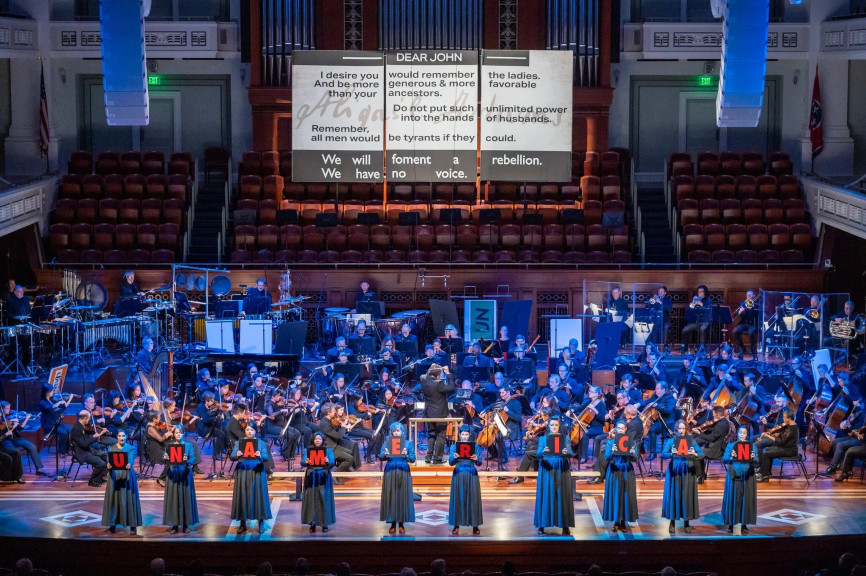
Members of Lorelei Ensemble, front, with the Nashville Symphony in the premiere of Julia Wolfe's “Her Story.” Kurt Heinecke
To commemorate Women’s History Month, we’re introducing you to five pieces of contemporary classical music that tell women’s stories in some way, whether commemorating women’s suffrage, meditating on the #MeToo movement, or honoring notable women. Read on to learn about these musical selections by Reena Esmail, Joan Tower, Julia Wolfe, Valerie Coleman, and Judith Weir.
Reena Esmail – Black Iris
“I always get asked why there aren’t more women composers,” composer Reena Esmail (b. 1983) said. “This piece is one response —of many hundreds of responses—to that question.” Originally titled #metoo, Esmail’s 2018 composition Black Iris is a response to her own experience of sexual abuse and the experiences too many other women in the music industry face. “So many of us decide to become composers when we are young women because we fall deeply in love with individual pieces of music . . . And then at some point, for some of us, as we engage with that music, something devastating happens to us—often by the very person who has introduced us to that music.”
To ensure the piece endured long after the #MeToo movement had passed from the public conversation, Esmail decided to retitle the piece Black Iris after a 1926 oil painting by Georgia O’Keeffe. Cast in a palette of purples and grays, the work features light petals on top and dark petals underneath, which Esmail said resonated with the experience on which this piece is based.
Black Iris draws on Esmail’s background as an American-born child of Indian parents. She weaves in a traditional Hindustani form called a “bandish,” a short melody that is intended to be improvised over. It is set in a raag that, to Western ears, constantly shifts between major and minor tonalities, reflecting the darkness and light of the painting. Esmail calls this bandish the “protagonist” of the piece, “a woman who is trying to navigate through a world filled with pitfalls, dead ends, dark turns—each time finding the way back to her own, individual, powerful voice.”
After a declamatory start, a nervous undulating figure in the marimba and strings sets the tone of unease. Eventually, the bandish attempts to break through the cloud of whirring melodic and rhythmic fragments. The perpetual motion is brought to a halt with a violent flourish. Over a held violin note, the women of the orchestra begin to sing, intoning an open fifth. They enter one by one in the order in which they joined the orchestra, crescendoing with each added voice. Meanwhile, a poignant lyrical duet between the cello and English horn can be heard.
Joan Tower – 1920/2019
In 2019, the New York Philharmonic commissioned Joan Tower (b. 1938) to compose a piece as part of the orchestra’s Project 19—an initiative to commission 19 new works by women composers in honor of the centennial of the passage of the Nineteenth Amendment, which enshrined women’s right to vote in the United States Constitution. Project 19 is the single largest commission project for female composers in history.
In composing 1920/2019, Tower took inspiration from the premise of the commission itself. “I began writing this music in 2019 as the #MeToo movement continued to grow,” she explains in her program note. “Victims of sexual abuse, assault, and harassment are ending their silence, finding strength by sharing their experiences and beliefs. These two years—1920 and 2019—were probably the two most historically significant years for the advancement of women in society.”
While nothing in the work points to any specific events in the fight for women’s rights over the last century, the recurring five-note rising motif and other ascending figures amid blocks of heavy chords signify a constant struggle upwards. Tower contrasts the density of the opening figure with sparser sections that highlight different solo instruments, including those within the percussion section. Tower explains that 1920/2019 is “largely about rhythm and texture . . . set in a dramatic and organic narrative.” Regardless of any programmatic intent, it is difficult not to hear the floating violin solo at the end as suggesting the promise of a better future.
Julia Wolfe – Her Story
Julia Wolfe’s (b. 1958) Her Story also arose from a commission to celebrate the 100th anniversary of women’s suffrage. When Beth Willer, the artistic director of the Lorelei Ensemble, approached Wolfe with the idea, she was initially hesitant. “I knew there was going to be a lot of attention paid to suffrage, a very important moment in American history and history all over the world, but I didn’t want to limit it to that anniversary year,” Wolfe told NPR. “It’s just one important moment in a very long conversation, a very long battle for equality.”
The resulting 45-minute semi-staged oratorio for orchestra and 10 women’s voices mixes history with documentary storytelling, using the words of historical figures to highlight the ongoing struggle for equal rights for women in America. Words from First Lady Abigail Adams and abolitionist Sojourner Truth bookend the work, demonstrating the centuries-long struggle. “Though we have yet to ratify the Equal Rights Amendment, women have been battling for equality from the beginning of the nation,” Wolfe writes in her program note. “Her Story captures the passion and perseverance of women refusing subordination, demanding representation, and challenging the prejudice and power structures that have limited women’s voices.”
Her Story premiered at the Nashville Symphony in 2022 with the Lorelei Ensemble conducted by Giancarlo Guerrero, with stage direction by Anne Kauffman, scenic design by Jeff Sugg, and production by Bang on a Can. Lorelei then took the show to five other symphony orchestras across the country.
Watch Her Story performed by the Lorelei Ensemble and the Boston Symphony Orchestra here.
Valerie Coleman – Phenomenal Women
Valerie Coleman (b. 1970) wrote Phenomenal Women, a six-movement concerto grosso for wind quintet and chamber orchestra in 2018. Inspired by Maya Angelou’s poem “Phenomenal Women,” first published in And Still I Rise in 1978, the work celebrates five influential women who have overcome adversity with grace: poet Maya Angelou, NASA mathematician Katherine Johnson, tennis star Serena Williams, First Lady Michelle Obama, and Olympic boxer Claressa Shields, who has brought greater awareness to the water crisis in her hometown of Flint, Michigan. The commonality between these women, Coleman said, is that “They figured out a way through their own determination to not only persevere through [adversity] but thrive.”
Although containing no lyrics, the first movement traverses Angelou’s poetry, from “Still I Rise” to “I Know Why the Caged Bird Sings” to the eponymous poem. Coleman deploys subtle tone painting in her portraits. For instance, “Serena” captures the percussive thwack of a tennis ball, while staccato oboe notes in “Katherine” stream like binary code before the spaceship eventually lifts off. In the middle of these character portraits is “Caravana,” which is dedicated to the migrant women walking in caravans across the southern border. In this movement, the solo flute plays a two-note figure reminiscent of Brahms’s Lullaby in a poignant reminder of the migrant mothers’ heartbreak at being separated from their children.
Judith Weir – woman.life.song
Operatic diva Jessye Norman believed there was not enough music written by women and about women’s stories in the art song repertoire. So, she approached composer Judith Weir (b. 1954) and three eminent poets—Toni Morrison, Maya Angelou, and Clarissa Pinkola Estés—to write a song-cycle to fill this gap. The resulting work, woman.life.song, premiered in 2000 at Carnegie Hall in New York. It was originally scored for voice and a 19-piece chamber ensemble (3 flutes, 3 clarinets, 3 percussionists, piano, guitar, harp, and 7 strings). However, to make it easier to program, Weir rearranged the work for voice and piano in 2020, which has allowed it to be performed more frequently in recent years. That said, the 45-minute piece that resulted from the massive libretto is a daunting task for any one singer to take on, regardless of accompaniment.
Divided into seven songs, the cycle traces the life story of a woman from girlhood, through maturity, to old age, bookended with prose by Maya Angelou. The songs meditate on themes of innocence, love, temptation, and loss. “In musical terms,” Weir explains in her program note, “I have attempted to suggest the progression of a life story through harmony which increases in complexity and an instrumental palette which becomes deeper and richer as the song-cycle approaches its end.”
The full libretto can be found here.