Composer Ilya Demutsky scores new “Eugene Onegin” ballet
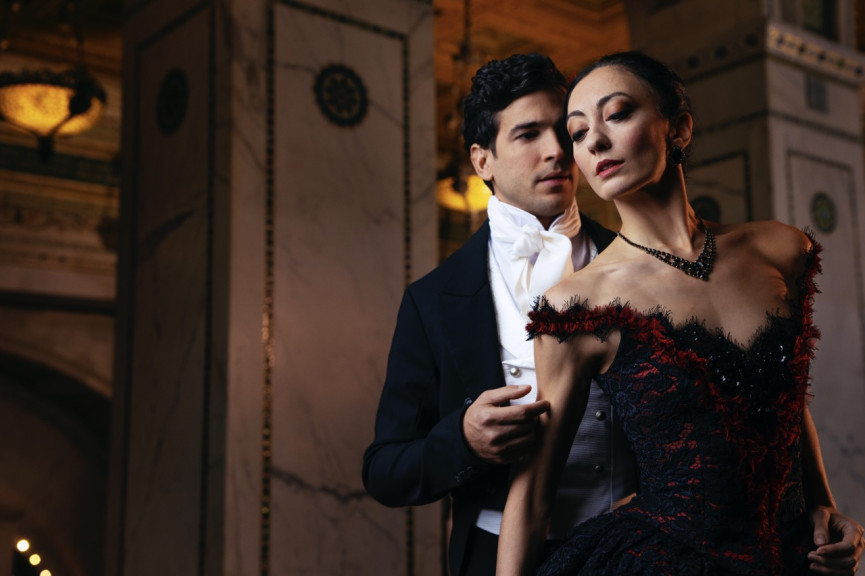
Company Artists Victoria Jaiani and Alberto Velazquez. Photo by Todd Rosenberg for The Joffrey Ballet.
The Joffrey Ballet concludes its 2025–26 season with the highly anticipated Chicago premiere of Yuri Possokhov’s Eugene Onegin. A co-production between The Joffrey Ballet and San Francisco Ballet, Eugene Onegin had its world premiere in San Francisco in January and comes to Chicago’s Lyric Opera House for ten performances from June 4 to 14.
A former principal dancer with the San Francisco Ballet, Royal Danish Ballet, and Bolshoi Ballet, Yuri Possokhov is now a frequent guest choreographer of the Joffrey. In the hopes that lightning strikes twice, Eugene Onegin reunites Possokhov with the creative team behind his celebrated ballet Anna Karenina, which was co-commissioned by the Joffrey in 2019 and revived in 2023.
Among the creatives returning is award-winning composer Ilya Demutsky, who has become a leading figure in the world of ballet and a frequent collaborator of Possokhov. Central Illinoisians may know Demutsky’s work from his time as a George A. Miller Visiting Artist at the University of Illinois’ Center for Advanced Study in 2023–24. His opera Black Square premiered at the Krannert Center for the Performing Arts in 2024.
There have been other notable theatrical adaptations of Pushkin’s verse novel—Tchaikovsky’s 1878 opera most famous among them. In 1965, choreographer John Cranko created a three-act ballet based on Eugene Onegin, using orchestral arrangements of Tchaikovsky’s piano pieces as the score. Suffice it to say, the music of Tchaikovsky has become linked with this iconic work of Russian literature, so composing a new, original score for Possokhov’s ballet was no mean feat.
Fortunately, Demutsky was up to the task. In a preview event and panel discussion about the ballet, Joffrey Music Director Scott Speck sang his praises: “I firmly believe if Tchaikovsky were alive today, he’d be writing like Ilya because he’s got the same sense of drama, he’s got the same sense of line, and he has a gift for melody that you just don’t find anymore . . . This talented feel for the music, coupled with [Possokhov’s] incredible choreography, creates something that truly feels like magic.”
Possokhov echoed these sentiments, highlighting how difficult it is to find a composer you trust and get along with. He explained how he had worked on commissions with other composers in the past, with mixed results. But in Demutsky, he found a true partner. “It’s a gift from God that I met Ilya Demutsky,” he said. He especially appreciated the composer’s flexibility, agreeing to add or subtract music from the score at the last minute to meet the needs of the drama and choreography.
While Demutsky was not in attendance at the panel discussion, he kindly agreed to answer some questions over email. Read on to learn more about his score for Eugene Onegin, his approach to composing for ballet, and his time at the University of Illinois.
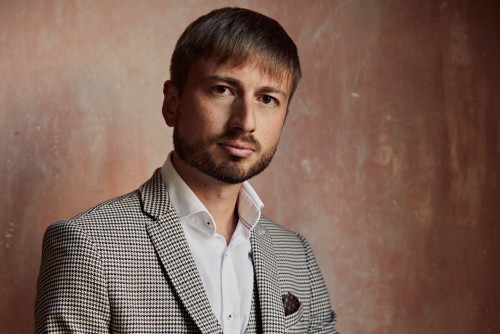
KB: When did the idea for this new ballet of Eugene Onegin come about, and how did you become involved in it?
ID: The idea emerged shortly after the premiere of our ballet Anna Karenina. As I understand it, Ashley Wheater, the artistic director of the Joffrey Ballet and a great admirer of Russian literature, became interested in turning to Pushkin after the success of that production.
Since Yuri Possokhov and I had already collaborated on several ballets, it was quite natural that he invited me to join the project. At first, I approached the idea cautiously. The cultural weight of Pushkin’s novel and Tchaikovsky’s opera is enormous. But once the creative team came together and the dramaturgical structure of the ballet began to take shape, the process became very organic.
KB: How has this collaboration with Yuri Possokhov compared with previous projects?
ID: By the time we began working on Eugene Onegin, Yuri and I already understood each other almost instinctively. This was our seventh ballet together, and over the years our collaboration had grown into one built on absolute trust.
What remains constant in our work is a clear division of artistic responsibilities. Yuri never interferes with orchestration or musical form, just as I do not interfere with choreography. But emotionally and dramaturgically we are always in close dialogue.
In Onegin, perhaps more than in some earlier projects, there was a shared understanding that restraint mattered. The emotional world of Pushkin's characters is very subtle, and we both wanted to avoid unnecessary theatrical excess. That demanded particular precision from both choreography and music.
KB: How would you describe your score? Are there musical motifs or themes that recur throughout the ballet that denote certain emotions or characters?
ID: The score is built around continuous emotional development rather than fixed musical “labels” for characters.
I do use leitmotif principles, but they are rarely attached directly to individual characters. More often they are connected to emotional states or ideas—love, distance, inner tension, loss. What matters to me is that these states are constantly evolving alongside the dramaturgy.
Musically, the score combines a fairly large symphonic scale with moments of intimacy and transparency. Since the story unfolds through memory, longing, and emotional displacement, the music often develops in long arcs rather than sharply contrasting numbers.
KB: Tchaikovsky is inextricably linked with the story of Eugene Onegin, both for his 1879 operatic adaptation and the 1965 ballet by Cranko. How much of Tchaikovsky’s voice was in your ear when you were composing this new ballet?
ID: It would have been impossible to approach Onegin while pretending Tchaikovsky did not exist. His opera is too monumental and too deeply embedded in cultural consciousness.
At the same time, I consciously avoided any direct musical dialogue with him. For me, the ballet needed its own musical language and dramaturgical structure. The influence of Tchaikovsky exists more as a distant emotional and cultural presence than as a concrete musical reference.
Of course, one cannot completely escape the broader Russian musical tradition, especially when dealing with Pushkin. But stylistically and compositionally, I was searching for my own path through the material rather than attempting to continue an existing lineage.
KB: What about the genre of ballet appeals to you as a composer? Does your compositional style or approach change when composing for ballet versus other genres?
ID: What attracts me most is that ballet allows music to exist physically, through movement. In ballet, music is not simply heard—it is embodied.
At the same time, writing for ballet requires a particular balance between complexity and clarity. The music must retain its internal logic and depth, but it also has to function practically: for dancers, for rehearsal processes, for stage timing.
My musical language itself does not fundamentally change between genres, but the way I think about form certainly does. In ballet, form is inseparable from dramaturgy and physical time. Music must breathe with movement and stage action.
KB: Our readers might have heard your work when you collaborated with Lyric Theatre @ Illinois several years ago. Can you tell us more about this experience?
ID: I have a long and very warm relationship with the University of Illinois and Lyric Theatre @ Illinois. Over the years, our collaboration grew into a close artistic friendship.
In 2017, we presented a workshop of my opera Black Square there, and in 2024 the university mounted a fully staged production of the work. It is an extraordinary theatre and opera department, with truly impressive artistic and technical resources that often feel almost limitless for contemporary music theatre projects.
What I especially value is their openness to new work and their seriousness in approaching contemporary repertoire. We definitely plan to continue collaborating in the future.
***
The Joffrey Ballet presents Eugene Onegin from Thursday, June 4, to Sunday, June 14, 2026.