








Composer Profile: Julia Perry
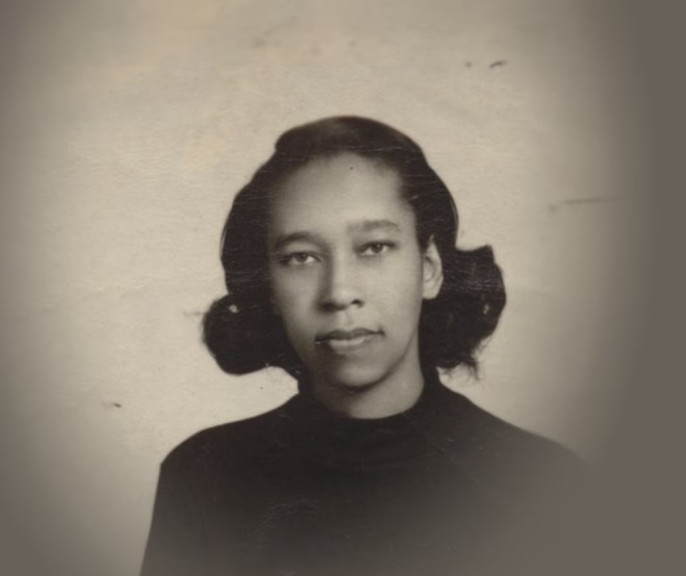
Julia Perry was born in 1924 in Lexington, Kentucky. She was the fourth of five girls born to Dr. Abraham and America Perry. The Perrys were an upper-middle-class African American family who encouraged her musical ambitions. She spent most of her childhood in Akron, Ohio, where she studied violin, voice, and piano. After earning her bachelor’s and master’s degrees from Westminster Choir College, she took courses at Juilliard, Curtis, and Tanglewood. An accomplished singer, she initially focused on writing songs and choral music.
Her breakout composition was Stabat Mater (1951), a work for contralto and string orchestra. The piece earned her two Guggenheim fellowships, which enabled her to travel to Europe in the early 1950s for further study. There, she studied with modernist composer Luigi Dallapiccola in Florence, Italy, and Nadia Boulanger in Paris. Later, she performed, conducted, and lectured throughout Europe as an ambassador for the U.S. Information Agency, conducting ensembles as prestigious as the BBC Philharmonic and Vienna Philharmonic.
One of Perry’s most notable works from this period is A Short Piece for Orchestra (also known as Study for Orchestra), which she composed in 1952 while studying with Dallapiccola. A Short Piece is marked by striking contrasts, rhythmic complexity, and the development of small motivic cells. The piece vacillates between the aggressive angularity of the opening figure and more meditative, haunting sections, first heard in the solo flute. A Short Piece made history in 1965 when it became the first piece by a woman of color to be performed and recorded live by the New York Philharmonic.
Despite her successes in Europe, numerous awards, and favorable reviews, Perry struggled to break through in the predominantly white (and predominantly male) classical music world. She was unable to attend the New York Philharmonic’s performance of A Short Piece due to her precarious financial situation, even though the Philharmonic offered to cover her travel. Having moved back in with her mother in Akron, Ohio, she sent a telegram to the Philharmonic in 1965 that read, “Unemployed at this time I am without the barest essentials.”
Her career was further stymied by a series of strokes in the early 1970s, which left her paralyzed on her right side. She taught herself how to write with her left hand so she could continue to compose, but the process was arduous, and she never recaptured her earlier success. Tragically, she died in obscurity in 1979 at the age of 55. When she died, only a handful of her compositions had been published or recorded.
Although she is still relatively unknown today, recent efforts by musicologists and performers have begun to restore her legacy. Scholars have identified around 100 manuscripts and scores, including a dozen symphonies, several concertos, three operas, and a ballet. However, most of her catalogue cannot be performed due to a lack of an established copyright holder, as she left behind no heirs or estate. A few years ago, Christopher Wilkins, music director of the Akron Symphony, began the process of resolving the legal ambiguities surrounding the rights to Perry’s music. Without identifying an heir, performers would have to wait until Perry’s work enters the public domain in 2049.
In 2024, there was finally a resolution, and the estate was able to assign all copyrights for Perry’s unpublished music to Videmus Inc., led by Dr. Louise Toppin. Videmus has since partnered with music publishing giant Boosey & Hawkes to bring Perry’s music to the world. According to the press release, Perry’s catalogue will be released across multiple years and includes a broad range of works for orchestra, choir, and chamber ensemble as well as songs and piano music.
More information about Perry and her works can be found on The Julia Perry Project, a website launched by the Wilkins and the Akron Symphony. You can also read up on the concerts and events that took place around Perry’s centenary in 2024 at icareifyoulisten.com.