








CUSO and UI Choruses Unite for Verdi’s Requiem
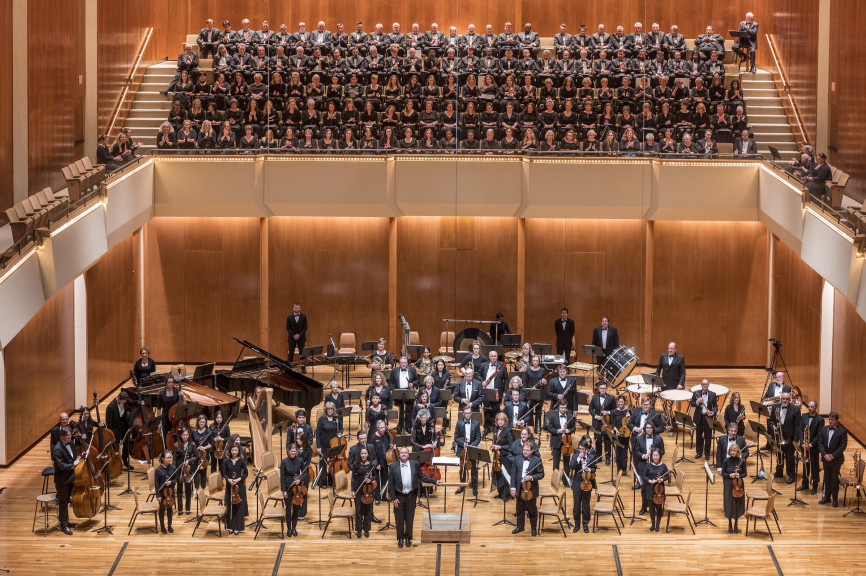
The Champaign-Urbana Symphony Orchestra under Music Director Stephen Alltop PC: Darrell Hoemann
On Saturday, May 2, the combined choruses of the University of Illinois join forces with the Champaign-Urbana Symphony Orchestra to perform Giuseppe Verdi’s Requiem at the Krannert Center for the Performing Arts. We spoke with Stephen Alltop, music director of the CUSO, to learn more about this powerful masterwork of the choral repertoire.
Part of what makes Verdi’s Requiem so powerful is the sheer sonic impact of the orchestra and chorus. In fact, it is often referred to as the “best opera Verdi never wrote” for its high drama and large forces. The chorus for this performance will boast over 250 singers, drawn from the combined choirs of the University of Illinois Meredith Chamber Singers, Women’s Glee Club, Oratorio Society, and Varsity Men’s Glee Club. This will be the largest choir in recent memory to perform with the CUSO. (The last time the CUSO performed Verdi’s Requiem in 2017, the choir was composed of the Oratorio Society and the Chamber Singers.)
Is that too many singers? Not for Alltop. “The piece can absolutely take that amount,” he said. “The orchestra is very full, and the hall is very live. Hopefully, I won’t have to temper the orchestra as much in those big places, [so] we can let the orchestra play and the choir will still be heard.”
Yet, Alltop stresses that Verdi’s Requiem is in more than just the famous loud sections, such as the “Dies Irae,” with its fearsome evocation of the Day of Judgement. “I once did an exhaustive analysis of the piece that shows that more of the piece is soft than loud, and that includes for the soloists,” he said. “I learned just how important it is to have sufficient time with a solo quartet to rehearse them so they’re cohesive. They’re really like a second choir in the piece. A lot of people just go find the four biggest voices that they can when, in fact, there’s so much evidence that Verdi was looking for very flexible voices that could sing quite soft.”
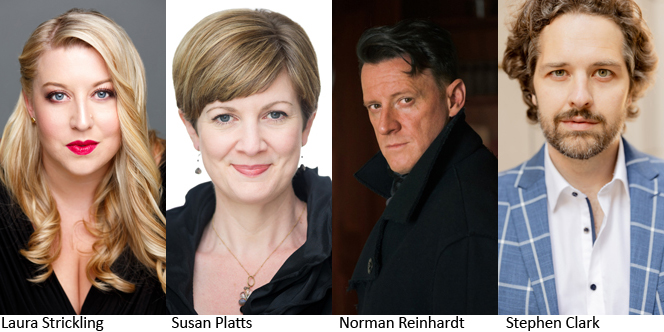
The four soloists will be soprano Laura Strickling, mezzo-soprano Susan Platts, tenor Norman Reinhardt, and bass Stephen Clark. For Clark, this will be his first time performing Verdi’s Requiem. “The Verdi Requiem is always one of those pieces you hope you get a chance to do,” he said. “A lot of bass parts tend to be smaller roles, like an afterthought, and you don’t always feel like you have an equal seat at the table with the other performers. But this Requiem is such a good example of an ensemble show: everyone (the orchestra, the chorus, and each of the soloists) all take turns getting these great moments to bring Verdi’s score to life.”
Like Alltop, Clark stressed that it’s the variation within Verdi’s score that makes it so compelling for singers. “I think Verdi so often challenges a singer’s dynamic and dramatic range,” he said. “Not only representing the loud, dramatic moments and the softer, more introspective parts, but transitioning between them without losing the inherent beauty and intensity within the piece. And I think it’s that challenge that makes it so thrilling and exciting to perform.”
Alltop has conducted Verdi’s Requiem about half a dozen times, as well as taught the piece to his students at Northwestern University. He said he learns something new each time he revisits it. With so many moving parts—between the soloists, choir, orchestra, an offstage brass—Alltop has found that leading with the text is the most effective strategy for cohesion. “The orchestra has to learn how to match their sound to the chorus and to play with a sense of text in their instruments, even though they don’t have the text,” he explained. “This is what I consider my highest calling—putting these choral works together in such a way that the text is preeminent, that the orchestra is very cohesive with the singers, and that the singers are very cohesive with the orchestra.”
Achieving the right balance between the orchestra and chorus is Alltop’s top priority so that the text can always be heard. Another challenge is ensuring the contrapuntally intricate sections are brilliant and exciting, but the ensemble is spot on. The Sanctus, which he likens to something from Verdi’s opera Falstaff, is a prime example of this, with the chorus divided into eight voice parts in a blistering fugue.
While they might seem musically simple on the surface, some of the most difficult sections are the quiet moments of choral plainchant—both in getting them together musically and setting and maintaining the right atmosphere. “You want to have a great sense of solemnity at the end when you’re leading this plainchant,” Alltop said. “The sense of drama and just the sense of wonder and awe at the end of the piece is remarkable, and you have to guide it the right way.”
“If there was ever a piece of music where the music continues well past the last sound, it’s Verdi’s Requiem,” he continued. The silence at the end of the piece is “a sacred moment, and it should go on for a long time,” he says. “One of the mysteries of music is the way it does that with people up there and the way we just kind of hold this in our souls.”
The Verdi Requiem is always emotionally impactful, regardless of one’s religious beliefs, but Alltop believes it will resonate with audiences even more in today’s climate. “I think particularly in our world at the moment, there are unfortunately a lot of reasons to do a requiem,” he said. “I mean, there always are, but especially at the moment. And I don’t think there’s been a time where truly profound music makes more of an impact than it has been of late. People are thirsting for that, and that thirst can really be quenched going through a performance like this.”
Don’t miss Verdi’s Requiem performed by the Champaign-Urbana Symphony Orchestra and University of Illinois choirs conducted by Stephen Alltop on Saturday, May 2, at 7:30 pm at the Krannert Center for the Performing Arts. Plus, watch this space for the CUSO’s announcement of the 2026–27 season, which Alltop assures us will be filled with even more musical barnstormers.