Five Cities Baroque Festival Returns for Fourth Year
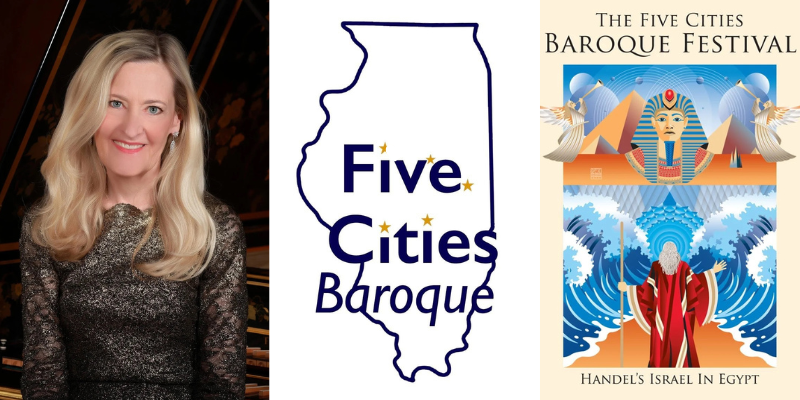
Artwork for Handel's "Israel in Egypt" by Rex Parker in memory of Katherine DeMoss Brown
Now in its fourth year, the Five Cities Baroque Festival returns June 16–21, bringing artists from around the region and beyond to perform in venues across central Illinois. This season features Handel’s epic oratorio Israel in Egypt, as well as a recital by renowned harpsichordist Charlotte Mattax Moersch and the festival’s first-ever collaboration with the Baroque Artists of Champaign-Urbana. We spoke with the festival’s founding director and principal conductor, Nate Widelitz, to learn more about this year’s festival.
The Five Cities Baroque Foundation and Festival was established in 2023 to bring free, world-class performances of 17th- and 18th- century music to communities in central Illinois. The mission is to provide access to great music to communities outside of the major urban hubs in the Midwest as well as partner with musical and educational institutions in the area.
This season begins with the festival’s first-ever partnership with the Baroque Artists of Champaign-Urbana (BACH), a stalwart of the early music scene in central Illinois since its founding in 1996. “We’re very excited to, after years of discussion, finally be able to feature them as beloved fixtures of baroque music in the region,” Widelitz said.
The program, selected in collaboration with BACH Music Director Dr. Sarah Riskind, will feature two Bach cantatas, BWV 106: Actus Tragicus (“Gottes Zeit”) and BWV 18: “Gleich wie der Regen und Schnee vom Himmel fällt,” alongside works by Heinrich Schütz, Salomone Rossi, and Alonso Lobo. The concert will take place on Tuesday, June 16, at Faith Methodist Church in Champaign and will feature the BACH choir, a small orchestra, and a quartet of vocal soloists.
“The BACH Choir singers and I are really looking forward to taking part in the Five Cities Baroque Festival for the first time,” Riskind said over email. “I have enjoyed collaborating with Nate in putting the program together, and it will be a great opportunity to share the conducting role with him in this performance as well!”
On Thursday, June 18, the festival’s resident artist this year, harpsichordist Charlotte Mattax Moersch, will present a program of solo harpsichord repertoire at The Church of the Exaltation of the Holy Cross in Champaign. Dr. Mattax Moersch is Professor Emerita of Harpsichord and Early Music at the University of Illinois Urbana-Champaign and is one of the world’s preeminent early music keyboardists.
Like the partnership with BACH, this collaboration has also been years in the making. “We are also very excited that we are featuring Charlotte Mattax Moersch as our featured artist this year,” Widelitz said. “She certainly needs no introduction, but she is just a stellar harpsichordist, and we’re so glad to be able to feature her in a solo recital this year after she joined us for some chamber music last year.”
Mattax Moersch’s recital will show off the expressive and colorful sounds of the harpsichord with solo works by Rameau, Couperin, Bach, and others. “The program centers around French program music, which has a narrative designed to evoke an idea or mood,” she said over email. “Through delicacy of texture and ornament, François Couperin’s miniatures explore universal themes of love and betrayal, while Jean-Philippe Rameau’s portraits use a theatrical harmonic palette to dramatize depictions of birds and exotic cultures. These gems are framed by improvisatory pieces of Louis Couperin and J.S. Bach that highlight the sonic grandeur of the harpsichord.”
The festival is continuing its mission to educate the next generation of baroque musicians through its young artist program. This year’s quartet of young artists will be soprano Lucy Tester, mezzo-soprano Aria Beert, tenor Filip Duda, and baritone Seth Hobi. In addition to receiving coaching from the festival’s musical leaders and singing in the choir for Handel’s Israel in Egypt, they will present a recital on Friday, June 19, at St. John's Episcopal Church of Decatur, accompanied by harpsichordist Chung-Ha Kim and cellist Amy Catron.
This year’s young artists are current students or recent graduates from universities across the region, including Illinois Wesleyan University, Wichita State University, the University of Notre Dame, and DePaul University. “We’re excited that that that geographical reach is expanding and bringing in some other amazing educational institutions to the program,” Widelitz said, indicating that the festival is gaining name recognition farther afield.
The festival will culminate in two performances of Handel’s epic oratorio Israel in Egypt at the Blessed Sacrament Church in Springfield on Saturday, June 20, and at First United Methodist Church in Decatur on Sunday, June 21. This is the first time the festival will perform the final concert in two separate locations, ensuring more people have the opportunity to attend.
A timeless classic that meditates on the themes of oppression, redemption, and freedom, Handel’s Israel in Egypt tells the famous story from Exodus of the Israelites’ enslavement in Egypt, the ten plagues, and the prophet Moses leading the Israelites to freedom.
“It’s a stunning piece of music and so much more dramatic than so many other oratorios by Handel,” Widelitz said when asked why he chose to program this piece. “Not that they lack their drama, but this oratorio in particular just runs the complete gamut in terms of expressivity and emotional depth and heights.” Adding to this drama is the oratorio’s vivid word painting, particularly of the plagues that descend upon Egypt (listen out for leaping frogs, buzzing flies, swarming locusts, and pounding hail).
Another reason Widelitz wanted to program this oratorio is the dazzling choral writing, which comprises the bulk of the piece. “Unlike many of his other oratorios, the chorus is the main character,” Widelitz added. “We’re very excited to have such a stunning chorus put together and to be able to feature them so prominently this year.” The festival’s 24-person professional chorus features many returning artists from previous years—a testament to the high musical standard and collegial atmosphere Widelitz has cultivated over the last four years. Soloists will be drawn from the chorus for the relatively few solo arias in the oratorio.
Since last year’s festival, Widelitz has left his position as Associate Director of Choral Activities at Millikin University in Decatur. He relocated to the San Francisco Bay Area in September 2025, where he serves as Artistic Director of both the California Bach Society and the Stockton Chorale. Although this has made organizing the Five Cities Baroque Festival more difficult, he remains committed to its success and passionate about its mission.
“With my own relocation outside the area, it has certainly taken a big team effort to make another festival happen, including all the planning work, all of the community outreach, all of the partnerships that we’ve tried to cultivate,” Widelitz said. This year, they have hired LJ Pemberton to serve as Assistant Director of the foundation. She has taken on some of the administrative load and helped publicize the Festival’s initiatives. They have also expanded the board of directors and have a dedicated team of volunteers on the ground.
“I am certainly very excited to return,” Widelitz expressed. “It was not an easy decision to make the move. There are so many people [in central Illinois] who were not only so supportive and generous of this venture, but who I really grew close to on a personal level. So I’m very excited to see them, and I’m so excited to make music again with so many of the people that I’ve been making music with for years now.”
Amid the rising cost of living, Widelitz feels it is especially crucial to offer access to world-class musical performances free of charge, as the Five Cities Baroque Festival has done since its inception. “I am more of a believer now than ever of the importance of projects like this, which break down barriers to access to great music and are truly grassroots community projects,” he said. “It seems like we say this every year. Every year seems to get just a little bit harder for ordinary folks, and the access to great things like this seem to shrink year by year. So, keeping this project going and even expanding it is more important than ever.”
For more information about the 2026 Five Cities Baroque Festival, visit fivecitiesbaroque.org.