








Jupiter String Quartet Welcomes New Violinist, Mélanie Clapiès
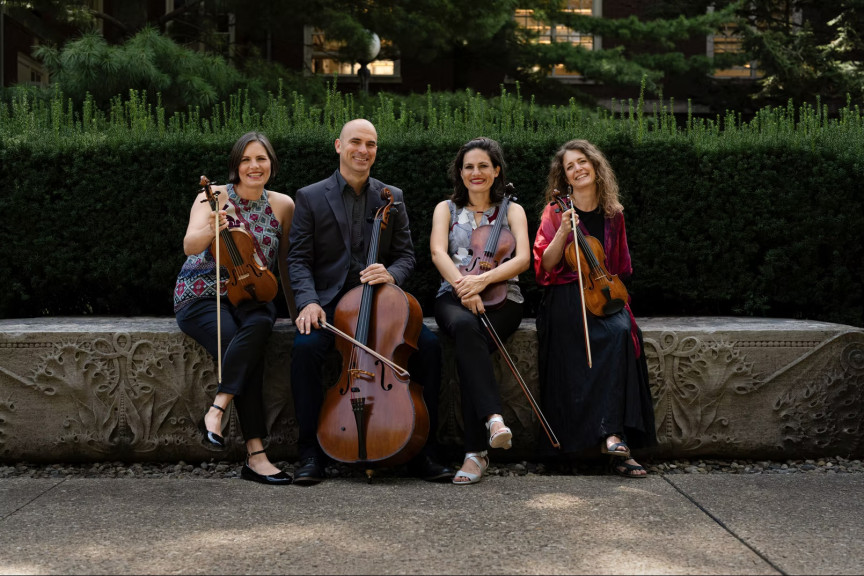
The Jupiter String Quartet, Mélanie Clapiès, right. Todd Rosenberg
When Dr. Mélanie Clapiès was hired as first violinist of the Jupiter String Quartet last fall, she stepped into an unusually close-knit ensemble. The quartet was founded in 2001 by violinists Nelson Lee and Meg Freivogel, violist Liz Freivogel (Meg’s older sister), and cellist Daniel McDonough (Meg’s husband, Liz’s brother-in-law). Since 2012, the Jupiter String Quartet has been in residence at the University of Illinois Urbana-Champaign. When first violinist Nelson Lee departed the group in September 2025 to take a position at McGill University in Montréal, it marked the first personnel change in the quartet’s 24-year history.
Joining an already established string quartet is daunting enough, let alone one that is so intimately connected. “It’s scary and it's also wonderful,” Clapiès said. Despite the challenge, she says it’s been “a very positive change” in her life, both professionally and personally.
Clapiès comes to Champaign-Urbana most recently from Indianapolis, where she was on faculty at Butler University, though she has taught and performed around the world. Born in Paris, Clapiès studied at the Conservatoires Nationaux Supérieurs de Musique in Lyon and Paris before moving to the United States, where she earned her MM and AD at the Yale School of Music and her DMA at the Manhattan School of Music. As a soloist and chamber musician, she has appeared at festivals in the US, France, the UK, Russia, Malta, Italy, Spain, Algeria, and New Zealand. She previously taught at the conservatories in Toulon and Bordeaux, and the École Normale de Musique in Paris.
Having spent most of her life in big cities, moving to Champaign-Urbana was an adjustment. However, she and her family are settling in well and enjoying what the area has to offer, from Urbana’s bikeable streets to Krannert Center’s wealth of diverse programming. “There is this dynamic that’s really wonderful here, so you never get bored,” she said.
When Clapiès was approached about auditioning for the Jupiter String Quartet last summer, she had not played with or even met any of the members before. However, as a seasoned chamber musician, she said it was a “lifelong dream” to join a string quartet, as long as it was with the right people. After a long phone call with violist Liz Freivogel to gauge her interest, Clapiès was invited to Urbana to audition with the group. She was asked to prepare seven or eight movements of different quartets, which she played and recorded with the quartet during her multi-day audition.
The phone call offering her the job came shortly afterwards. She had multiple factors to consider before accepting, especially as the mother of a toddler. Ultimately, it was the quartet's family-friendly attitude that sealed the deal. The other members also had children and were able to travel with them on tour, so she knew it would be a good fit for her and her family.
Five months in, Clapiès said they are still in the exciting “discovery period” as she finds her voice in the quartet. “So far it’s been really an amazing pleasure to play with them,” she said. They have had many different settings in which to get to know each other, from rehearsals and recording sessions to concerts and festivals.
When we spoke, Clapiès had just returned from the Adam Chamber Music Festival in Nelson, New Zealand, where the Jupiter String Quartet not only performed as a featured quartet but also collaborated with other festival participants. Clapiès cited playing Benjamin Britten’s Serenade for Tenor, Horn and Strings with Canadian tenor Colin Ainsworth as a highlight. They also led a masterclass and coached two young quartets. “It was very nice to feel that we’re passing on something to people who are really passionate about [chamber music],” she expressed.
Education is a crucial component of being in the Jupiter String Quartet—and it is something that runs in Clapiès’s blood. Coming from a family of teachers, “the idea of transmission has been always very central for me,” she explained. Joining the faculty of a large public university was therefore an attractive aspect of the job. As artists-in-residence at the University of Illinois, the Jupiter String Quartet directs the chamber music program, and each member maintains their own teaching studio.
On March 12, the Jupiter String Quartet will present its first concert at the Krannert Center for the Performing Arts in its new lineup. Titled Reverberations of Nature, the program highlights the connection between music and the wonders of nature. The concert will include String Quartet in C Major, Op. 33 No. 3 “The Bird” by Franz Joseph Haydn; Quartet No. 1 by Alberto Ginastera; and Quartet in F Major, Op. 59 No. 1 by Ludwig van Beethoven.
“Reverberations of Nature features three of our favorite works—the charmingly beautiful Haydn ‘Bird’ quartet, the brilliantly folksy first quartet of Alberto Ginastera, and one of Beethoven’s most epic quartets, Op. 59 No. 1,” the Jupiter Quartet said in a press release. “We hope the program will provide space for both reflective beauty and for celebratory energy in the listeners.”
Haydn’s C Major Quartet received its nickname, “The Bird,” from the opening chirping motif in the first violin and the insistent accompanimental pecking underneath, which pervades the whole piece. Ginastera’s rhythmically intense quartet also contains some references to bird calls, though its connection to nature is primarily through its folk elements, specifically the Argentinian folk figure of the “gaucho.” Set in the pastoral key of F Major, Beethoven’s Op. 59 No. 1 draws from the beauty and drama of the natural world.
“The Beethoven is a very big endeavor,” Clapiès said of the monumental quartet, the first of Beethoven’s famous “Razumovsky” quartets. She likens it to a journey through multiple scenes, from the pastoral landscapes of the first movement, through the lush Adagio, to the nonstop energy of the finale. Although they have already performed the Beethoven quartet several times, she said, “Every time we play it, it’s a new challenge.”
Because concert seasons are programmed far in advance, Clapiès did not have a hand in programming her first season with the Jupiter Quartet. However, as they start to plan their 2026–27 season, she will be able to put forward some ideas. Clapiès brings an interest in new, experimental, and electronic music as well as lesser-known works from the 20th century, which she hopes to introduce to the quartet. “I don’t think that we’re ready to do electronic music or anything like that,” she explained, but she wants to explore multimedia works as well as collaborations with artists, dancers, and others from various disciplines.
The Jupiter String Quartet performs Reverberations of Nature on Thursday, March 12, at the Krannert Center for the Performing Arts. For tickets and more information, visit Krannert Center’s website: https://krannertcenter.com/events/jupiter-string-quartet-5