








Millikin Opera Theatre Presents Pauline Viardot’s “Cinderella”
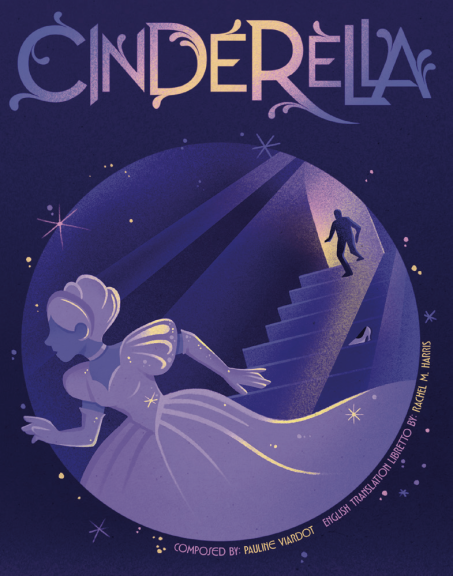
Millikin Opera Theatre presents Pauline Viardot’s Cinderella on May 1–3, co-produced with the School of Theatre & Dance, School of Music, and Millikin-Decatur Symphony Orchestra at the Virginia Rogers Theatre. We spoke with director Aubrey Hawkinson, Lecturer in Opera and Voice at Millikin University, to learn more about the opera and its composer.
Pauline Viardot (1821–1910) came from a family of accomplished musicians. Her father was Manuel García, an opera singer and teacher who is often considered the “father” of modern vocal technique and pedagogy. Pauline led an illustrious career as a mezzo-soprano, and later as a highly sought-after singing teacher. Although she never intended to be a composer professionally, she wrote music throughout her life and even studied with Franz Liszt as a young woman. She left behind over 100 songs as well as popular vocal arrangements of Chopin’s Mazurkas and five salon operas.
Composed in 1904 at the age of 83, Cinderella (or Cendrillon in the original French) was Viardot’s final opera. As with her previous salon operas, she intended Cinderella to serve as a pedagogical tool for her students, helping them learn the fundamentals of bel canto technique. Consequently, the music is very accessible, with catchy, sweeping melodies, simple harmonies, and melismatic passages that are friendly to young singers’ voices.
“When she wrote this opera, it wasn’t necessarily meant to be performed at all,” director Aubrey Hawkinson said. Hawkinson, a Lecturer in Opera and Voice at Millikin University, explained that the opera was instead meant to be performed by Viardot’s students in her living room. “Her works weren’t necessarily meant for public consumption in the way that you would see most operatic composers produce their operas.”
Given its original purpose as a teaching tool, the opera is a perfect choice for undergraduate voice students. “It has helped everybody’s vocal technique by far,” said Hawkinson, who has been on the voice faculty at Millikin for seven years. “I’m able to reinforce things from the studio that they’re learning in rehearsals.”
Although originally scored for piano accompaniment to suit its original intimate venue, Millikin Opera Theatre’s production of Cinderella will use a transcription for full orchestra by Rachel M. Harris. John Massaro will conduct the 23-piece orchestra made up of musicians from the Millikin-Decatur Symphony Orchestra, providing the students the rare opportunity to perform as a soloist with an orchestra—an experience many undergraduates do not get. The opera will also be performed in English with a new translation by Harris, making it accessible for audiences of all ages and experience levels.
The opera is in three short acts, running just over an hour. Despite its diminutive size, the production will be anything but. “This is going to be the biggest, grandest version of this tiny chamber opera,” Hawkinson said. “We have a movable set. We have a set that is Cinderella’s home, which breaks away to reveal the castle behind it. We have some magical lighting people who are going to do tremendous lighting effects for our magical fairy godmother, and the costumes are being made custom by the costume department here.”
Soprano Sarah Semon stars as Cinderella (Cendrillon), with Jack Fokkens as the Prince, Micah Gabriel as Baron Pictordu, Callie Francis and Bella Crank as the evil stepsisters, Morgan Reckamp as the fairy godmother (La Fée), and Cyrus Ditch as Barigoule. The libretto, which Viardot wrote herself, differs from the familiar Disney version in several key ways. Instead of an evil stepmother, there is a bumbling, clueless stepfather (Baron Pictordu). In addition, Cinderella first meets the Prince before the ball when he comes to their house disguised as a beggar. When she offers to help him, he falls in love with her for her kindness and generosity. The Prince again disguises himself at the ball, switching places with his valet, Barigoule. There, Cinderella falls in love with him, not for his noble status, but for his character, just as he fell in love with her not merely for her beauty.
“Pauline was very ahead of her time to portray this version of the story where the prince actually sees Cinderella before the ball,” Hawkinson said, and it’s actually closer to the original children’s story by Charles Perrault, written in 1697. “[The Prince] fell in love with her first before he sees the pretty girl at the ball…and she fell in love with him not for being a prince. I find that to be a highly modern love story.”
It is this take on the Cinderella story that made Hawkinson want to produce this opera. “One of the main things that drew me to this production specifically was the theme that Cinderella shows us that kindness can be a survival tactic—that it’s nice to be important, but it’s important to be nice,” she explained. In today’s political climate, when people often meet each other with close-mindedness and hate, Hawkinson said, it is nice to have a heroine like Cinderella, whose first reaction is kindness, even when she has been mistreated herself. “I think Cinderella has been given a certain circumstance, and she has chosen to be kind to survive. It ends up working out for her in the end, because it’s never the wrong thing to do the right thing.”
Don’t miss Millikin Opera Theatre’s production of Pauline Viardot’s Cinderella at the Virginia Rogers Theatre in the Center for Theatre & Dance in Decatur on May 1, 2, and 3. Tickets can be purchased online or by calling 217-424-6318.