







Opera Goes to the Olympics
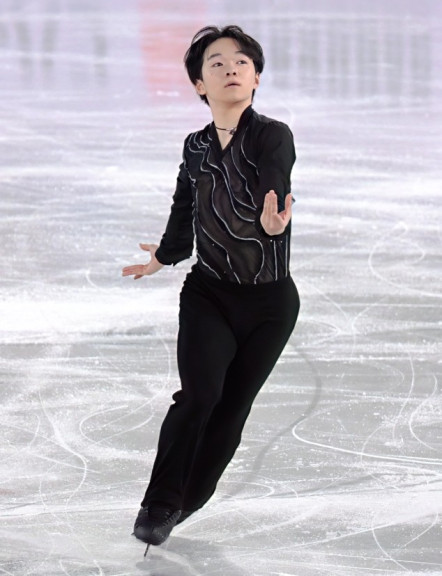
Yuma Kagiyama performing his short program at the 2024-25 Grand Prix Final
Phantom Kabocha, CC BY 4.0
On Friday, February 13, Japanese skater Yuma Kagiyama took home silver in the Men's Figure Skating Finals at the 2026 Winter Olympic Games in Milan. The music he chose for his powerful free skate routine: opera.
But it wasn’t just any opera. It was GRAMMY®-winning composer Christopher Tin’s completion of Turandot by Giacomo Puccini. The opera, about a vengeful Chinese princess who challenges her suitors to solve three riddles or face execution if they are unsuccessful, was famously left unfinished when Puccini died in 1924.
At Turandot’s eventual premiere in 1926 at Milan’s La Scala opera house, the orchestra stopped playing in the middle of Act III. Conductor Arturo Toscanini then turned to the audience and said, “Here the opera ends, because at this point the maestro died.” For the subsequent performances, Toscanini used a completion composed by Franco Alfano. Alfano’s ending has now become standard, though many consider it unsatisfactory. In the century since, numerous composers have sought to devise a tidier musical and dramatic conclusion.
Christopher Tin is the latest composer to try his hand at completing Puccini’s final opera. Tin has garnered legions of fans outside traditional classical circles as a video game composer, elevating the genre most notably through his score for the Civilization series (the first piece of video game music to win a GRAMMY® Award). In 2018, director Francesca Zambello and Washington National Opera commissioned Tin and librettist Susan Soon He Stanton to create a more dramatically and musically compelling ending to Turandot. Tin and Stanton’s completion premiered at the Kennedy Center on May 11, 2024, to great critical acclaim, with the run selling out before opening night.
“I spent many years studying Turandot and Puccini's leftover sketches, as well as the endings written by my predecessors,” Tin writes in his program note. “And ultimately I devised a way to compose the ending that was true to my own voice, but incorporated both the earlier themes from the completed opera, as well as selected sketches that he left on his deathbed.”
Japanese figure skater Yuma Kagiyama came to collaborate with Tin through his choreographer, Lori Nichol, and figure skating coach, Carolina Kostner. Nichol was already a fan of Tin’s music and had choreographed routines to other works of his. When Tin posted on X about how thrilled he was to see these routines, Kostner reached out to him to collaborate.
“Working carefully through the goals and nuances of the new figure skating program, Christopher, Carolina Kostner, Lori Nichol and Yuma Kagiyama felt that a suite from Christopher’s new finale of Turandot would be the perfect music to perform to, and so the plan to record it rolled into action,” Tin’s website reads. Choosing Turandot for the 2026 Winter Olympics in Milan was especially apt, given that the opera premiered exactly 100 years ago in Milan—a city Puccini called home for much of his life.
Kostner collaborated with Tin to create a special arrangement for Kagiyama that would account for the technical and timing demands of his routine. The “Yuma edit” condenses Tin’s 18-minute ending into 4 minutes and 17 seconds. The recording was made at Abbey Road Studios in London with Tin conducting the Royal Philharmonic Orchestra, English National Opera Chorus, soprano Christine Goerke (Turandot), and tenor Clay Hilley (Calaf). Tin recorded extra musical material to smooth transitions and match the pace of Yuma’s routine. For Kagiyama's choreography, Nichol turned to the opera’s libretto to capture the dramatic story of Turandot in his movements.
Tin’s arrangement for Kagiyama has taken the figure skating world by storm. NBC Sports commentator Mark Hanretty said, “I defy anybody not to be moved by the emotion of the music, the story behind the creation of this piece, specially recorded for Yuma . . . it just has Olympic moment written all over this piece. I feel and sense it’s set to be an iconic piece in the history of our sport to come.”
You can watch the routine here, and listen to the Yuma edit here.