








The History of the Vienna Philharmonic’s New Year’s Concerts
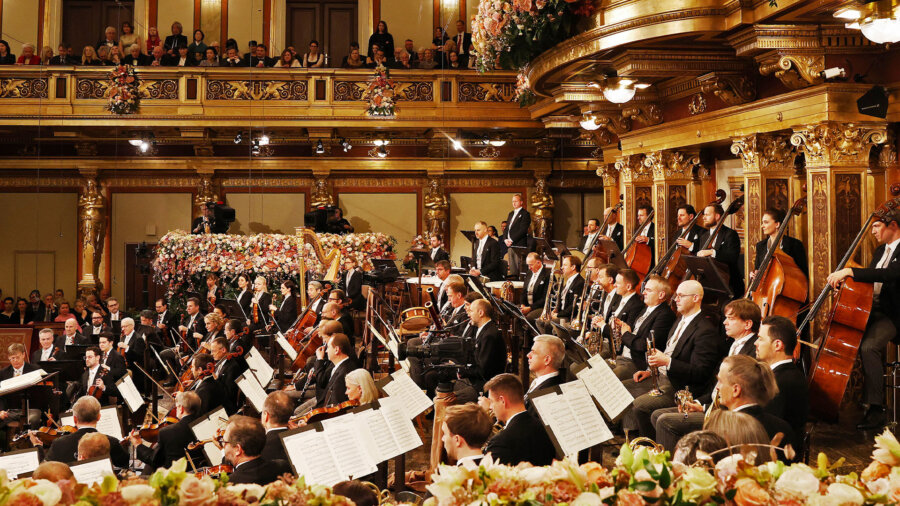
On January 1, the Vienna Philharmonic rings in the New Year with its annual concert from the gilded Musikverein. Conducted for the first time by Yannick Nézet-Séguin, the concert also features performances by the Vienna State Ballet performed on location in sumptuous Vienna landmarks and location segments hosted by Hugh Bonneville (Downton Abbey, Paddington). Waltzing into the New Year with the Vienna Philharmonic has become a global sensation, watched by 1.2 million people worldwide each year. But what is the history behind this tradition? Read on as we explore the complex history behind the glittering spectacle.
Every year, the Vienna Philharmonic presents a concert on New Year’s Day, featuring light dance music largely by the Strauss family and their contemporaries. The 19th-century musical dynasty—Johann Strauss, Sr. and Johann Strauss, Jr. chief among them—helped elevate the dance form of the waltz from a rustic peasant dance to the height of sophistication and elegance. (Read more about “Waltz King” Johann Strauss, Jr. here.)
Their music has come to symbolize Vienna’s cultural golden age and has become the most popular Viennese cultural export, thanks in part to the annual New Year’s concerts. However, the Strausses weren’t always so well-liked by the musicians of the Vienna Philharmonic. In the 19th century, some musicians turned up their noses at the light waltzes, polkas, and marches, believing that performing “popular” music would sully their reputation.
Even so, Strauss Jr. did conduct the Vienna Philharmonic several times during his career, making his debut leading his own Wiener Blut waltz in 1873. In 1894, the Vienna Philharmonic even mounted a festival concert celebrating Strauss’s 50th anniversary in the music business.
Yet, Strauss’s music fell out of fashion after his death in 1899 until after World War I. In 1929, conductor and opera impresario Clemens Krauss began reviving the music of the Straus family with annual concerts at the Salzburg Festival dedicated to their music, anticipating the format of the New Year’s concerts to come.
Although the Vienna Philharmonic had held New Year’s concerts in the past, they only began to resemble their current form as a celebration of Strauss’s music in 1939, during the darkest chapter of Austria’s history. The Vienna Philharmonic is open about this history, stating on their website,
“In the midst of barbarism, dictatorship and war, at a time of constant worry regarding the lives of members and their families, the Philharmonic sent an ambivalent signal: the net income from a concert dedicated to compositions by the Strauß dynasty which was performed on December 31, 1939, was donated entirely to the National Socialist fundraising campaign ‘Kriegswinterhilfswerk’ [Winter War Relief Fund].”
Krauss led the New Year’s concert the following year, this time held on New Year’s Day, and continued to do so until the end of the war. “Taking place in the middle of the war, many regarded this as an expression of Viennese individuality,” the Vienna Philharmonic writes, “but it was also misappropriated for the National Socialistic propaganda of the ‘Großdeutscher Rundfunk [Greater German Radio].’” Through these radio broadcasts, the Strauss family’s music had become an unwitting cog in the Nazi propaganda machine. Joseph Goebbels even went so far as to falsify wedding register documents to cover up Johann Strauss’s partial Jewish descent.
Krauss was a complicated figure, simultaneously a Nazi apologist who took conducting jobs his colleagues refused in protest of Nazi policies, while also privately assisting Jewish artists in danger. He and his wife, Romanian soprano Viorica Ursuleac, befriended British sisters Ida and Louise Cook, two ardent opera fans who ultimately helped at least 29 Jews escape Germany and Austria in the late 1930s. Ursuleac asked them to look after a Jewish friend in London, who opened their eyes to the persecution Jews were facing. Krauss then arranged opera performances as cover for the Cooks to smuggle the valuables of Jews fleeing to England, as they were not able to transport money or valuables across the border themselves but still somehow had to satisfy British financial requirements for immigration. (You can read more about the sisters’ quiet heroism here and here.)
After the war, the Allies banned Krauss from conducting for two years. In 1946 and 1947, Josef Krips conducted the New Year’s concerts, now firmly established as an annual tradition across Germany and Austria thanks to the radio broadcasts. Krips, whose father was Jewish, was one of the few conductors allowed to work in post-war Austria, as he had fled the country during the war and never worked under the Nazi regime. Krauss returned in 1948 and conducted these New Year’s concerts until his death in 1954.
Concertmaster Willi Boskovsky took over, directing the New Year’s concerts 25 times from 1955 to 1979. Strauss Jr.’s iconic waltz From the Beautiful Blue Danube and Strauss Sr.’s Radetzky March became established as traditional encores under his leadership. Lorin Maazel took over in 1980 after Boskovsky suffered a stroke. Maazel conducted the concerts until 1986, when the musicians of the Vienna Philharmonic decided to select a different internationally renowned conductor each year. Herbert von Karajan was the first in 1987, followed by the likes of Claudio Abbado, Carlos Kleiber, Zubin Mehta, and Riccardo Muti, to name a few. Yannick Nézet-Séguin, music director of the Metropolitan Opera and the Philadelphia Orchestra, conducts the 2026 concert for the first time.
The first television broadcast took place in 1959. The tradition remained mostly a regional one until the first international television broadcast in 1972 introduced the world to the glittering Goldener Saal of the Musikverein paired with the frothy music of Johann Strauss. PBS began broadcasting the concert as part of Great Performances in 1985. The television broadcast features performances by the Vienna State Ballet from various famous locations across Austria, including the Schönbrunn Palace, Schloss Esterházy, and the Vienna State Opera.
The prominence of music by Johann Strauss, Jr. and his contemporaries continues, though programs have expanded to include new music, with conductors striving to achieve a delicate balance between familiar favorites and less familiar works within the same vein. While the Vienna Philharmonic has made strides to address the dark elements of its past, it is far behind in terms of gender parity. A woman has yet to conduct the New Year’s Concert, and it was only this year that a piece by a female composer was performed for the first time. (Conductor Wolfgang Dörner programmed Fernandus-Walzer by Constanze Geiger, a contemporary of Strauss Jr. who wrote the waltz when she was just 12 years old.)
However slow, progress is being made. According to NPR, this year’s program will feature six works performed for the first time by the Vienna Philharmonic on New Year’s Day, including two by female composers: Florence Price’s Rainbow Waltz and Josephine Weinlich’s Siren Songs, Op. 13.
Tune in Thursday, January 1 at 7 pm and 8:30 pm for From Vienna: The New Year’s Celebration 2026, or stream on the PBS App from January 2.