








The Love Stories that Inspired Musical Masterpieces
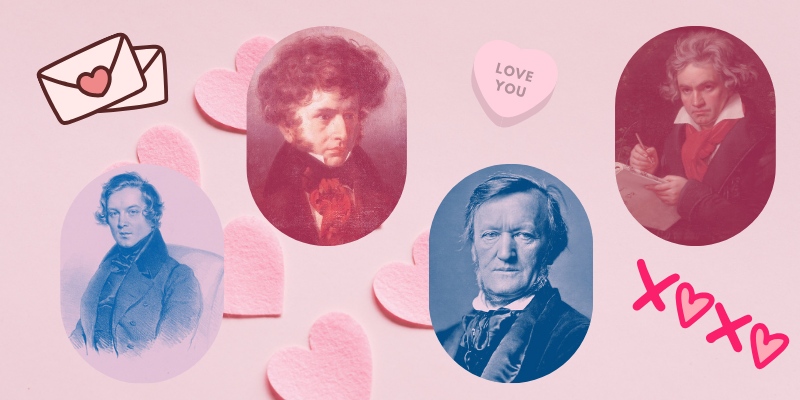
Whether burning from afar or passionately reciprocated, love has been a fruitful muse for many of the great composers. Come along as we celebrate Valentine’s Day with the love stories that inspired four famous compositions.
Hector Berlioz – Symphonie Fantastique
It’s a common trope: unrequited love and romantic fixation fueling the creative fire. But perhaps no example is more famous than the outpouring of romantic angst that is Hector Berlioz’s (1803–1869) Symphonie fantastique.
In 1827, Berlioz fell desperately in love with a captivating Irish actress named Harriet Smithson when he saw her in the role of Ophelia in a production of Shakespeare’s Hamlet. The idea of her consumed him entirely, though they did not meet until many years later. He wrote in his Memoirs, “The impression made on my heart and mind by her extraordinary talent, nay her dramatic genius, was equaled only by the havoc wrought in me by the poet she so nobly interpreted.” In 1830, this obsession with Smithson turned sour, and Berlioz channeled his frustration into writing Symphonie fantastique, an astonishingly modern symphony that traces his own heartbreak through a fantastical tale.
In the first movement, a young artist is consumed with passion when he sees the embodiment of his ideal woman. He falls desperately in love and cannot stop thinking about her. Berlioz writes, “Whenever the beloved image appears before the mind’s eye of the artist, it is linked with a musical thought whose character, passionate but at the same time noble and shy, he finds similar to the one he attributes to his beloved.” This idée fixe, or recurring musical motif, appears in each movement.
In “A Ball” and “A Scene in the Country,” the image of his beloved continues to plague the artist no matter where he goes. In “March to the Scaffold,” things take a turn for the worse. Convinced his love is unrequited, he attempts to poison himself with opium. Although the dose is not strong enough to kill him, it causes him to hallucinate that he has killed his beloved and has been condemned to death. At the end of the march to the scaffold, the first four bars of the idée fixeappear like a last thought of love before the fatal blow of the guillotine. The hallucination continues in “Dream of a Witches’ Sabbath,” where a frightful band of ghosts, witches, and monsters come together to celebrate the artist’s death by laughing, groaning, and emitting all manner of strange noises. The idée fixe returns once more, transformed into a grotesque dance tune as if his beloved has come to join in on the demonic revelry.
Beethoven – An die ferne Geliebte
Although Beethoven isn’t particularly remembered for his songs, he did write what is considered the first song cycle with An die ferne Geliebte (“To the distant beloved”). He composed the cycle in 1816 in the wake of multiple personal and professional setbacks, including the loss of his “Immortal Beloved,” the subject of a famously unsent love letter penned in 1812 and posthumously discovered among the composer’s papers. “My angel, my all, my own self,” it begins. “While still in bed my thoughts rush to you, my Immortal Beloved, sometimes joyfully, other times sadly, waiting to see whether Fate will listen to us. I can only live with you either completely, or not at all.” Written over the course of several days, the letter vacillates between passion, confusion, agitation, and rationality. It ends poetically, “Ever thine, Ever mine, Ever us. L.”
The identity of the “Immortal Beloved” is still up for debate, though the most convincing argument is for Antoine Brentano, the wife of a Frankfurt businessman with whom Beethoven was acquainted. She met Beethoven while staying in Vienna between 1809 and 1812 as she tended to her dying father and dealt with his estate. Letters indicate she was unhappy in Frankfurt and did everything she could to delay her return. We do not know the extent of Brentano’s feelings for Beethoven beyond friendship and admiration for his artistry, though she might have relied on him emotionally during this unhappy period.
Beethoven, who never married, seemed to be especially attracted to unavailable women. We can only speculate, but he may have fallen for women he knew he could never realistically be with as a method of self-preservation as his deafness further isolated him. No matter the reason, pining after the unattainable fed his music. Beethoven scholar Scott Burnham writes, “Here was a creative artist who felt cut off from the simple communal joys of society, who yearned for an idealized love, and who was able to react to these privations with an outpouring of music conceived on an unprecedented scale. A more potent model for the Romantic view of the artist could hardly be imagined.”
Beethoven was able to explore his inner feelings most directly through the medium of song. An die ferne Geliebte sets poetry by Alois Jeitteles (1794–1858), an amateur poet and medical student who was 20 years old at the time. The poetry struck a chord with Beethoven as it deals with the sublimation of romantic desire and channeling it into art, as well as the power of art to overcome barriers of time and space in reuniting distant lovers.
Robert Schumann – Fantasie in C, op. 17
An article on romances that inspired pieces of classical music would be incomplete without Robert and Clara Schumann. Theirs is one of the greatest love stories in all of classical music—one that sparked music of intense passion and beauty.
Robert met Clara when he took up piano studies with her father, Friedrich Wieck. Despite the nearly 10-year age gap, the two eventually fell in love in 1835 when Clara was 16. Friedrich vehemently opposed the match and warned Robert against seeing her “upon pain of death.” He even sent his daughter, an internationally renowned piano prodigy herself, on prolonged concert tours to separate the two.
After 16 months apart, they rekindled their romance through secret correspondence and clandestine meetings. When Robert asked Friedrich for his permission to marry Clara in 1837, he refused outright. (At the time in Saxony, a woman under the age of 21 needed both her parents’ permission to marry.) Friedrich threatened to disinherit Clara, seize her concert earnings, and sue the couple if they married, claiming that Robert could not financially support a wife. But love will out, and after much back and forth, the courts finally ruled in the couple’s favor. Clara and Robert married on September 12, 1840, one day before Clara’s 21st birthday.
During their imposed separation in 1836, Robert Schumann penned what would become Fantasie in C, op. 17. It is full of passionate longing for Clara, who was not only the object of his love but also the muse for nearly all his piano works, as she was the far superior pianist. Although Schumann intended the work’s proceeds to go toward building a Beethoven monument in Bonn and officially dedicated it to Franz Liszt, who was collecting funds for the memorial, the Fantasie is really a love letter to Clara in musical form. After the work’s publication, he wrote to Clara, “You can understand the Fantasie only if you think back to the unhappy summer of 1836, when I renounced you; now I have no reason to compose such unhappy music.”
Schumann called the first movement “the most passionate I have ever composed” and told Clara it was “a profound lament on your account.” It begins with the four descending notes of the “Clara theme,” heard in declamatory octaves over a tempestuous left hand expressing Robert’s roiling passion. (This “Clara theme” would recur across Schumann’s piano output and repeats throughout the movement.) The movement ends with a quote from the last song of Beethoven’s An die ferne geliebte, a line which reads, “Take then, these songs, beloved, which I have sung for you.” (10:47). This allusion does double duty, both honoring Schumann’s hero, Beethoven, while also serving as a secret message to his distant lover. The second movement is a majestic outpouring of love that becomes increasingly frenetic, while the third movement is more tender and intimate, with unexpected excursions into distant keys creating a feeling of suspended time.
Wagner – Siegfried Idyll
On Christmas Day, 1870, Cosima Wagner awoke to a chamber orchestra playing in the stairwell outside her bedroom. Her husband, Richard Wagner, had composed a piece especially for her birthday on December 24, rehearsing it in secret with 15 musicians from the Tonhalle-Orchester Zürich so it would be a surprise on Christmas morning. The piece, Siegfried Idyll, is now one of Wagner’s best-loved works.
The two had officially wed that August, though they had fallen in love in 1863 and had been living together for four years. They shared three children: Isolde, Eva, and Siegfried, for whom Siegfried Idyll is named. When their passionate love affair began, Cosima—the illegitimate daughter of Franz Liszt—was married to conductor Hans von Bülow, one of Wagner’s biggest supporters. Wagner was also married at the time to his first wife, Minna. When Minna died in 1866, Cosima pleaded with her husband to grant a divorce, but he refused. He finally assented in 1869 after Siegfried was born, though the divorce was only legally finalized in 1870. Siegfried Idyll was therefore not only a birthday present but also a way to mark the end of their premarital struggles and the dawning of a new chapter in their lives.
Intended as a love letter to his wife, Siegfried Idyll is a remarkably intimate piece by Wagner’s standards. The piece, which was never meant for public performance, was originally scored for 13–15 musicians so they could fit in the stairwell of his villa on Lake Lucerne. Personal meaning suffuses each melody, with references to a German lullaby, evocations of birdsong outside their Swiss villa, and strains from his yet-unfinished opera Siegfried. In 1878, Wagner bowed to financial pressures and sold the score to a publisher, expanding the orchestra to 35 players to make it more marketable.