







Get a sneak peak of the new Obama Presidential Center, then listen his 2004 interview with WILL-radio
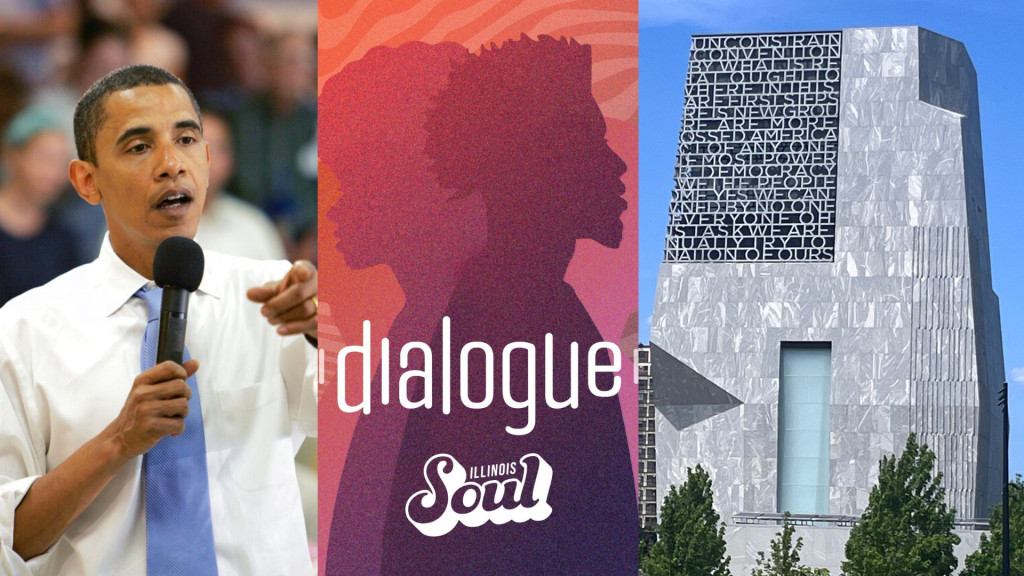
Left: Democratic presidential hopeful U.S. Sen. Barack Obama, D-Ill., speaks during a town hall meeting, Monday, June 18, 2007, in Newton, Iowa. Right: Obama Presidential Center in Chicago in May 2026. AP Photo/Charlie Neibergall and Reginald Hardwick/IPM News
// This is a machine generated transcript. Please report any transcription errors to will-help@illinois.edu.

[00:00:00]
Kimberly Schofield: From Illinois Soul, this is Dialogue, an exchange about culture straight from the soul. I'm Kimberly Schofield. The Barack Obama Presidential Center sits on a sprawling campus on the south side of Chicago. It officially opens on June 19th, but IPM news director Reginald Hardwick toured it in mid-May. He joins me in the studio now. Hi, Reginald. Reginald, were you invited?

[00:00:34]
Reginald Hardwick: Well, Kimberly, I wasn't formally invited. I went to take pictures of the center so that we would have some nice exterior shots for preview stories closer to the grand opening in June. You may have heard about the museum, but it's so much more. I parked on the south end of the 19-acre campus and walked north to the 8-story granite building that houses the museum.

[00:00:56]
Kimberly Schofield: Wow. And what was the first thing that you saw?

[00:00:58]
Reginald Hardwick: Well, on the southernmost point is Home Court. It sits across from Hyde Park Academy High School, and that's important because it is a 60,000-square-foot athletic facility. It has an NBA regulation basketball court. You may have heard, you know, former President Barack Obama loves basketball, as do you —

[00:01:19]
Kimberly Schofield: [Probably Kimberly's basketball.]

[00:01:25]
Reginald Hardwick: And there are also activity rooms where local teens can work on career building and connecting. The skybox overlooking the court is named after the great boxer Muhammad Ali.

[00:01:35]
Kimberly Schofield: Wow, what did you see next?

[00:01:37]
Reginald Hardwick: I'm still a few blocks from the museum, still walking north. Home Court overlooks the largest playground I have ever seen. And if you remember, First Lady Michelle Obama championed the Let's Move campaign to fight childhood obesity. And this has got to be a kid's dream. Every kind of slide, swings that are Americans with Disabilities [Act] compliant, and what you'll really notice is just this aqua-colored spongy floor. It's all outdoors, but if anyone falls, they bounce right back up.

[00:02:08]
Kimberly Schofield: Is that the only outdoor space?

[00:02:11]
Reginald Hardwick: Keep in mind I'm only halfway to the museum, and no, it's not the only outdoor space. I crossed a huge hill where [our] South Side Chicago families can spread out on a blanket and take in a concert or watch a movie in the park. And then I came to a massive garden.

[00:02:29]
Kimberly Schofield: Oh, another idea inspired by the former first lady.

[00:02:32]
Reginald Hardwick: Yes, two first ladies, in fact. The Eleanor Roosevelt fruit and vegetable garden has rows and rows of wooden boxes that are already sprouting plants like mustard and collard greens. I also saw some boxes that had snap peas and other vegetables being grown. It's here where South Side residents can come to learn about growing, harvesting, and inside the nearby Nancy Pelosi Garden Center, learn about preparing and cooking fresh produce.

[00:03:00]
Kimberly Schofield: It sounds amazing and delicious. And Reginald, I understand the garden is on top of a building?

[00:03:06]
Reginald Hardwick: That is correct. This is one of those living roofs, so, you know, people can work and visit the gardens on top, but it's also on top of the Obama Center branch of the Chicago Public Library. So families from the South Side of Chicago are encouraged to grab a book or study inside while people are gardening upstairs. And then just north of that is the Forum building, and that is another community space. It's a two-story building that connects the library with the museum. There's an auditorium for lectures and concerts. There are media rooms where local kids can learn about podcasting or producing music, and there's also a cafe in there.

[00:03:46]
Kimberly Schofield: I am loving this tour that you are giving me. Have you arrived at the museum yet?

[00:03:51]
Reginald Hardwick: Yes, it took me about an hour, but I finally arrived. And first, let me say, you've probably heard about Obama's memoir, "The Audacity of Hope." I'm joking, it's the audacity of a building. It's [striking] to stand next to it. It's a big gray granite thick building that really stands out on the South Side. There's no other real tall buildings that surround it, so it really stands out, and also it's a green space, so that gray really sticks out. And on top of the eight stories are 5-foot-tall words taken from President Obama's speech in 2015 at the 50th anniversary of the civil rights march on Selma, Alabama. And here's what he said then, and those are the words that are on the building.

[00:04:32]
Barack Obama: You are America. Unconstrained by habit and convention. Unencumbered by what is, because you're ready to seize what ought to be. For everywhere in this country there are first steps to be taken. There's new ground to cover, more bridges to be crossed. America is not the project of any one person. Because the single most powerful word in our democracy is the word "we." We the people. We shall overcome.

[00:05:16]
Speaker 3: Yes we can.

[00:05:18]
Speaker 2: That word is owned by no one. It belongs to everyone. Oh, what a glorious task we are given. To continually try to improve this great nation of ours.

[00:05:32]
Kimberly Schofield: That's so amazing to hear. Reginald, you were welcomed in then.

[00:05:37]
Reginald Hardwick: Yes, I was surprised, as I think other people, you know, who probably just were curious, and they said, come on in. And I walked through a metal detector and paid for my ticket, which is $26 for Illinois residents, $30 for anyone else over the age of 12, and we began taking escalators that go up, up and up, and there are staffers who pointed the way, answered our questions. I will warn people, wear comfortable shoes. This is a lot of walking.

[00:06:06]
Kimberly Schofield: Sprawling. Does each floor have a theme?

[00:06:10]
Reginald Hardwick: Yes, indeed, Kimberly. Each floor is named after people like NBA great Michael Jordan of the Chicago Bulls and Rabbi Abraham Joshua Heschel, who was a Jewish theologian and philosopher who took part in the civil rights movement. We don't have enough time to go through everything in this short story here, but each floor has a theme. You learn about the struggles for freedom through various movements — civil rights, women's suffrage, Native American, disability and LGBTQ rights movements — and you also start by learning about Barack and Michelle's upbringing. His Kansas mother and Kenyan father, and the former first lady's Chicago South Side roots. You also see his rise from a community organizer to state senator to U.S. senator, and of course, the presidential campaign.

[00:06:56]
Kimberly Schofield: Yeah, I remember the slogan, "Yes we can."

[00:07:00]
Reginald Hardwick: Yes, it is everywhere. And from hundreds of campaign buttons to a wall of homemade posters, purses, signs and shirts, as well as interactive exhibits on his primary defeat of Hillary Clinton and general election defeat of John McCain, there is so much and we get really nostalgic if you remember that time, to take in. And of course there's a picture of Obama kicking off his presidential campaign at the old state capitol in Springfield under the headline "Against All Odds."

[00:07:32]
Kimberly Schofield: Wow, I know that you didn't expect to be asked or welcomed in. Were there a lot of people also there?

[00:07:39]
Reginald Hardwick: There were dozens of people, and I wouldn't say we were elbow to elbow. I think that's gonna be the opening ceremony week for sure, but I don't think this has been promoted that the museum is open, because I bet huge crowds would just descend. But on one floor there was a replica of the Oval Office during the Obama years and there was a line of people who, you know, come into the space — which is a little bit smaller — and take pictures behind the president's desk. I was really struck by the joy on the faces of many elderly Black people. Growing up as a Black person, I often heard my elders say there would never be a Black president. And this is the same generation posing for pictures who could probably tell you where they were during the civil rights movement and where they were when Obama became president. It was really inspiring. Wow.

[00:08:33]
Kimberly Schofield: What else did you see?

[00:08:35]
Reginald Hardwick: Gosh, so much. Throughout the museum, there's lots of artwork and there are also a lot of places where people are asked what are they going to do, you know, you've had the Obamas through the years and people are looking for, you know, the next political leader to inspire them. But I think there's a lot put on people, particularly young people, to ask them what are they going to do and, you know, what are ways they can get involved. There's a Democracy 101 wing that explains our government, how you can take part in civic engagement, running for office, or just volunteering to make a difference. There's an interactive breakdown of who votes [in] America by age. Spoiler alert, 70% of people over the age of 65 vote, whereas people under age 24 are around 40%. And there's a quote on the wall in that area from Barack Obama: "We are the ones we've been waiting for."

[00:09:31]
Kimberly Schofield: Reginald, you say the escalators go up. How far can you go?

[00:09:36]
Reginald Hardwick: Yes, floors 2 through 6 take you through various exhibits. There's a lot of media to take in. And remember Obama's presidency took part in the digital age. You don't have access to the 7th floor — those are private offices. But here's another surprise. We went all the way to the 8th floor and that top is called the Window Room, and that's because you have a 360-degree view of the South Side of Chicago. I bet it would be phenomenal to watch the 4th of July fireworks from up there. And in the middle is an atrium, and when you look up there's artwork made out of Obama's speeches. You literally see his words if you look at it really closely.

[00:10:17]
Kimberly Schofield: Is there a gift shop or somewhere to eat in case you need a break from absorbing all of the incredible media?

[00:10:24]
Reginald Hardwick: Yes, they've thought about everything. And so you're also probably wondering how do we get back down. So the museum guides will [direct] you to large elevators that take you back down to the lower level where there is a cafe. It wasn't open while I was there, but I'm sure it'll be great food. And the gift shop, which was packed, and I walked by there on my way back to the car.

[00:10:50]
Kimberly Schofield: What do we know about the grand opening?

[00:10:53]
Reginald Hardwick: The official opening ceremony is June 18th. The Obama Presidential Center website says there will be inspiring performances by legendary world-renowned talent. It is invitation only, so most of us will have to watch on a live stream. I remember when the George W. Bush Presidential Center opened in Dallas. You know, some of the other former presidents came to see that. So I'm thinking it'll be also a high-security space. And then the museum officially opens on Juneteenth, June 19th, and I've read people have already bought tickets from all over the world, all the way through November already. And there is, by the way, a large underground parking lot on site. So if you're planning to go from Champaign-Urbana, I'd advise you to make sure you have tickets. I winged it, but again, this is before the official opening was open, and I don't recommend that, because that's rare. And you know you don't want to come all the way two hours to the South Side of Chicago and not be able to get in because of the crowds. Again, there were some crowds when I went in, but I'm sure there will be many more people once, you know, the official opening has started.

[00:12:09]
Kimberly Schofield: Imagining if I was there and I saw people starting to go in, I would think probably to myself, is this real? Am I allowed to go in? So I am glad that you took the opportunity. Reginald, do you have any other thoughts?

[00:12:21]
Reginald Hardwick: Yeah, I was following some folks pushing a stroller, and then, you know, and so, yeah, and then, you know, the curiosity of being a journalist, you know, OK, well if they can get in, I'm gonna get in and see it. You know, this is my third presidential museum visit. Of course I've seen the Lincoln Museum in Springfield, and I lived in Dallas-Fort Worth and was there when George W. Bush's museum opened at Southern Methodist University, and it's interesting to me as a person who heavily covered both Bush and Obama, how the museums are both very unique and different. Bush's museum is at SMU, as I said, it also has a Resolute Desk and has the Oval Office and many elements of the September 11th, 2001 attacks. Also striking that both the Obama and Bush museums feature the first ladies' dresses and outfits, very, very popular. I feel like they're both like time capsules of eight years of our country's history, and again they're very unique in their own ways.

[00:13:26]
Kimberly Schofield: That's IPM news director Reginald Hardwick, who went to the Obama Presidential Center to get some outside pictures and saw much more. You can see his videos and pictures at [illinoisSoul.org].

[00:13:50]
Reginald Hardwick: From Illinois Soul, you're listening to Dialogue. Four years before he was elected the 44th president of the United States, people around central Illinois may have just been getting to know state senator Barack Obama as he campaigned to become a U.S. senator from the Land of Lincoln. Obama talked with WILL's Focus 580 talk show. In this 2004 interview with Jack Brighton, here's a little bit of what Obama had to say, starting with his name.

[00:14:20]
Barack Obama: Well, you know, usually the first thing people want to know is where did I get this name? Barack Obama. And people mispronounce it and call me Alabama. There are all kinds of variations to it. My father was from Kenya, from Africa, and he was a foreign student who came here to study back in the early '60s. My mother was from Kansas, which is why I talk the way I do. And it's actually community organizing that brought me to Chicago. I had graduated from Columbia University in New York and had become interested in figuring out how I could help rebuild communities that had been devastated by job closings or were hurting because of long histories of segregation, and there were a group of churches out in the far South Side of Chicago here that were dealing with steel plants that had closed and were trying to figure out how they could help rejuvenate communities. So they didn't have much money. All they could afford was a 23-year-old kid who was interested and was willing to work hard. So I came out here and worked for three years setting up job training programs for the unemployed, organizing parents to help promote school reform in the area, bringing resources and city investment into areas that had been neglected. And so I did that for 3.5 years before I went to law school, and it was the best education I ever had. It really taught me that ordinary people can do extraordinary things when they're given the opportunity.

[00:15:55]
Jack Brighton: So the other basic question I have, and then I want to defer to callers as much as possible since that's what the show is all about, what do you hope to bring to the U.S. Senate? What would you hope to accomplish there?

[00:16:07]
Barack Obama: Well, you know, as I think you noted in the introduction, I've devoted most of my life to public service, certainly most of my adult life, both as a community organizer, then as a civil rights attorney, and most recently as a state senator. And I'm very proud of the track record that I've been able to develop in the Illinois Senate. You know, I helped to shape the [KidCare] program that provides health insurance for children who don't have, who don't qualify for Medicaid, but whose parents don't have health insurance on the job. I helped to implement a welfare reform program here in Illinois that's one of the least punitive but one of the most successful in moving women into the workforce, primarily by providing them with daycare and transportation assistance and job training. I helped pass the Earned Income Tax Credit that provides tax breaks for people who really need it, people typically making $30,000 a year or less. And then this year really focused a lot on revamping our criminal justice system and passed the first-in-the-nation videotaping of interrogations and confessions, the cornerstone of death penalty reform in the state. So I'm very proud of my track record at the state level, but I now think that this country is at a crossroads, both internationally and domestically, and the voices of ordinary working people are not being heard in Washington. They're being drowned out by special interests. I think we have an administration who sees its primary role as protecting the powerful from the demands of the powerless, and I'm hoping to give voice to, you know, the young men who are standing on street corners without vision and hope, and to families that are struggling to get by, and to seniors who are unable to get the medicine they need. Those are the people I hope to represent effectively in Washington the same way that I believe I've effectively represented them in Springfield.

[00:18:09]
Caller: Good morning. If you were elected senator, what would you be doing? Would you be following the lead of hopefully a Democratic president, or would you be in the forefront with your own legislation?

[00:18:22]
Barack Obama: Well, I think that there is unanimity on the part of Democrats right now that Bush and the Republican Congress have not put in place economic policies that are helping working families. This has been the most fiscally irresponsible administration in recent memory. I've been very specific on a couple of issues that I think we can address right away on the issues of jobs, and I do think that jobs and economic security have to be our number one priority. We've proposed that we have to revamp our tax code because it currently really incentivizes a lot of the outsourcing that is taking place and that is harming not only our manufacturing base but increasingly is taking away jobs in the service economy, high-paying jobs in areas like computer programming. So what we've proposed is that we close those corporate tax loopholes that currently allow companies, for example, to locate offshore and repatriate their profits at a lower tax rate than those who are producing goods domestically. And put all those incentives into companies that are doing the right thing by their workers and by their communities. We call it the Real Corporations Act, and what we say is that if a corporation is investing 50% of its research and development money in the United States, 90% of its workers are in the United States, it is providing benefits to those workers, then they should get generous tax breaks. Their shareholders should get generous tax breaks. And those can be paid for by closing the loopholes that are currently benefiting companies that are sending our jobs offshore.

Mr. Obama, sir, could you become nominated and then elected, what standing committees and standing subcommittees in the Senate would you like to serve on?

Well, that's a terrific question. You know, every freshman senator, I think, aspires to be on the Appropriations Committee because that's where the money is. And, you know, it's like [Willie Loman] said, you know, that's why you go there. Obviously, it's sometimes difficult to get that much sought-after appointment, but I think that areas — those committees such as appropriations, finance, or commerce — are all of great interest to me because they have a direct impact in terms of how the tax code is written and how our budgets are prioritized in Washington. I'm also interested in the Judiciary Committee because as a constitutional lawyer, somebody who teaches constitutional law at the University of Chicago Law School, I am very concerned about the direction of the federal courts. George Bush's nominees, I think, have generally been ideologues out of the mainstream of American society, and that is one of the most critical functions that the Senate can play is to make sure that our judicial confirmation process reflects our core values in terms of equality and justice.

[00:21:39]
Reginald Hardwick: You're listening to Dialogue from Illinois Soul. I'm Reginald Hardwick, and we've opened up our Illinois Public Media archives for a vintage interview with Barack Obama from 2004. At that time, then-State Senator Obama was running for the U.S. Senate. Four years later, he would win the presidency and serve eight years in the White House. Now let's go back to that interview with WILL's Jack Brighton.

[00:22:05]
Jack Brighton: What I actually wanted to ask you about was your support in the state Senate of the Health Justice Bill and to describe that a little bit and see how you might be able to, in your role as a U.S. senator, have something to do with how that might be implemented down the line.

[00:22:20]
Barack Obama: You know, when I came into office seven years ago, people already had a concern about the 40 million-plus who were uninsured. Seniors were already struggling to keep up with the ever-escalating cost of prescription drugs. Now what you're seeing, though, are people who have health insurance benefits on the job seeing their copayments go up, their premiums go up, their deductibles go up. I'm meeting families who are saying that they are going to cover their children but are not going to cover themselves. It is a full-blown crisis across the board, and I'm also meeting small businesses and large businesses that are unable to sustain the double-digit inflation that they're seeing in their health care costs. So I think we've got a terrific opportunity politically.

What I've tried to do at the state level is to move a process forward to talk about how we provide basic coverage for all Illinois citizens. I was a sponsor of the [Bernadine] Amendment, which would amend the Illinois Constitution so that health care was a basic right for all Americans. We weren't able to get it out of committee. We continue to work on that. There is a bill pending currently called the Health Justice Act which would insist that the state legislature move a process forward over the next couple of years to examine ways in which we could achieve full coverage for all Illinois citizens and perhaps set up a menu of options by which we could achieve that and then have an up-or-down vote on one of — or more than one of — the proposals that were put forward. It is a difficult problem. It's not one that's going to be solved overnight, but it's something where we can make significant progress.

And at the federal level, what I'm looking at is a very specific proposal that would provide health care coverage for all children who need it all across the United States, would allow 55- to 64-year-olds to buy into the Medicare system, and would continue to recognize — would recognize — that we're going to still have significant employer-based health insurance throughout the country, but that we're going to have to provide subsidies to some companies and particularly unemployed workers who are in transition for their COBRA coverage in order to make sure that everybody has basic access to health care. We could do just the expansion of health insurance to all children for $37 billion. That's how much it would cost to expand the current [KidCare] program that I worked on so diligently here in Illinois. We could cover all children who currently are going without health insurance for $37 billion — less than half of what it costs for the Bush tax cut to the top 1%. And I think that if we can start with children and those persons 55 to 64 that are most vulnerable, then we can start filling in those holes and ultimately, I think, move in the direction of a universal health care plan.

[00:25:33]
Jack Brighton: How do you feel about the direction that the United States has taken in terms of foreign policy over the past few years? What would you hope to see different about that? And certainly we could talk about Iraq and whatever else you'd like to.

[00:25:46]
Barack Obama: Well, this is an area in which I think there are some significant differences in the Democratic field for the U.S. Senate. I stood up publicly and unequivocally over a year ago to oppose the Bush war in Iraq. I did so not because I think that — the world is not better — [that was] too many negatives. I did so knowing that the world would be better off without Saddam Hussein, that he was a brutal dictator and had terrorized his people for many years and threatened his neighbors. But because inspections were working, sanctions were working, there was no evidence of weapons of mass destruction that would cause an imminent threat to the United States, and there was no connection between Saddam Hussein and al-Qaida. And I felt that our number one priority needed to be effectively prosecuting the war on terrorism. This was an enormous and hugely expensive distraction that has frayed our international relationships.

[00:26:56]
Reginald Hardwick: Here on Dialogue, we've been listening to then-State Senator Barack Obama speaking with Jack Brighton on WILL's Focus 580 talk program back in 2004. At the time, Obama was running for the U.S. Senate, which he won later that year. Four years later, he was elected U.S. president and made this acceptance speech in Chicago's Grant Park.

[00:27:21]
Barack Obama: It's been a long time coming. But tonight, because of what we did on this day, in this election, at this defining moment, change has come to America.

[00:27:34]
Reginald Hardwick: The Obama Presidential Center on the South Side of Chicago that chronicles the entire lives of President Obama, as well as First Lady Michelle Obama, holds its grand opening on June 18th and 19th. Coming up, a special farewell for one of our beloved colleagues here at Illinois Soul. Stay with us. You're listening to Dialogue, an exchange about culture straight from the soul.
The Barack Obama Presidential Center sits on a sprawling campus on the South Side of Chicago. It officially opens on June 19, but IPM News Director Reginald Hardwick toured it in mid-May.