








Behind The Mic: Illinois Student Newsroom editor Christine Herman leads the newest generation of public media reporters
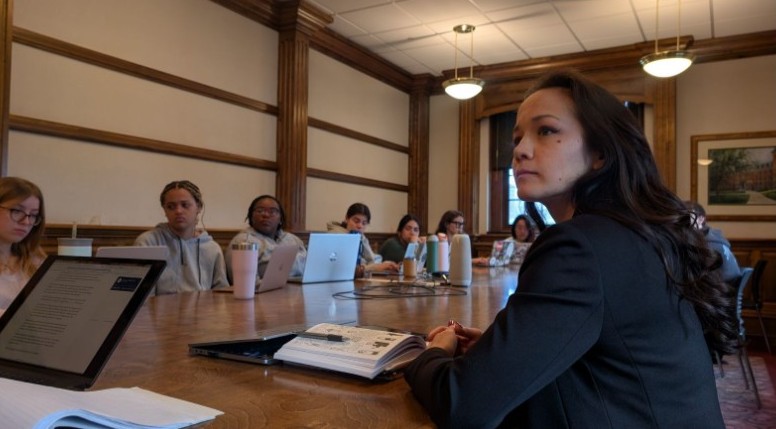
Every Tuesday and Thursday, Christine Herman meets with Illinois Student Newsroom reporters to shape them into experienced journalists through guest speakers, analyzing stories and hands-on equipment practice. Giuliana Means/IPM News
Christine Herman has been a working journalist since earning her graduate certificate in journalism from the College of Media at the University of Illinois Urbana-Champaign in 2014. She initially joined Illinois Public Media as a part-time producer before becoming a founding full-time producer of The 21st Show in early 2016. Two years later, Christine became a general assignment reporter for Illinois Public Media. Now, she is the editor for the Illinois Student Newsroom, where she oversees 15 to 20 reporters each semester.
This interview has been edited for clarity and brevity.
IPM: What got you into journalism?
CHRISTINE: “I had an existential crisis in graduate school where the thing I thought I wanted to do for a very long time was not the thing that I wanted to do. Three years into my chemistry PhD program, I reached out to a journalism professor, Jennifer Follis, and she encouraged me to take a journalism class.
So I took JOUR 100 and wrote for the DI [The Daily Illini student newspaper] for two semesters and then I was like, actually, I don't want to do chemistry. I want to do journalism.”
IPM: What makes you passionate about being an editor for up-and-coming journalists?
CHRISTINE: “Part of the reason I'm so excited to help students get opportunities in professional newsrooms is that when I was a student here, I published zero stories in professional newsrooms. And so when this opportunity came up, I was like, that's fantastic. I wish I had that when I was in journalism school.”
IPM: What drew you to journalism?
CHRISTINE: “The first time I saw my name printed in The Daily Illini paper, it was such a high. Then I thought, oh, I could be a technical writer, I could be a science writer, I could write for an academic institution.
It is to serve the public, whether it's giving them important information that will help lead healthier lives, raising awareness about the systems and structures in our society, or shedding light on problems or injustices.
Especially audio, being able to hear emotion in people's voices, and putting their own voice into the story. There's power in hearing a person share about their life and their experience in their own voice, in their own words, in a way that you can't quite capture in a digital story.”
IPM: Why do you think journalism is important?
CHRISTINE: “Journalism helps people be informed about what's happening in their community, state, country and in the world. There's a phrase of being a mirror to the community that you are serving. Like, we reflect what Champaign-Urbana is. Also, I think journalism is powerful because you get to meet and introduce your audience to people from all sorts of walks of life.
Especially during a time when there is so much division and polarization, it's really important. it helps cultivate empathy and understanding in a way that bridges the divides that we have in our society that—at least according to the experts out there who study this sort of thing—these divides are getting deeper and worse.”
IPM: What makes your job special?
CHRISTINE: “I am very encouraged by the fact that there are young people today who, are excited to become journalists because they believe that journalism is important for a healthy democracy, even if that means there will be a lot of uncertainty around their own career stability.
What we're doing here is pretty unique. We've taken lessons from other places that have done similar things, but there aren't very many places where you can be a journalism student somewhere and then work out of a NPR station for multiple semesters in a row.
Some of our students will start brand new, and by their second or third semester, they're doing feature length stories, in-depth interviews, or even pitching their stories to NPR.”
IPM: Why do you think public media matters?
CHRISTINE: “Public media is so important because everything we do, we give away for free. You can listen, you can tune in, you'll hear our underwriters, our sponsors. But we don't charge people for our content.
But it is costly to produce. So, when people who are able to pay into support, that contribute financially, it makes it possible for us to do the work that we're doing and are giving away for free.”
IPM: What is your favorite public media story that you have written?
CHRISTINE: “When I was a reporter, I did try to focus on health reporting, and mental health. The issue in particular, I was looking into children's mental health. Being a mother and having kids, I was really interested in understanding more.
It was about how kids who have severe mental health conditions that need a high level of treatment were being denied coverage and couldn't get access to this care. There were parents who were giving up custody of their kids because that's the way that the state would be forced to pay for and provide the care that the child needs.
It was very heartbreaking issue. But it highlighted the bigger failings of the health care system.”
IPM: Is that the story that changed the trajectory of your career?
CHRISTINE: “Yes.”
IPM: What does a day in your life look like?
CHRISTINE: “Every day is different. Overall, I'm checking in with students to find out what story ideas they have. They'll write a story, and I work with them to edit those stories and get them ready for broadcast and publication on the web.
I also work with my co-lead on the student newsroom, Stretch Ledford, to plan what we're going to cover in their class time. Like what speakers are we going to bring in, what additional training should we provide, What kinds of professional development opportunities should we explore?”
IPM: When you're not at the station or working with the students in the newsroom, where can listeners find you?
CHRISTINE: “Probably in my car, driving around, picking kids up from school, and taking them to gymnastics, ballet, piano lessons, pottery class, and a variety of other after-school activities.
Then, I'm often times at Defy Gravity: Pole Fitness & Aerial Art studio. I teach almost every apparatus we have in that studio, from pole, trapeze, lira, hammock, and silks.”
IPM: What's your biggest hobby? Is it dancing?
CHRISTINE: “Yeah, definitely. Pole dance and aerial arts.”
IPM: And if you could bring one album to a desert island, what album would it be and why?
CHRISTINE: “I'm so bad at music. But the kids that I worked with, in Circus camp last summer, got me hooked on K-pop Demon Hunters. I don't listen to it that much anymore. I was on the bandwagon when it was very popular.”
IPM: Is there a public radio show that you've been listening to lately?
CHRISTINE: “I listen to Morning Edition every day because I can wake up and, instead of doomscrolling to find out the news, I can just turn it on while I'm making my coffee and frying up my eggs for breakfast.”
IPM: Who is your greatest inspiration?
CHRISTINE: “I will say that becoming a parent has changed my life. And I learned so much from my children. Like the way that my youngest son will eat something and just get so much joy and pleasure out of the experience. That's a lesson in life; savoring the little things. The little things are the big things.”