








A look into the settlement after Illinois State University workers’ strike
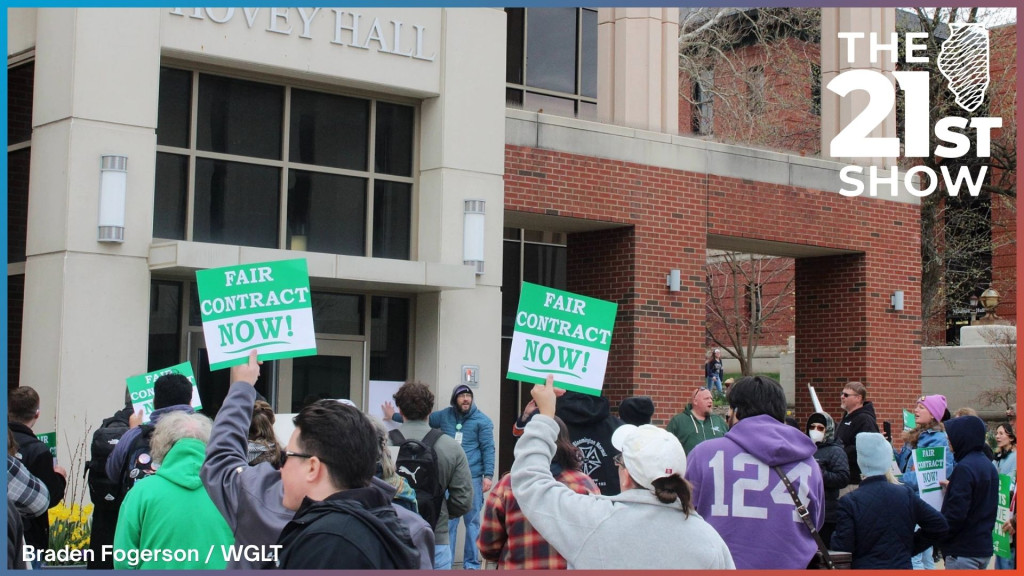
Demonstrators outside Hovey Hall, the main administration building, at Illinois State University on Tuesday, April 7, 2026. Braden Fogerson / WGLT
// This is a machine generated transcript. Please report any transcription errors to will-help@illinois.edu.

[00:00:00]
Brian Mackey: Today on The 21st Show, service workers at Illinois State University recently spent nearly a month on strike. Now that it's over, we'll hear from a union leader about their demands, the university's bargaining positions, and what finally brought them together. Then, if you've ever wondered what it's like to drive one of the big rigs, the video game American Truck Simulator offers an opportunity. The company behind it is based in Europe, but this week they're launching an upgrade that adds Illinois locations to their game map. That includes Peoria, Champaign, Rockford, and the Quad Cities. I'm Brian Mackey. That's all coming up today on The 21st Show, which is a production of Illinois Public Media, airing on WILL in Urbana, WUIS in Springfield, WNIJ in Rockford DeKalb, WVIK in the Quad Cities, and WSIU in Carbondale.

But first, news. From Illinois Public Media, this is The 21st Show. I'm Brian Mackey.

One week ago today, we were planning to bring you a conversation on a strike among workers at Illinois State University. They included groundskeepers, janitors, food service workers, all represented by Local 1110 of AFSCME, the American Federation of State, County and Municipal Employees. By that time, the strike had been going on for nearly four weeks. It was getting the attention of state elected officials, and the union had brought a lawsuit accusing the university of hiring replacement workers at higher wages than the people who were on strike, which would have been against state law. Then overnight before the show, word came that a settlement had been reached, so we postponed, and here we are a week later.

Now, instead of an update on the strike, this is a sort of postmortem. Joining me for this is Anders Lindahl, spokesman for AFSCME Council 31, the overarching organization of AFSCME locals in Illinois. Anders, welcome to The 21st Show.

[00:02:02]
Anders Lindahl: Thank you, Brian. Glad to be here.

[00:02:04]
Brian Mackey: I should say we also invited Illinois State University leadership to join us. They sent a statement. I'll read from that later in this conversation. I should also mention we pre-recorded this program, so we are not taking calls today, but you can always let us know what you thought. Our email address is talk@[2firstshow.org]. All right, Anders, tell me who the affected workers were at Illinois State, more than I said in the introduction.

[00:02:30]
Anders Lindahl: Yeah, you touched on it. There's more than 300, close to 350, folks who do some really important work that make the campus possible. They cook and serve the meals to students in the dining halls, they clean the dining halls and the dorms and the bathrooms and the classrooms, they trim trees and pick up downed limbs from storm damage, which happened during the strike, they shovel snow. They're the storekeepers that keep and catalog all the tools and supplies that anybody working on campus needs and distribute those thousands of different products every day, and they do so much more that supports the faculty and most of all the students. Yet, for all their essential contributions, they're some of the lowest paid workers on campus.

[00:03:30]
Brian Mackey: Well, that gets at something else I wanted to ask you about. So, you know, we've heard a lot about strikes among faculty at Illinois universities in recent years. Just talk to me a little bit about the working relationship — the employment relationship and how it's different for these types of workers with a university, a state university.

[00:03:47]
Anders Lindahl: Yeah, so AFSCME represents the staff like these folks at nearly all, most state university campuses. We also represent clerical workers on many campuses, including at ISU, although that is a separate local, and their contract was settled. So under this collective bargaining agreement, you know, just like any other, we negotiate wages, benefits, and other terms and conditions of employment.

And going into this negotiation last year, we were looking at a contract that was slated to expire last June 30th, so at the end of June of 2025. The ISU administration really dragged their feet and bogged down the negotiations, in particular over two takeaway demands. Administration at the top of the university wanted to take away two pretty basic, very common provisions that ensure fair treatment and fair pay in our contract. One of those was retroactive pay going back to that June 30th of 2025 date when the last contract expired. And the other one was — if you work for a university and you aren't under a collective bargaining agreement, whether AFSCME or a faculty union or one of the trades unions — so, essentially, all the top administrators, they're part of what's called a campus wage program, and the university president designates what an annual wage increase will be for those people. It's always been that our members, most union members on campuses all over the state, have a provision that says if the administrators in the campus wage program get a higher increase, then the union members get that same increase instead of what's in their contract. It's not in addition, it's not like a double dip. It's to say if the boss is going to get 3.5 this year and my contract only said 3%, well then, so I don't fall further behind, I'm going to get the 3.5% as well.

ISU administration was trying to take that away. They were trying to say, we didn't negotiate this contract in time, but you're not going to get the increase you were due last year. And if we give ourselves a higher increase, you're not going to get that. They were trying to take those two things away and our members weren't having it.

[00:06:35]
Brian Mackey: So what sort of salary demands were the union members making?

[00:06:41]
Anders Lindahl: You know, it's not necessarily so much about wages. In the end, we were pretty close on wages, and what we ultimately agreed to is a 16.5% compounded increase over the life of the agreement, which is going to run through June 30th of 2030.

And we were coming in from the context that the pay at ISU starts at [$16.66] an hour for the lowest paid people. And the majority of the bargaining unit makes less than the $21.49 an hour that is considered to be a living wage in McLean County. So, just to set that context, we are talking about the lowest paid folks on campus, many of them having to really struggle to make ends meet. And so when the boss was then trying to take money out of their pockets by taking away these provisions we've long had, that's why it was a non-starter.

ISU had made this demand and actually said it was their final offer back in January. Our bargaining committee said, look, we don't think this is the basis of a fair agreement. We're not acquiescing to this and we're not recommending it be adopted, but we will take it to our members and let them consider it and vote. And in February, our folks voted it down overwhelmingly. So administration knew that their takeaway demands were not the basis of a fair agreement, and yet they continued to refuse to negotiate.

Even into March we took a strike authorization vote. We met with them again. They said we're not budging. We set a strike deadline of April 8th. We met with them with the federal mediator on April 7th, the day before. They said we're not budging. All this time we were bringing new proposals to try to find common ground, and so folks went out on strike on April 8th.

[00:08:44]
Brian Mackey: And talk to me about the concerns that some of the union members had about the replacement workers during the strike. This ultimately led to a lawsuit, as I mentioned.

[00:08:55]
Anders Lindahl: That's right. So within the first few days that our folks were out on strike, in that second week of April, we started to hear reports, then we saw actual want ads for replacement workers on a temporary basis, more commonly known as strikebreakers or scabs, to do the work of our members who were out on strike — to cut the grass, to take out the trash, to cook the food in the dining halls. And it turned out that the university had hired several private for-profit companies, one of them from Chicago, that were bringing in workers, and through FOIA we exposed the contracts which showed that they were paying up to $130 an hour to these companies.

ISU administration — now, again, most of our folks making less than $21 an hour — they were paying these private for-profit companies up to $130 an hour. And ISU administration tried to say, oh, that's the amount we were paying to the companies, not the amount we were paying to the workers, as if that makes it any better. They were paying the scabs and they were funneling profit into the pockets of these private companies. Again, all out of our public dollars, tax dollars and student tuition dollars that should be going to education on campus. So that's what they were doing. They were paying these scabs and paying the scab companies exorbitant sums.

[00:10:41]
Brian Mackey: What ultimately do you think brought the university back to the table and brought this strike to a resolution?

[00:10:47]
Anders Lindahl: Well, I think there were a lot of different pressure points, as you mentioned. We filed a lawsuit. We filed a number of charges with the Illinois Labor Relations Board over violations of labor law. We had a lot of support from elected officials, from Senators Durbin and Duckworth to [Alexi Giannoulias] and Mike [Frerichs], real champions in Dave [Koehler] and Sharon Chung, they're in the district. The president of the university, [Aondover Tarhule], went twice to the Capitol for appropriations hearings and really did not comport himself well before those panels — he was there to talk about their funding, but he was really not being forthright about the way that he was treating his workers.

So there was a lot of pressure, but I think the biggest pieces were, you know, A, the unity of our members — nobody wants to strike. You really don't want to strike if you're a low-paid worker who lives paycheck to paycheck, because you're out there and all you know is you've got to go one day longer and one day stronger, and you're not getting paid. So their unity was absolutely essential. But B, and almost as important, was the support from the ISU Redbird community. Students by the thousands signed a petition supporting workers. Students of their own volition organized a walkout from class to support the workers. Faculty and the faculty unions were incredibly reliable supporters and out on the picket line. Alumni, parents of students were filling up the social media pages and contacting the president. And so I think all of these things brought it together, to where they were willing to finally come back to the table after nearly a month.

[00:12:58]
Brian Mackey: Let me read — I mentioned that we invited ISU leadership to join us. They sent a statement attributed to President [Aondover Tarhule]. Quote, "I'm pleased the bargaining teams reached agreement and the union members voted to ratify the contract. The university appreciates the efforts made by both bargaining teams as they worked late into the night to reach this agreement, which reflects a collective commitment to moving forward together. I encourage our campus community to unite in the spirit of collaboration, respect all individuals' rights and choices, and work to heal differences of opinion, real or perceived, so that we may reestablish our sense of shared values and mission." End quote. What do you make of that?

[00:13:36]
Anders Lindahl: I mean, that sounds nice and they're singing Kumbaya now, but the fact is that President Tarhule and Vice President Glenn Nelson, who was hired by ISU just last January of 2025, right as this negotiation was starting, they chose this path of conflict. They brought this division and ultimately [a] stain on the reputation of ISU upon themselves by choice — by their demands, by their stubborn refusal to move from January to April 28th.

And the agreement that we reached after four weeks out, ultimately, it had been — it would have been available to them in January, in February, in March, or in April. We would have reached this agreement at any point, but they were demanding these takeaways — no retroactive pay. Ultimately, we got a lump sum ratification bonus that's worth more than the retroactive pay would have been, and especially to the lower paid people, worth significantly more. And they were demanding no worker participation in the campus wage program, so that you wouldn't be assured that you would get the same increase that the bosses were getting. We were able to restore that for 2028 and going forward, so that would be there in the contract.

So, you know, ultimately we turned away their demands to take these provisions that provide for core fairness in the contract. We were able to get that 16.5% wage increase, and we did some other things on pay as well that are really going to help folks. And that is why, when we ultimately took it to our members last week, more than 95% of votes cast were yes to ratify.

[00:15:42]
Brian Mackey: Let me reintroduce our conversation. If you're just joining us, we're talking with Anders Lindahl, spokesman for the AFSCME labor union here in Illinois. Their members recently ended a strike at Illinois State University. When we come back from the break, we'll talk more about this strike in particular and the broader status of public employee unions in Illinois government and politics.

Today's show is on tape, but you can still let us know what you think about our program by calling our voicemail line. The number is [217-300-2121]. That's [217-300-2121]. From time to time, we may share your comments on air, and in fact, let's do that right now. This is a message we got yesterday during the show.

[00:16:24]
Caller (Ellen, Urbana): Hi, this is Ellen calling from Urbana, and I really, really wish that you would say once a day that you're called The 21st because we are the 21st state. Because people just don't know that and you don't say it often enough that anyone can learn it. So that is my pet peeve with your otherwise wonderful and interesting show. Thanks a lot.

[00:16:52]
Brian Mackey: All right, Ellen, thanks for the call. Good advice. As she said, we are The 21st Show because Illinois was the 21st state admitted to the union. My understanding is the people who came up with the name, our predecessors at Illinois Public Media, they also liked the nod to the fact that we're in the 21st century. I don't know about you, but it still sounds futuristic to me. Never mind that we're more than a quarter of the way through. Anyway, that's what we're about. I'll try to say it more often, Ellen. Thanks for the call. We'll be right back. It's The 21st Show. I'm Brian Mackey.

We're talking about the recent strike among service workers at Illinois State University — the people who maintain the grounds, clean the buildings, and prepare food in the cafeterias. It lasted nearly a month and ended last week. We invited both the university and the union, AFSCME Local 1110, to join us today. ISU sent a statement, which we shared earlier. AFSCME sent Anders Lindahl, spokesman for the statewide council. We taped this conversation yesterday, so no calls today, but let us know what you think. talk@[2firstshow.org].

In preparing for this conversation, I did a little bit of research into the job market in Bloomington-Normal. If you want to get a job at the Chipotle on Veterans Parkway there, 305 North Veterans Parkway, the pay is $15.25 to $16.25 an hour starting pay. Why does an ISU food service worker represented by AFSCME deserve a higher wage than somebody starting out at Chipotle, which seems like pretty similar work — and I should say, without a pension and some of the other benefits of state employment?

[00:18:44]
Anders Lindahl: I think the relevant comparison for the market here is to other state universities. The closest one just 50 miles away being UI at Urbana-Champaign, and the wages are higher at UIUC for the same positions.

The folks who work at a state university — and I think probably unlike folks working in fast food or a big box store — the folks working at the university are doing it for the long haul as a career. Public service is a calling, and they want to have relationships with the students and see them over their undergraduate career, work alongside student workers and to serve them, and ultimately to do their part to serve the university community. So people stay for years and years, decades, and make this their career.

You know, I've got teenage kids, they do summer jobs, their friends work at fast food, and it's no shade on working fast food, but I think that's a more transient workforce. It tends to be people that are just starting out in the workforce, and the folks who are working in a university setting, in a higher-ed setting, tend to be a much more stable and long-term workforce. So we need to recognize it and reward it, and incentivize it as such.

[00:20:24]
Brian Mackey: Earlier in our conversation, you mentioned some of the public officials that supported the labor union. I can't help but notice you did not mention Darren Bailey, who is the Republican gubernatorial nominee, and made some news when he appeared with some of the striking workers there. I wonder what you make of his support this time around — considering, especially, and I'll say, as you well know, a decade ago, AFSCME was in an existential struggle with a Republican governor of Illinois in the form of Bruce Rauner.

[00:20:59]
Anders Lindahl: Yeah, I mean, first of all, Darren Bailey showing up at the picket line came out of the blue. We didn't have any idea, and then the next thing we knew, he was there with cameras in tow. And, you know, some folks did stand up next to him, and what I think it really underscores is how isolated ISU top management, top administration was.

You know, Governor Pritzker — we were talking to his staff behind the scenes, they were talking to the governor, they were making phone calls to the president of the university, and that assistance was appreciated. Senator Duckworth called the president of the university. Everybody's assistance was appreciated, and the fact that it was from the local level — the Normal Township supervisor was out on the picket line almost every day — all the way up to Tammy Duckworth and Dick Durbin, and everybody in between, and included, as you mentioned, folks from the Republican Party as well. That just showed how isolated the ISU president and the vice president were, and that they were out here on an island in their refusal to negotiate. And ultimately, that became untenable for them. I think that everybody just wishes they would have reached that realization a lot sooner and we could have avoided this needless conflict.

[00:22:35]
Brian Mackey: I do want to press on this though, bigger picture. I mean, I'm old enough to remember when unions that represent people who work for the government — be they teachers or directly for state or local government — had strong bipartisan relationships. And that did change a lot, and that was sort of the project of Bruce Rauner and a number of his allies and backers to sort of break that connection, at least on one side of the aisle. Do you sense that's changing or reverting to the way it was in the past?

[00:23:06]
Anders Lindahl: Well, I think you're right. That is the way it was in the past, and certainly we're not a partisan organization. We look at every candidate on their records and their priorities, their promises.

[00:23:22]
Brian Mackey: Yeah, to be fair, I do — as much as you and Rauner clashed, I also remember AFSCME members protesting Democratic Governor Pat Quinn over some pension changes he was pushing.

[00:23:31]
Anders Lindahl: Yes, absolutely. In my career, we fought with Rod Blagojevich, we fought with Pat Quinn, we fought with Mike Madigan when their priorities weren't the same as those of the folks who are on the front lines of providing the services that state government does in every part of our state and that people rely on.

So, you know, if you go back to another era within the Republican Party, we were able to work — at times with and to endorse — Jim Thompson or Jim Edgar. I'm not sure if that breed exists [anymore]. I think there's a strong case to be made that we would have a healthier democracy if it did. And certainly we would encourage pro-worker stances from politicians of both parties going forward.

[00:24:35]
Brian Mackey: Last question, and maybe even bigger picture than we've been going: there are those out there who say that public sector workers, government workers, should not be unionized. I'm sure you've heard people cite the Franklin Delano Roosevelt quote about specifically federal workers and how he felt that was incompatible with the democratic process. What is your argument for — be they the cafeteria workers, the people who empty the trash cans at Illinois State, to state prison guards overall — this idea that it is appropriate for public sector workers to unionize, given that the constraints on government in negotiating with workers are so different than they would be at a private company?

[00:25:20]
Anders Lindahl: I mean, I'm not sure that's the case, and I think this has been pretty well settled here in Illinois. We passed a Workers' Rights Amendment that says everybody who works for a living has a constitutional right to be free to come together with their coworkers, to have a voice on the job, to have a say in the decisions that affect them at work. And when your work is the public service, much of that say is you're advocating to improve those services because, of course, nobody goes into public service to get rich.

People do it because they have that calling to serve. I think that's why you see so many public service workers who are veterans themselves — they serve and then they come out of the armed services and they find another way to serve in their communities, whether it is being a teacher, a first responder, keeping our prisons safe, and so much more.

So, ultimately, what underpins forming a union, it's these core American values — like freedom of speech, to have a voice on the job; freedom of association, to come together with your coworkers and to claim that voice. You know, I think Bruce Rauner tried to make this case. The folks in the far right of the Illinois Policy Institute have tried to make this case. I think that was litigated in elections — Bruce Rauner lost and left. The Workers' Rights Amendment was enshrined in the Constitution, and I think that Illinois is actually showing another way that's a high road to a fairer economy. And I don't think anybody could say that in this country, the problem is that costs are too low, wages are too high, rich people aren't paid enough — and having strong unions is an antidote to all those things. Let's have more of them.

[00:27:30]
Brian Mackey: Anders Lindahl is spokesman for AFSCME Council 31, which includes AFSCME Local 1110, which represents groundskeepers, janitors, food service workers, and others at Illinois State University. Their contract was ratified. They returned to the job last week. Anders, thank you for being with us today on The 21st Show.

[00:27:49]
Anders Lindahl: Thank you, Brian.
Groundskeepers, janitors, and food service workers — all represented by the local branch of AFSCME and employees of Illinois State University were all on strike for nearly four weeks. The union had brought a lawsuit accusing the university of hiring replacement workers at high wages as opposed to the people on strike, which would have been against state law.
Now, a settlement has been reached. A representative from AFSCME Council 31 joins the program with the details.
*Leadership from ISU was invited to participate in the discussion by the 21st Show. They sent a statement in response.
GUEST
Anders Lindall
Spokesman, AFSCME Council 31