








Meet the Illinoisans representing the U.S. Navy in the Warrior Games
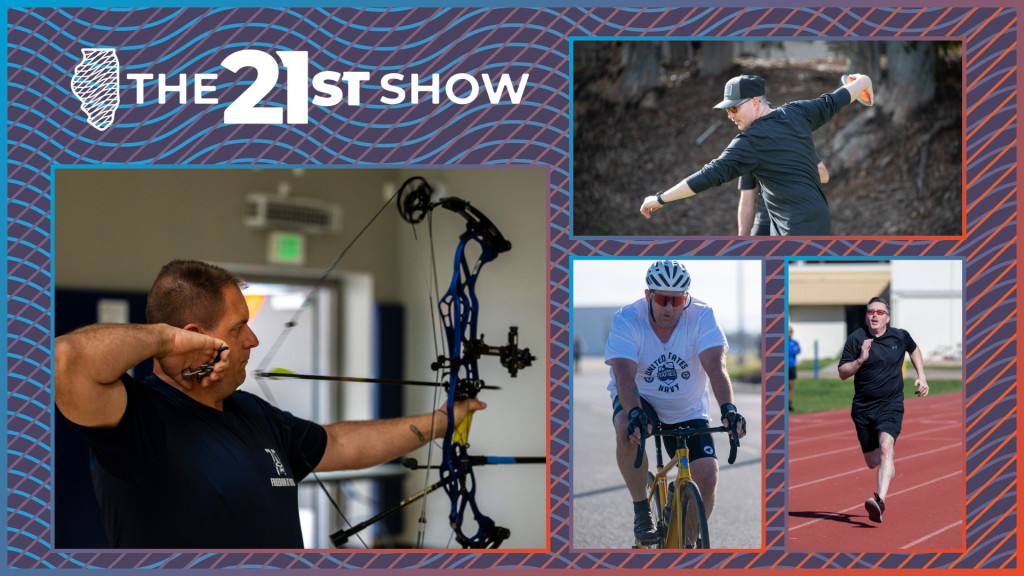
Clockwise from top right: PRI James Shoemaker hurling a discus and running; AM1 Thomas Thomas Trosper riding a bicycle and participating in archery. Handout from Warrior Games — discus by Alyssa Ross / running and cycling by TSgt Jen Healy / archery by MC3 Joey Sitter
// This is a machine generated transcript. Please report any transcription errors to will-help@illinois.edu.

[00:00:00]
Brian Mackey: It's the 21st Show. I'm Brian Mackey. All eyes are on the U.S. men's soccer team as they compete in the FIFA World Cup, but there is another sporting event taking place right now aiming to celebrate our nation's service members and veterans. The 2026 Warrior Games are underway in San Antonio, Texas. First started in 2010, the Warrior Games are meant to bring together wounded, ill, or injured service members from the Army, Marine Corps, Navy, Air Force, Space Force, Coast Guard, and Special Operations Command.

[00:00:38]
Speaker 1: Being able to participate in things like this has been extremely helpful to my recovery the entire time. I mean, you join the Army because you're a competitive person, because you want to better yourself, better those around you, better your country, and being able to have this outlet again has been incredible for [unclear].

[00:00:52]
Speaker 2: [Allison. Anna Allison for] Ocomm starting to gain ground and then we've seen this time and time again in the [four-minute] race. To really

[00:01:00]
Speaker 3: showcase some of our top athletes, we're now excited to present the medals for the 2025 Warrior Games ultimate champion. Yes.

[00:01:09]
Brian Mackey: This year, there are nearly 200 people competing in 12 adaptive sports, which brings us to our next conversation and our next guests. Navy aviation structural mechanic First Class Thomas Trosper is a native of Georgetown, Illinois, and he's competing in archery, cycling, field, swimming, and wheelchair basketball. Also with us is retired Navy aircrew survival equipmentman First Class James Shoemaker, who's competing in archery, sitting volleyball, swimming, and track. James is a native of Effingham, Illinois. They're with us for the rest of the hour today to talk about competing in the Warrior Games. Thomas, James, welcome to the 21st Show. Thank you.

And listeners, in order to make our schedules work, I should say we taped this conversation on Friday, but you can let us know what you thought. Our email address is talk@[21stshow.org]. All right, I want to begin by asking each of you about your experience with the Navy and Thomas, I'll begin with you. What drew you to enlist in the Navy?

[00:02:07]
Thomas Trosper: Influence from my family. My uncle Donnie, he was an electronic technician in the Navy, and he kept pressuring me, "Hey, you need to get out of here. There's a bigger world out there than [Vermilion] County." And 2006 was the year that I said, OK, let's do this. With the support of my wife, we — I just was tired of getting laid off from [the] factory. Yeah, so

[00:02:28]
Brian Mackey: it seemed like a good opportunity. [Family] pressure as well. What were some of the more memorable or challenging experiences you had during your service?

[00:02:39]
Thomas Trosper: Just trying to play the game in boot camp. And my uncle kept telling me, "You're not gonna do this. I'm not gonna allow you to pick this rate. This is what you wanna do. If you wanna do this, go this avenue." And a lot of influence was from him because he was enlisted, what, 20 years ago. So he still has an idea of what goes on shipboard and on the aircraft side, aviation side. So I chose AM.

[00:03:04]
Brian Mackey: Aviation, yeah. And that's again, that's aviation structural mechanic. What sort of work is that?

[00:03:11]
Thomas Trosper: It's keeping track and making sure the aircraft frame is [airworthy]. [Minimizing] corrosion, all the hydraulic systems, the tires, the paint. I'm in charge of all of it, making sure it's good to go and airworthy.

[00:03:26]
Brian Mackey: Nice. All right. And James Shoemaker, I'm gonna come to you. Same question, you know, what prompted you to join the Navy?

[00:03:33]
James Shoemaker: Well, my grandfather and my stepdad were both sailors. So living in a small town farming community, not much to do, so why not join. So I took off, went to boot camp in '05. It was fun, you know, I was a little bit older. I was 21 when I joined. Most challenging thing for me was '07 when I had to go on my first ever deployment. It's one thing going to a different city, being away from everything you grew up with. It's another thing being in the middle of the ocean, being away from everything you grew up with. And then I loved every minute of it. Came back and like I — I wanna go back out. It was amazing. I really enjoyed it and I wouldn't trade it for anything. Yeah.

[00:04:18]
Brian Mackey: So, to the extent you're willing and comfortable talking about it, can I ask each of you what injury resulted in you ultimately competing in the Warrior Games? And James, I'll start with you.

[00:04:30]
James Shoemaker: I have a neuro injury. My nerve system doesn't really communicate with my brain very well, so it likes to mess me up every now and then.

[00:04:40]
Brian Mackey: Yeah. And Thomas, same question if you're comfortable talking about it.

[00:04:45]
Thomas Trosper: I have a blood clot issue, which was found in 2024. I found it in my left leg. My left calf swelled up and that's where I found the blood clots. And then going for their investigation at the hospital, they found four blood clots in my left lung and five in my right lung. So unbeknownst to me, I have a clotting issue. Don't know why or how. So yeah.

[00:05:12]
Brian Mackey: So what has the recovery process been like for you, at least before getting involved with the Warrior Games?

[00:05:17]
Thomas Trosper: Well, for one, not being afraid to ask for help, you know, being pulled away from the job that we signed up to do, being groomed at sea — where we belong, at sea — and being told that you can't go out on a ship anymore, that was mentally really tough. And just getting the help I needed mentally, saying, "Yeah, you're still worth something. Come over here and we'll help you out and just help you recover." And this is — that's where I'm at today. So my shipmates, my teammates are all dealing with something different and when we talk to each other, their story could be inspirational for me, which a lot of them has been, and vice versa.

[00:05:59]
Brian Mackey: And James, same question to you. What has your sort of recovery path been like?

[00:06:04]
James Shoemaker: I was very — the mental part is correct. It plays a heavy toll because you're so used to being able to do and handle whatever it is, and it took a while. I was very reluctant, and Navy [VO] got a hold of me and started talking to me and — no, it wasn't an option. So I went running with it and I met my teammates. I met some very inspirational people and, and looking at them push through everything that they pushed through taught me I can push through it, and I used it and, you know, now I use it for my own kids. I wanna show my kids that no matter what you're going through, you just keep on going because you're gonna come out on the other side. And yeah, it's been a real blessing. It's really helped me out and helped me find who I used to be, even though the adaptive part — the sports might be a little bit different, but I'm still out there. I'm still competing, which is what I've always grown up doing.

[00:07:02]
Brian Mackey: So yeah, well, James, let me ask you about competing in the Warrior Games then. So can you remind us what sports you're gonna be competing in?

[00:07:11]
James Shoemaker: I'll be doing archery, track, swimming, and sitting volleyball.

[00:07:15]
Brian Mackey: How did you — those seem kind of different in a lot of ways. How did you come to choose those particular sports?

[00:07:22]
James Shoemaker: Well, we went to team trials and I tried out every sport they had to

[00:07:26]
Brian Mackey: offer. Wow,

[00:07:28]
James Shoemaker: everything, and those were the ones I was selected for. And you know, sitting volleyball is probably one of my favorite ones because I'm a team guy. Grew up playing baseball and stuff like that, so team really matters to me, and it really drives me and pushes me to compete at a higher level. I've never done track growing up, so it was the first time for me. Same with archery. And I mean, everybody's been in a pool, so I've been swimming, but never like as a race, you know, so it's been exciting. It's been fun. The training's been awesome and the people just cheering you on, regardless of how you do, they're still there cheering you on and, you know, the main goal is to finish.

[00:08:15]
Brian Mackey: What is sitting volleyball like for someone who's maybe never seen that particular sport?

[00:08:20]
James Shoemaker: I would rather play standing up. It's a little bit easier. Sitting volleyball

[00:08:25]
Thomas Trosper: is rough on the backside.

[00:08:25]
James Shoemaker: It's pretty rough. You gotta have a very strong core.

[00:08:29]
Brian Mackey: Is it in a wheelchair or like a stationary chair?

[00:08:33]
James Shoemaker: Nope, I am sitting on the ground.

[00:08:34]
Brian Mackey: Oh, on the ground. Wow, OK.

[00:08:36]
James Shoemaker: And you still play with the same rules as volleyball. The net's not as high, obviously, but you still got the same rules as volleyball, and you're just sitting on the ground moving, not allowed to come up off your butt. You gotta move on the ground. And it's fun and it really builds teamwork because you gotta have that communication skills to be able to let your teammates know which direction you're moving in and whether or not you got that ball.

[00:09:03]
Brian Mackey: Yeah, wow, that does sound really challenging. Thomas, same question to you. What sports are you competing in, and tell me a little bit about your training.

[00:09:13]
Thomas Trosper: I'm in archery, cycling, swimming, field, and wheelchair basketball. My first camp was in Maryland last year, November time frame, and I didn't know what I was getting myself into, so they threw me in all the sports, and I like a challenge, and I really like wheelchair basketball, being familiar with all the other sports. In high school, throwing shot put and [discus], I have an idea of what to do there and — just going back — all of it, all of it is just getting ready for the challenge.

[00:09:48]
Brian Mackey: Tell me about wheelchair basketball. Did you play basketball before you were using a wheelchair to do it?

[00:09:56]
Thomas Trosper: Just recreationally, never collegiate or high school level. Yeah.

[00:10:00]
Brian Mackey: What are some of the challenges that go with that, right?

[00:10:03]
Thomas Trosper: Trying to dribble and shoot. You can either shoot when you're moving or if you're open you can take your time, and it's just getting caught up trying to go left and right real quick — that's the challenge, and it's all arms. Everything's arms.

[00:10:19]
Brian Mackey: A lot of strength to move yourself around, I'm sure, and try and keep track of the ball. So, James, what is the atmosphere like, you know, so far? I know you're still getting into this — with the time we're talking, the games haven't officially opened yet — but you're competing alongside veterans and service members from other military branches. I know there are healthy rivalries that can sometimes get a little unhealthy. Marines and Navy, you know, everybody in the Air Force. How do you approach that?

[00:10:52]
James Shoemaker: Everybody here — it's like a family reunion, is a good way to put it, you know. Right before everything starts happening, you meet everybody, you talk, you enjoy, you listen, you become family. And it's just been a very pleasant atmosphere. The town, just walking around, having random people just come up to you and start talking to you about it, you know, it's been fun. Very different than what you're used to, but fun. It's kinda like a family reunion and seeing those fourth and fifth cousins you've never met before.

[00:11:32]
Brian Mackey: Thomas, what does it mean to you to represent Team Navy in particular?

[00:11:37]
Thomas Trosper: I think it's awesome. Just having the pride knowing that I've had family members in the Navy in the past — for one, family. Two, just the pride of knowing that I'm still active and I'm in the Navy.

[00:11:52]
Brian Mackey: Yeah. So, what do you personally hope to be able to get out of the Warrior Games? Thomas, I'll start with you.

[00:12:00]
Thomas Trosper: Well, I will finish all my events. I know that. If I finish fast enough, then puts me in the top three — cool. If not, I'm happy with doing my best. And everything — only expectation for me is not quit.

[00:12:17]
Brian Mackey: And James, what about you? Same question.

[00:12:21]
James Shoemaker: Finish. I wanna be able to prove to myself that regardless of how I'm feeling that day, I'm able to push, and that's a goal of mine. I don't care where I finish at. I just wanna finish.

[00:12:32]
Brian Mackey: Yeah. I guess for people who might be listening to this who maybe didn't serve in the military — or people who did, everyday people, whatever — what do you hope they better understand about the Warrior Games or about wounded, ill, injured service members and veterans? Thomas, I'll start with you.

[00:12:53]
Thomas Trosper: Don't suffer in silence, no matter how prideful somebody is. If you need help, don't suffer in silence and stray away from people you love because they do count on you. Just ask for help, try to find the help that you need, because once you do receive that help, there's nothing that you can't accomplish.

[00:13:13]
Brian Mackey: And James, same question. What do you hope people come away understanding about wounded warriors, as they say?

[00:13:20]
James Shoemaker: Knowing that there's more to recovery than medicine. Get out there, challenge yourself. I mean, that's what we're used to every day. Just because you got hurt or ill or injured, challenging yourself doesn't stop. You gotta get out of bed every day — that's a challenge. You gotta continue pushing through — that's a challenge — and do it for the ones you love, not only for yourself but the ones

[00:13:42]
Brian Mackey: you love. Thank you both so much for sharing your experiences with us. Thank you, sir. Thanks, sir.

Once again, Thomas Trosper, Navy aviation structural mechanic First Class, is a native of Georgetown, Illinois, and James Shoemaker, aircrew survival equipmentman First Class. They are both competing in the Warrior Games this week in San Antonio, Texas.

That is it for us today. Coming up tomorrow on the 21st Show, we begin with grand jury troubles. After the case of the Broadview Six was dismissed with prejudice, it came out that federal prosecutors had been improperly behaving with a grand jury in Northern Illinois, and it turns out that is part of a national trend. Judges are beginning to look with suspicion on government prosecutors who previously enjoyed the benefit of the doubt. We'll talk with a reporter who's been covering that.

Plus, we'll talk about bats in Illinois with regard to their place in our ecosystem and potential risks to human health.

The 21st Show is produced by Christine Hatfield and Jose [Zaeda]. Our digital producer is Colson Kahn. Technical direction and engineering from Jason Croft and Steve Mork. Reginald Hardwick is our news director. The 21st Show is a production of Illinois Public Media. I'm Brian Mackey. Thanks for listening. We'll talk with you again tomorrow.
The 2026 Warrior Games are currently underway in San Antonio, Texas. First started in 2010, the Warrior Games are designed to bring together wounded, ill or injured service members from the Army, Marine Corps, Navy, Air Force, Space Force, Coast Guard, and Special Operations Command.
This year, there are nearly 200 people competing in 12 adaptive sports. Among them are Navy Aviation Structural Mechanic 1st Class Thomas Trosper, a native of Georgetown, Illinois; and retired Navy Aircrew Survival Equipmentman 1st Class James Shoemaker of Effingham, Illinois.
Trosper will be competing in archery, cycling, field, swimming and wheelchair basketball. Shoemaker is competing in archery, sitting volleyball, swimming and track.
Guests
Thomas Trosper
Aviation structural mechanic 1st Class, United States Navy
James Shoemaker
Aircrew survival equipmentman 1st Class, United States Navy (ret.)