








The blue wave reaches Illinois. What do Democrats do with it?
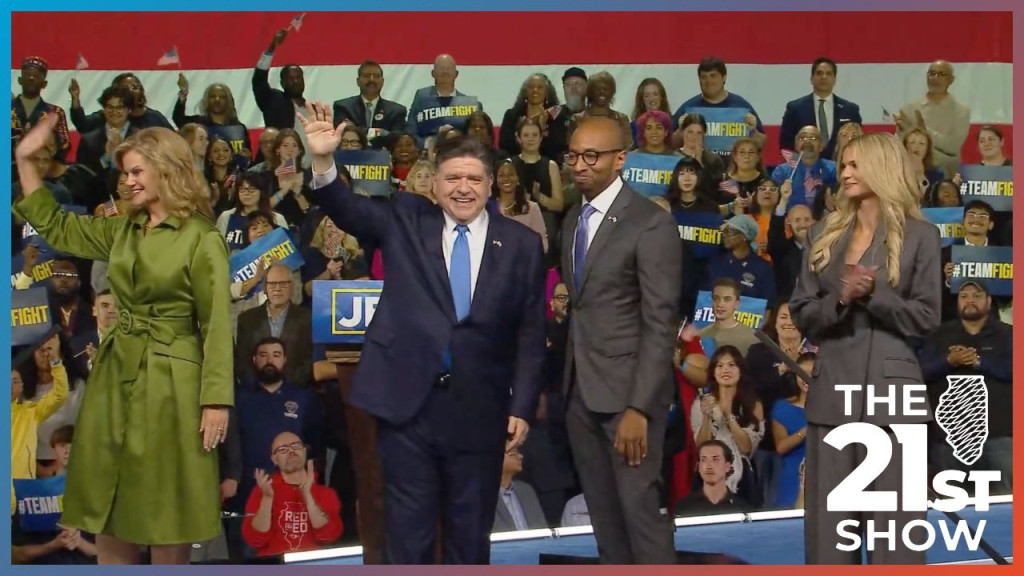
Celebrating a third term in Chicago: First Lady M.K. Pritzker, Gov. J. B Pritzker, Lt. Gov.-elect Christian Mitchell, and the governor's daughter, Teddi Pritzker. screen capture from Pritzker campaign on YouTube
// This is a machine generated transcript. Please report any transcription errors to will-help@illinois.edu.

[00:00:00]
Brian Mackey: Today on the 21st show, Democrats have won decisive victories across America and run up historic margins here in Illinois. With 90% of the vote counted, both Governor JB Pritzker and Senator-elect [Giulliana Stratton] won by 23 percentage points, a significant increase over their already strong victories in the past decade. Meanwhile, Democrats also seem to have increased their already substantial supermajorities in the Illinois [House] and Senate.

With us to talk about all that and more is Dan Petrella, political writer at the Chicago Tribune. We also want to hear from you at 800-222-9455. What did you think of what happened last night? What does it say about America? Make your voice heard at 800-222-9455. I'm Brian Mackey. That's today on the 21st show, which is a production of Illinois Public Media. But first, news.

From Illinois Public Media, this is the 21st show. I'm Brian Mackey. What a night. Democrats have won decisive victories across the country, flipping Senate seats in Maine, Ohio, Iowa, Kansas, Texas, North Carolina, and South Carolina. Beginning in January, they'll have control of the U.S. House and Senate, and a large share of governors will be Democratic as well.

That includes Governor JB Pritzker, who here in Illinois became only the second person in our state's history to win a third term, and his lieutenant governor, [Giulliana Stratton], won her election to succeed U.S. Senator Dick Durbin. We are live today and you can join us at 800-222-9455. What is your reaction to the blue wave? 800-222-9455. What does the outcome of last night's election say about America? 800-222-9455. And how should Democrats wield their power in Washington and Springfield? Make your voice heard. 800-222-9455 is the number to join us today. 800-222-9455.

Joining us to talk through the election results and what it all means is friend of the pod, Dan Petrella, political writer at the Chicago Tribune. Dan, welcome back to the show. Hope you got some sleep last night.

[00:02:33]
Dan Petrella: Not quite 6 hours maybe, but, uh, enough to be coherent this morning, I hope.

[00:02:38]
Brian Mackey: That's all we ask. Not bad for an election night. We've certainly had less — think back to 2016, for example — but that is a conversation for another day.

All right, I wanna start with Lieutenant Governor [Giulliana Stratton]. She was the top name people would have seen on their ballots across Illinois. She won her race to become the next U.S. senator here. At her election party in Chicago last night, she painted it as a victory for the people.

[00:03:05]
[Giulliana Stratton]: If you've seen me on the campaign trail, you've probably heard me reference an African proverb that I love. It says, if you want to go fast, go alone. But if you want to go far, go together. Well, Illinois, look how far we've come. And we did it together. Together we did what so many told us was impossible. Together we built a movement that reached every corner of this state. Together we showed that we can center a campaign on the people, not the powerful. And together we made it clear that Illinois is not going backwards. No.

[00:03:59]
Brian Mackey: All right, Dan, so Stratton defeated a more moderate or centrist Democrat, [Rajakrishnamurti], in the primary. So where does she fit into the broader scope of the Democratic Party, especially after last night?

[00:04:12]
Dan Petrella: Yeah, I think that's gonna be really interesting to see how her time as a United States senator matches what she said on the campaign trail. In that primary, she really tried to stake out more of a progressive lane, taking on issues such as abolishing the U.S. Immigration and Customs Enforcement Agency, though never really made clear what her plan for, um, you know, some of the responsibilities that that agency handles would be.

[00:04:35]
Brian Mackey: I will say in our interview, I mean, she didn't have like a 10-point plan, but she did say, you know, those functions would go elsewhere in the government. You'd still have borders and things like that, despite what some of her opponents said. But sorry to interrupt you.

[00:04:47]
Dan Petrella: No, totally, totally fair. And, um, you know, the $25-an-hour minimum wage is another issue that she talked a lot about on the campaign trail. Obviously, as a freshman senator, it's gonna be interesting to see what kind of committee assignments she gets, things like that, what issues she really tries to, um, you know, sink her teeth into.

Um, you know, she has been lieutenant governor for almost 8 years now, but her experience as a legislator is limited. She really was not around for very long before Governor Pritzker tapped her to be his running mate back in the 2018 election cycle. So it'll be interesting to see how that translates to work in Washington.

Um, obviously she's coming into a much better situation than Illinois Democrats on the congressional level have in recent years, where she will be in a majority and it's looking like a pretty, um, you know, sizable one by Senate standards. So, um, you know, it's gonna be interesting to see whether she's able to take a lead in pushing any of those issues, particularly something like the minimum wage, which Governor Pritzker himself has also spoken about a lot as something that needs to be addressed at the national level.

So, um, yeah, it's gonna be very, very fascinating to watch how her career in the Senate unfolds, cause she's been on the stage for quite a while now, but the lieutenant governor's role is one where it's really hard to get attention and one where there's not a lot of really defined responsibilities that go along with the job. So it's gonna be interesting to see her, um, you know, make herself known more individually on the national stage than she has here over the past decade or so in Illinois.

[00:06:25]
Brian Mackey: Yeah, and you mentioned Dick Durbin, and he was obviously — for all, I don't even know how long now, years and years — he has been the No. 2 Democrat in the U.S. Senate. And I think, you know, those of us in the press corps, from a sort of self-involved media perspective, got kind of spoiled by that, right? Having pretty good access. I mean, you were based in Springfield for a time. I'm sure you probably covered one of those news conferences he would hold on the front lawn of his house on Sunday mornings. And that is gonna be a change, going from someone very high on the seniority list to someone near the bottom of it.

[00:07:04]
Dan Petrella: Yeah, absolutely. And obviously, you know, Tammy Duckworth, who will now become the senior senator, will move up in seniority, but does not have the length of tenure that Dick Durbin had. And that touched on another interesting point, which is, um, you know, this is ending a long-running tradition in Illinois of having one United States senator from the Chicago area and one from downstate. We're gonna have a Chicago United States senator in Stratton and a suburban Chicago senator in Tammy Duckworth. So it's gonna be interesting to see the effort that they both make to try to reach out to voters downstate, to make appearances downstate when they're home in Illinois.

Um, that was gonna be something interesting to watch as well. You know, Stratton in the primary campaign, and in the general election as well, trying to play up her time leading the governor's rural affairs council as part of her work with folks in downstate Illinois. So that's gonna be really interesting to watch as well, sort of how that dynamic plays out — something very different than, obviously, what you've experienced with Durbin and others in the Senate before him who came from downstate.

[00:08:11]
Brian Mackey: Yeah, and I mean, personally, I feel like I always saw a lot more of Dick Durbin than Tammy Duckworth. I mean, some of that could just be the fact of her — frankly, it's harder for her to get around using a wheelchair some of the time — than him, and him living in Springfield. Obviously you'd see more of him. But, um, that'll be something we have to keep an eye on.

You know, I was really struck by the margins. So I'm looking at the Associated Press results page as of this morning. It says 93% of votes counted. It hasn't really moved in a while now. 61% for [Giulliana Stratton], 37.5% for her Republican opponent Don Tracy, 1.6% for the American Center Party candidate [Whitfield Harrington Jr.] So, what do you make of that margin? I'm gonna do something dangerous here, try a little math on air — 22, 23, 23.5%, I think that is, um, of a margin, that exceeds even the large margins that Democrats have had for the past decade.

[00:09:12]
Dan Petrella: Yeah, and I think — maybe I'm also gonna do a little quick math here — but slightly ahead of the margin that [Jamie] Pritzker is leading Darren Bailey by in the governor's race, with slightly less of the vote counted there. But, you know, I think there are several things going on there. Obviously, if you look at the national map, it was a very, very good night for Democrats, winning in a lot more surprising places than Illinois.

You know, I think one thing that it speaks to is just the very weakened state of the Republican Party in Illinois right now. The funding of the party, the organization of the party, in the time since United States Senator Mark Kirk lost to Tammy Duckworth and Bruce Rauner lost to [Jamie] Pritzker in those elections — it really has just fallen off in terms of its ability to raise funds, and also the appeal to voters, particularly in the population-dense suburban Cook County areas and [DuKar] County places where Republicans used to do very well in Illinois, where they frankly just don't anymore.

Um, and obviously the elephant in the room in that situation is that aligns with the time that Donald Trump has been on the political stage. So, um, you know, I think Republicans in Illinois are going to have to think about how they want to course correct, or rebrand, or however you wanna think about it, but how they can appeal to voters in some of the places where they've really lost those connections and lost a lot of races over the past decade-plus, if they want to be able to narrow some of these margins, become more relevant in the state legislature, things like that. It's a long road ahead for them, especially when some of their big funders have taken their money elsewhere. So it's gonna be an interesting time going forward to see how the party tries to course correct there and whether they can make any gains in future elections.

[00:11:21]
Brian Mackey: Yeah, and it's stunning — you think back a decade ago, you know, as the 2016 election was coming to an end, half of the statewide constitutional officers were Republicans: Governor Bruce Rauner, the lieutenant governor Evelyn Sanguinetti, Comptroller Leslie Munger, and one of our U.S. senators, Mark Kirk, was a Republican. So, you know, the idea that Illinois has always been a blue state — that is certainly recency bias at play.

But let's put a pin in the Republicans. I want to come back to them later. We'll have some tape to play. Let me remind listeners this is the 21st show. We are talking about last night's elections and what happened across the country and especially here in Illinois. If you want to join us, 800-222-9455. That's 800-222-9455.

And let's go now to the phones. We have Joyce calling from Urbana. Joyce, thanks for calling in. What did you think of last night?

[00:12:18]
Speaker 3: Um, thanks for taking the call. Um, I was struck by something that I haven't heard anyone discuss, which is the possible reaction to the lack of Congress being in session over the past year, and how much people may have been reacting to that. And I'm wondering if Democrats may be willing to make a commitment to being fully in session in their coming upcoming time of service. And I'll take the discussion offline.

[00:12:56]
Brian Mackey: All right, Joyce, thank you so much for the call. Dan, what do you think about that? Was — I mean, we certainly saw the Republicans adjourning early, I think to avoid some challenging votes in some cases. Was it also to avoid seating another member earlier this year, if I'm remembering that correctly? I don't want to get too far out over things I don't know, but yeah, take it where you will.

[00:13:17]
Dan Petrella: Yeah, and I think I recall that as well, but not with total clarity or certainty. But I think that, um, you know, one of the things that speaks to is the lack of really a strong legislative agenda on the part of the president over the past year, really since the one big beautiful bill act got passed and signed into law in summer 2025. Um, you know, there haven't been really huge major pieces of legislation they've been trying to move through. He's been trying to do much of what he has done through executive actions. Um, you know, there have been times where there's been controversial issues that they've been trying to avoid, like the release of the Epstein files and votes on war power resolutions and things of that nature.

Um, so I think it was safe to say that with an opposition House and Senate in the new Congress next year, you will see them wanting to be there a lot more, wanting to hold hearings and pass bills perhaps that they maybe even know will get vetoed if they reach the president's desk, but to signal to voters across the country — who handed Democrats a lot of power in last night's election — the direction that they would like to take the country. And I think it's gonna be hard to see, um, you know, how unified Democrats on the national level are able to stay. And if they get into big intraparty fighting, they might also decide that they should take some longer recesses and sort of work things out away from the spotlight, so to speak. So that'll be, yeah, definitely an interesting thing to watch. I think, you know, it's often a lighter legislative agenda in an election year, but I think there are particularly challenging circumstances for Republicans in Congress over the past year.

[00:15:01]
Brian Mackey: Yeah, well, and the big question is, you know, how will Democrats strike that balance of, sort of, economic issues, right, and the impulse to focus on things that — cause that is seemingly what drove a lot of the vote, right? The price of gas and other high costs — versus accountability. I saw that one of the incoming Democratic chairmen issued a statement that consisted of the words "lawyer up" last night. So certainly there will be a big push, at least among their party faithful, to do some accountability for the Trump administration.

All right, let me share some comments we got from listeners in our texting group. Helen in Springfield says, "I'm jubilant at the outcomes of yesterday's elections. I'm trusting the winners to continue performing their current duties and responsibilities as their titles and job descriptions change in the near future. I'm confident that Governor Pritzker and Lieutenant Governor Stratton will use their time planning and organizing rather than bragging or gloating about their victories. Again, I'm extremely satisfied and pleased with the election results," she says.

And in fact, Dan, we need to take a break here in about 30 seconds, but I understand the governor is speaking with reporters right now as we go to air this morning about calling on Congress to take some legislative action. Briefly, what is — what was at least the announced purpose of this news conference?

[00:16:30]
Dan Petrella: That's right. He's out with this 75-page plan — you know, some of which he sort of previewed in an interview I did with him a couple of weeks ago — but an agenda for what he'd like Congress to do, what he thinks the Trump administration should do, framed around what they should do to relieve Illinoisans from some of the pressures, economic and otherwise, that have happened under the last two years of the Trump administration.

[00:16:54]
Brian Mackey: All right, we will talk more about that when we come back. A 75-page plan on national policy from Governor Pritzker — huh, interesting. We could dig into that with Dan Petrella, political writer at the Chicago Tribune, when we return. If you want to join us, 800-222-9455 is the number. 800-222-9455.

This is the 21st show. I'm Brian Mackey. We are talking about yesterday's election results, in which Democrats seem to have had a number of striking victories across the country, flipping the United States Senate by a comfortable margin, taking back control of the U.S. House of Representatives. Of course, that won't actually happen until January.

Meanwhile, here in Illinois, Democrats seem to have expanded their already substantial supermajorities in the Illinois General Assembly, and of course Governor JB Pritzker and all the other constitutional officers won reelection by large margins. Also, Lieutenant Governor [Giulliana Stratton], who won her election for U.S. Senate, will succeed Dick Durbin again in early January, assuming things go on as scheduled.

A few listener comments to share this morning. You can join us at 800-222-9455. Chris in Rock Falls said, "Best morning after ever. While I see the need to start cleaning up the messes and working on the fixes, I don't want to hear one single person say it's time to move forward and leave the past behind us. We need accountability," Chris says. "So what we've been seeing over the last decade can never happen again."

Another point of view from Sonia in Decatur: "I'm hopeful and anxious at the same time. I hope the Democrats don't have impeachment on the agenda. We all know how that worked last time. The war needs to come to an end. It seems we can't move forward till this happens. The priorities for all Americans should be their focus."

And we also got this voicemail.

[00:19:13]
Speaker 4: Hi, I'm [Tana] from [Romanard] County. I'm not a Democrat, but I was very pleased to hear Rahm Emanuel of all people say last night that the Democrats really need to remember all the Republicans who voted for them yesterday, and also the ones who voted against them, and to remember to represent them all. I was surprised and very pleased — that would be the right thing for all ethical people to do, no matter what party we belong to. It doesn't seem like yesterday's results would have happened if a lot of people hadn't crossed party lines in order to vote for our constitution.

[00:19:48]
Brian Mackey: All right. Again, you can join us. Thanks to everybody who wrote in with texts, and [Tana] for leaving that voicemail. You can join us live today — 800-222-9455 is the number. 800-222-9455.

All right, Governor Pritzker was of course reelected to a third term. He becomes only the second person in Illinois to achieve that, the other being Big Jim Thompson, who had — I think he was actually elected to four terms because there was a shorter two-year term in there as we switched from having our gubernatorial elections lined up with the president to being lined up with the midterms. Anyway, I digress.

Governor Pritzker had this to say at his election watch party in Chicago last night. OK, we seem to have some issue with the tape there. So we'll, maybe we'll listen to that a little later.

Dan, what is your read on the dynamics of this race, especially in the context of what happened nationally?

[00:20:51]
Dan Petrella: Yeah, it was really interesting. You know, Republicans chose to nominate the same person who lost four years ago by 13 percentage points, Darren Bailey. He laid out the idea that he was going to pivot, sort of try to distance himself from President Donald Trump a little bit, present a kind of gentler version of himself, particularly when it came to his attitude towards Chicago and the suburbs, the [DuKar] counties. And, you know, struggled, I think, at times to do that or to figure out what his message was in doing so.

You know, he ended up being endorsed by the president, who had also encouraged him to run again after the tragedy that the Bailey family went through last year, where the former senator's son and daughter-in-law and two grandchildren died in a helicopter crash. But the thing that Bailey didn't have going for him this time was he didn't have his own billionaire outside backer helping his candidacy, and really struggled to raise money on his own, was not a visible presence on television.

Um, you know, and when you are competing against a billionaire who has been in office for two terms, that's a very hard way to try to win a race. Um, you know, it wasn't really — I don't think there was enough of a change in tone or in message to persuade a lot of people who didn't vote for him last time. Obviously, when you look at the results — and I think, obviously, he was also facing very, very strong national headwinds that would be very difficult even for a better-funded and maybe more, um, you know, on-message candidate to overcome.

[00:22:40]
Brian Mackey: Yeah, I still want to come back to the margins though, because as you say, it's one thing to have the sort of victory that he had, but when you look back over the past decade — I think the low point for a Democrat statewide, you know, among the top of the ticket, right? So I'm looking at governor, senator, and presidential candidates. The low point was, I think, Kamala Harris over Donald Trump, which was I think 11% in 2024. Then you get the high point being Hillary Clinton over Donald Trump, 17% back in 2016. And yet Pritzker seems to have won by well more than 20 percentage points.

Let me see — I'm scrolling here to the right page. Yeah, 2020 — 23 percentage points. Almost 60% for Governor Pritzker, 37% for Bailey, 91% of votes counted there, 3% to the independent candidate in that race, Colin Corbett. But Dan, I guess, yeah, I don't know. Same story with the Senate in the margins here. Well, actually let's — yeah, let's trust what [Tana] said in her voicemail there. What do we know about — is this, you know, Republicans crossing over? Is it turnout? What do you think of that?

[00:24:00]
Dan Petrella: You know, that is hard to say here in Illinois without really digging into the numbers, but you assume there has to be some of that, right? I'm sure there's strong Democratic turnout as well. And just on your point about the margin thing — back a little further, you know, think back to the 2010 governor's race, which obviously, in the immediate post-Blagojevich era, there are a lot of unique dynamics here in Illinois. But Pat Quinn beat Republican Bill Brady by less than a percentage point in the 2010 governor's race. So from less than a percentage point, you know, 16 years ago, to over 20 percentage points last night is a pretty big swing.

[00:24:41]
Brian Mackey: Well, yeah, we can go even further, right, because Bruce Rauner won, so it was actually negative in 2[014].

[00:24:46]
Dan Petrella: This is true, yeah, yeah. And yeah, I think obviously there has to be a lot of crossover. And I think, you know, if you wanna zoom out and look at it from a little bit more of a national perspective — I think one thing that really stood out to me last night, the New York Times on their website has their graphic where they have the map and the blue and red arrows showing the change in direction. And I may be missing one cause it's small, but every single arrow I see on that map as I look at it now on my computer screen here is a blue arrow pointing to the left, even in places like Wyoming, for example, where the Republican won the race. Voters shifted to the Democrats. And looking at their arrows for Illinois, that seems to be the case here as well.

So yeah, I think there have to have been some crossover voters here and across the country. And I think, you know, even in places like Georgia and where there was a big win for Democrats in the governor's race, it's obviously part of a larger trend. But here in Illinois, I think it extended the margin rather than changed the possible outcome of the race — I guess that would be my read on it.

And yeah, it's gonna be interesting to see what Pritzker tries to do in the third term. I had a chance to scroll through some of that plan, and you know, it obviously is federal issues, but it is — in fairness to them — a lot of stuff that affects what happens here at the state, dealing with SNAP benefit cuts and health benefit cuts and premium support for Affordable Care Act health insurance plans and stuff like that. Stuff that is done at the federal level but really does affect residents here in Illinois and affects the state budget when the state has to try to step in and make up the difference for folks when federal funding for programs gets reduced.

[00:26:48]
Brian Mackey: Yeah. All right, let me remind listeners this is the 21st show. We're speaking with Dan Petrella, political writer at the Chicago Tribune. We'll go back to the phones at 800-222-9455. That's 800-222-9455. We have Pete calling from Champaign. Pete, thanks for calling in.

[00:27:08]
Speaker 5: Hi, thank you for taking my call. I am thrilled about the outcome of the elections, though I am slightly concerned about some of the language I'm hearing this morning in regards to this being a Democratic mandate. I do think that this was by and large a repudiation of Trump and should be treated as such. I think that at the end of the day, people enjoy and want to see a bully being knocked down, and while there is celebration for that, that doesn't mean they necessarily want to be principled. And I think that the Democrats should be looking at this as an opportunity rather than a mandate for change, and that they should be using this next two years to show what they can do and what the Democratic Party is capable of when they are able to work together.

[00:27:55]
Brian Mackey: Interesting perspective, Pete. Thanks for sharing that. Yeah, Dan, what are you hearing from Democrats in terms of whether they think — you know, there's a way of looking at this election, and people can point to whatever they want and say, "Oh, this repudiates the immigration enforcement," and this, that and the other thing. But, you know, honestly, but for the price of gas being where it is, I'm not sure we wouldn't be having a very different conversation this morning. So yeah, back to you, Dan. What do you think — or what are you hearing from Democrats in terms of, you know, how much of a mandate they think they have versus how they're reading the results?

[00:28:31]
Dan Petrella: You know, I think the sense that I have gotten, in the few conversations I've had since the results came in last night, but even in some of the days before, is that it is a mandate — like the caller was saying — to show what they want to do and what they are able to get done. And I think that's gonna be the big question, right?

And I think it was alluded to earlier — will the whole impeachment issue come up again, or will Democrats decide that Trump has two years left in office and it's not worth the time and effort and divisiveness that that would involve, and do they want to focus on trying to pass legislation that they think needs to be passed and do it regardless of whether the president is gonna sign it into law or not?

You know, one of the things that the governor said a couple of weeks ago when I sat down with him was that minimum wage, for example, was something that he thought they should pass right away and should do it even if Donald Trump is going to veto it. And it got me thinking — actually, some conversations in our newsroom last night about the way the Democrats in the Illinois legislature operated in the years under Bruce Rauner, where they passed all sorts of legislation that they believed in and thought was popular with voters that they knew the governor might veto. Minimum wage again being one of them — they passed an increase and he vetoed it, and then were able to get it signed into law when they got a Democrat into the governor's office.

So I think there's gonna be very interesting dynamics to see. It's gonna be interesting to see how much fighting there is between some of the more moderate folks who are headed to Congress versus some of the more progressive folks. Obviously, over the weekend we saw the big blowup over the Michigan Senate race, with the loser of the Democratic primary withdrawing her endorsement from her former primary opponent and endorsing the Republican in that race.

So that's gonna be very fascinating to see how those dynamics play out. I think even here in our congressional delegation, some of the new folks who are going — like [Daniel Biss] in the 9th district and [Patty Garcia] in the 4th district here in the Chicago area — are on the very progressive end of the spectrum. And then you have Melissa Bean, who's a centrist, moderate candidate in the more northwest suburban area who is headed back to Congress after a decade or so away. So some of that same national dynamic may be at play here in the Illinois delegation. So yeah, they're really gonna have to decide what their priorities are gonna be — whether it's gonna be oversight or legislative policy, or whether they can balance both of those things.

[00:31:07]
Brian Mackey: Yeah, and well, to that end, the question of who is going to lead the Democrats in Washington may be part of what you're talking about there. And we have a caller on that topic, Paul calling from Urbana. Paul, thanks for calling in.

[00:31:21]
Speaker 6: Yeah, thank you. Well, on the state level, I wish that [Pritzker] would bring back the graduated income tax and ride on this wave of anti-concentration of wealth that seems to me was fundamental in this election. And to that end, having the Democratic leadership be Jeffries and Schumer, who both represent, you know, Manhattan or the boroughs — I forget which — districts, and are one of the major recipients of Wall Street and financial interest [money], is, you know, it's against what the election was about in my opinion. And we're hearing a lot of pundits pooh-pooh the idea that there might be a struggle over it. They should at least get rid of Schumer, please. So, uh, that's my contribution. And thanks for taking my call.

[00:32:18]
Brian Mackey: All right, Paul, thanks for calling in. I'm — we have one of our producers checking the transcript of our interviews with [Giulliana Stratton], because I just frankly don't remember. I know we had in our list of potential questions to ask about whether she supported Chuck Schumer to continue as the leader in the Senate. We did not get to that question in our general election interview. She's checking the primary transcript as we speak. But Dan, I don't know if that came up.

[00:32:43]
Dan Petrella: She certainly did say on the primary campaign trail that she would not vote for Chuck Schumer to be the leader. I don't know — I do believe she repeated that on the general election campaign trail as well. And that's gonna be a big question. That's a pretty concrete position that she took, and is it one that she's going to stick to?

Um, you know, I think it's gonna be interesting to see how Tammy Duckworth would vote on that same question, whether there's a split there among these two senators who are gonna be working together for the first time, who from all appearances have a very strong relationship going in. Yeah, I think that's gonna be a big question — whether Democrats want to start off this new era of having some legislative power with an internal fight over who's going to lead them.

[00:33:35]
Brian Mackey: Yeah. All right, a couple more listener text messages to share here. Jesse in [Mattheon] said, "I was excited to see that as a country we've said enough is enough. The ultra-rich had their fun. Now let's see the receipts." I guess that dovetails with what we heard from Paul there a moment ago.

Also, Ricky in Urbana: "Democrats must follow through on this opportunity to fight for equality, prosperity and cooperation. They should vote to raise the federal minimum wage, pass Medicare for all, and allow cheap pharmaceuticals from Canada, support unions through [EFCA], support equality and [voting] rights, bring the troops home, spread renewable energy more than ever before, and cut carbon emissions drastically." He goes on with some other policy suggestions, but he — or she — comes to the conclusion: "Trump may veto every move they make, but Democrats have to stand for a clear, positive, unifying message," Ricky says, "or lose the chance to achieve positive good. Prioritize that over prosecution."

Thanks to everyone for calling and writing in. You can still call in — 800-222-9455. We're gonna talk more about where the Illinois Republicans go from here and some of the other races that happened last night. Dan Petrella of the Chicago Tribune is with us.

This is the 21st show. 800 — it's the 21st show. I'm Brian Mackey. I'm so eager to give the number out cause I want you to join us today. 800-222-9455 to join us on the air. 800-222-9455. Let us know what you think about what happened last night in the general election, when Democrats really had a very strong performance across the country and here in Illinois. We're talking about that with Dan Petrella of the Chicago Tribune, who is a political writer there and has been covering many of these things.

I want to come to the Republicans in a moment, but I don't want to move off Pritzker yet. Dan, he has been for a time very coy about what his future plans are. I know you were on the [Illinois] podcast with [Patrick Fingston] earlier this year, sort of debriefing on Patrick's sort of long back-and-forth with the governor about whether he would run for president. And then you and a friend of the show, a friend of mine, [Dan Vck], recently collaborated on a story for the Chicago Tribune about how Pritzker is spending millions of dollars around the country to extend Democrats' reach and his 2028 network, as the headline says. So what do we know about Governor Pritzker's future plans?

[00:36:36]
Dan Petrella: Still being pretty coy, but obviously, even just as governor, he sees himself — and has, I guess, you know, if you look at the results last night in the races where his [Ready for the Fight] PAC, which is involved in congressional and Senate races in other states where they were involved and performed well, you know, can say that he has had an influence in some of these races.

Um, obviously he has ambitions to be involved at the national level. Whether he is going to go ahead and jump into the presidential race is still yet to be seen, but obviously he has positioned himself as a power player within the Democratic Party. And I think, you know, in his position as the now going-to-be three-term governor of a solidly blue state, but also somebody who has an immense amount of financial capital that he can invest in these races — um, you know, one place where he seems to have really made a difference is the Texas governor's race, where he really put his political force and some political capital behind [Gina Hinojosa], the governor-elect there in Texas, who was able to defeat Greg Abbott. Um, you know, I think there's a lot of personal bad blood there with Greg Abbott over many issues.

Um, you know, I think it's gonna be interesting to see if he does decide to run — whether he waits to announce a run until the, you know, first legislative session of his third term wraps up in late May or early June, or if he jumps in sooner than that. Um, you know, I think there are a lot of questions about his viability as a candidate. One of the big questions is, you know, this sort of idea of economic populism — that sort of thing is ascendant on sort of both sides of the political spectrum. And is a billionaire —

[00:38:37]
Brian Mackey: Is that who Democratic primary voters want right now?

[00:38:41]
Dan Petrella: Is that the standard bearer you want for a party that's trying to reposition itself as the party of working people? And you know, I think the counterargument to that is there was a lot of that skepticism about [Pritzker] when he got into the Democratic primary for governor in 2018, and I think he dispelled those concerns for a lot of people. And then, you know, there are progressives who still have that question from time to time over various issues, like the graduated income tax, which they have not gone back to since it failed in 2020. So it's gonna be very interesting to see how he and his team navigate all of those issues over the next six months or so.

[00:39:21]
Brian Mackey: Yeah, I — so you're in [Dan Vck's] story — that he has spent nearly $39 million so far this election cycle. And you know, on the one hand that is a lot of money, but for him, if you take his net worth as — let's just say $4 billion, that's in the range that Forbes reports — $39 million is less than 0.1% of his worth. So nothing to him. I mean, it's a very sort of low-cost move to keep his options open, I guess.

And let me put this out there to listeners, right? If you are an engaged Democratic voter, what do you think? Would you want to see Governor Pritzker over a [Wes Morris], a Pete Buttigieg — you know, some of the other names that have been floated as potential presidential candidates? What do you think about Governor Pritzker setting his sights beyond Illinois? Let us know — 800-222-9455.

Well, Dan, I want to talk more about Darren Bailey. This was his second defeat to Pritzker. We mentioned that he also lost a Republican primary in between against Mike Bost in southern Illinois. We have some tape from his concession speech last night in Effingham, when he led the crowd in prayer.

[00:40:38]
Darren Bailey: Lord God, I pray for this constitutional republic that I know that you gave for us for a very specific reason. And Lord God, I pray that in the days ahead, men and women of integrity that would desire to stand for what is true, what is noble and what is right would rise up, Lord God. This isn't the last of Illinois. This isn't the last of this nation. And Father God, maybe it's a new day because it's a new low.

[00:41:08]
Brian Mackey: A new low. So, Dan, I mean, I guess — I'll leave it to theologians to discern the, you know, the biblical implications of that, but it's certainly true in terms of modern Illinois politics: a new low for the Republican Party. Where do they go from here?

[00:41:28]
Dan Petrella: That is a very good question. And one of the things that was sort of head-scratching to me this morning that landed in my inbox was a statement from the Illinois Freedom Caucus — which is the farthest right group within the Illinois legislature, out of which Darren Bailey emerged as a statewide figure largely based on his opposition to the governor's mask mandates and other moves during the early part of the COVID pandemic — saying that, you know, we've lost this many seats over the past several election cycles. Is it time to stop and ask yourself, other Republicans, what do we need to do differently?

Um, and my sort of response to seeing that was, you know, maybe a little introspection is needed there, because as the party and the primary voters have moved more in that direction, the influence of the party writ large across the state of Illinois has diminished. And so, you know, President Trump has been very unpopular in Illinois since he entered the political arena. You know, he got involved in national politics — I don't know, maybe for the first time, but most prominently — with his peddling of conspiracy theories about Barack Obama's birth certificate and things like that. So he has never been popular among voters in general in Illinois.

And so maybe this gives the Republican Party in Illinois a chance to move away from that. It'll be interesting to see nationally if Republicans start to distance themselves from Trump. You know, that line of thinking is just — unless there's a major shift in the electorate, or obviously there are many events that can change people's minds — but that sort of social conservative message is not one that has broad appeal across the state of Illinois.

You know, I think it's misleading when you look at all the red on the county-level maps of election results, right? Because three-quarters or so — over, let me do some quick math in my head — yeah, about three-quarters of the state's population lives in six counties in the northeast corner of the state. So, yeah, it's understandable how folks in those other places that appear red on the map feel, you know, left out or unheard. But it's important to remember that the vast majority of the people are packed into a pretty small geographic area.

[00:43:57]
Brian Mackey: All right, let's go back to the phones. We have Patricia calling from Freeport, Illinois. Patricia, thank you for calling in. What are you thinking about this morning?

[00:44:06]
Speaker 8: Well, I just have a statement that I'd like to share with you that really touched me when I heard it. It's by a very popular politician. And he said the most important office in democracy is the office of a citizen. And I so believe that, and I have tried to practice that. Instead of complaining to the neighbors about situations in my community, I try to go to the powers that be and I try to present maybe positive inputs of what could be done to be changed. So far I've been very successful with that. And I think the grassroots people just make an amazing difference when we come together in communication with each other.

Um, I was — I'm actually been transferred here from Kansas City, so I was thrilled when I saw what happened with [Adam Hamilton], who I know, and I know his mother. And so I just know that when we bond together and we're positive, so much more can be done than tearing down other people and tearing down what's happening. Find a better way, be the change you want to make.

[00:45:22]
Brian Mackey: Patricia, lovely sentiment, small world. Thank you for calling in. Appreciate you doing so today.

Um, Dan, just a few minutes left on the show. I do want to mention, as we were talking about Republicans and the Freedom Caucus — which does tap into a minority view, but some real heartfelt discontent among some people in Illinois — another manifestation of that is the Illinois separation movement. This is the idea to partition Illinois into two states. It was on the ballot in 11 more counties, succeeded in all of them. And the question has run the table — it passes every time it's come before voters.

You know, that said, I believe — with the exception of Madison County in the Metro East — this is still largely a phenomenon of mainly rural counties with smaller populations. Last night on our livestream, Brian Gaines, who's a state politics expert at the UI, he put this in some context.

[00:46:17]
Brian Gaines: I think there are some true believers here, people who really would very much like to break the state up. But, you know, I would agree it's not going to happen, and I think some of the easy passage of these advisory questions — some of that is essentially symbolic voting.

[00:46:32]
Brian Mackey: Yeah, symbolic voting. So, you know, Dan, it's one thing — you have true believers and also people shaking their fist in an orderly direction, which is a tried-and-true tradition downstate in Illinois. You know, that's one thing. This movement would require the General Assembly to make it happen. And so, you know, maybe this is a good time to talk about state House and Senate elections. What is the big picture there, briefly?

[00:46:57]
Dan Petrella: Uh, similarly, not good for Republicans. I'm relying on the New York Times for this cause they've got the easiest number breakdown, but as it sits, Democrats look like they've picked up at least four seats in the Illinois Senate and at least two seats in the House. But it looks like when some more races are called, it might be a wider margin than that.

Um, you know, Republicans losing seats in places like DuPage County in particular, which not that long ago was the bastion of the Illinois Republican Party. Full disclosure, that's where I grew up — I grew up there in the '90s when I believe Henry Hyde was my congressman. And, you know —

[00:47:45]
Brian Mackey: State legislative leaders were from there on the Republican side.

[00:47:49]
Dan Petrella: Absolutely, that's right. Yes. And when Republicans had majorities for part of the decade at least in Springfield. So, you know, that sea change has been quite dramatic, and it's happened across the suburbs. I think even McHenry County, which is the far northwest suburban county that had still gone to Republicans, I think Pritzker won pretty handily last night. So yeah, it's gonna be interesting to see how Democrats work with these larger majorities in the House and Senate.

The House majority has been difficult to manage, to say the least, over the last several years as it's grown in size and, um, you know, gotten more diverse in its, you know, center-left and —

[00:48:33]
Brian Mackey: Further progressives, yeah, exactly.

[00:48:35]
Dan Petrella: — and they've really had some tough times coming to consensus on issues, you know, from healthcare for immigrants who are in the country without legal permission and things like that, all sorts of issues where the moderates and progressives have not seen eye to eye. And it's taken extra time for the legislature to wrap up its business.

It's gonna be very fascinating to see how far they push the envelope on some issues as well, and whether there's maybe pressure put on Governor Pritzker to act on some things like the graduated income tax that, you know, more progressive members of his party would like to see him take a bigger stand on. So it's gonna be a fascinating [time].

[00:49:18]
Brian Mackey: They say that would require a constitutional amendment, which would have to go before voters at some point as well, correct?

[00:49:23]
Dan Petrella: Yeah, and he actually technically doesn't have a formal role in that process, but obviously his political force behind that would make a big difference in motivating legislators to actually take the votes needed to put it on the ballot, and his resources to run a campaign —

[00:49:38]
Brian Mackey: His political force and his wallet. Very much factors in Illinois government and politics, still. Dan Petrella is political writer at the Chicago Tribune. Thanks so much for sharing your reporting with us today on the 21st show.

[00:49:52]
Dan Petrella: Thanks, [Maran]. Good to chat.

[00:49:54]
Brian Mackey: That is it for us today. Thanks to everyone who called in and sent text messages today. Keep the conversation going. You can always reach us anytime, day or night, at our email address, which is talk@21stshow.org. talk@21stshow.org.

Tomorrow on the program, we'll be talking with Ambassador Eric Whittaker, Illinois native and now retired ambassador, about what's happening around the world and how it relates to us here. The 21st show is a production of Illinois Public Media. Thanks for listening.
Democrats won decisively across the country Tuesday, and Illinois was no exception. Gov. J.B. Pritzker won a third term, defeating Republican Darren Bailey for the second time. Lt. Gov. Juliana Stratton won the race to succeed U.S. Sen. Dick Durbin.
Chicago Tribune political writer Dan Petrella joins The 21st Show to sort through the results. Topics include where Stratton fits in a changing Democratic Party, Pritzker's national ambitions and the money he's spent helping candidates around the country, what's next for Illinois Republicans, Democratic gains in the General Assembly (and DuPage County), and another round of wins for the movement to split Illinois in two.
Plus, listeners from across the 21st state shared their reactions, along with what they want Democrats to do with their new power in Washington.
Discussed
- AP: Illinois Results
- Chicago Tribune: Gov. JB Pritzker spending millions in Texas and beyond to extend Democrats’ reach — and his 2028 network
Guest
Dan Petrella
Political writer, Chicago Tribune