








The rise of socialism in Illinois and beyond
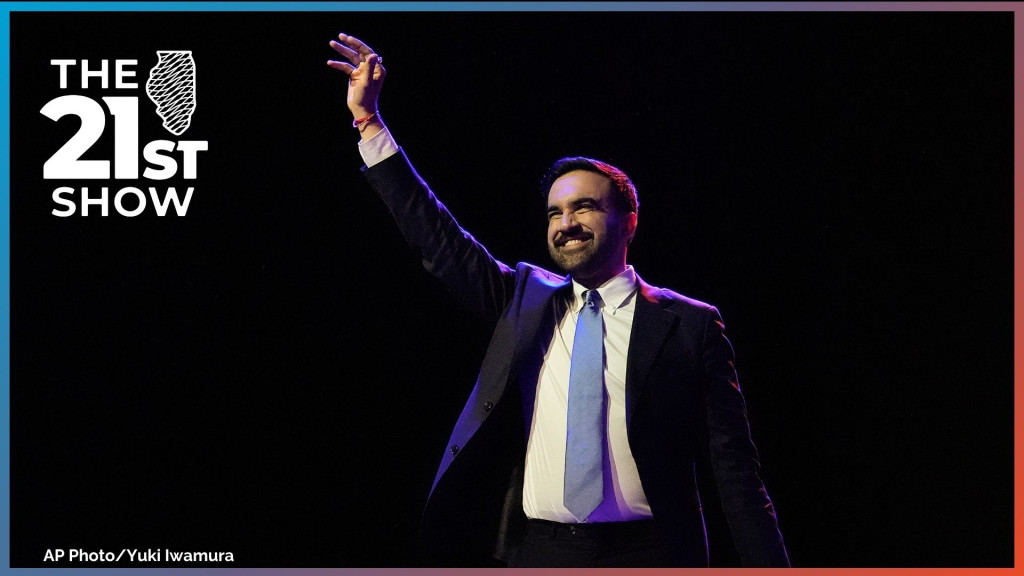
Zohran Mamdani reacts as he walks on stage to speak at a mayoral election night watch party, Tuesday, Nov. 4, 2025, in New York. Mamdani identifies as a Democratic Socialist and his election as mayor of New York City was a large win for the socialist movement. AP Photo/Yuki Iwamura
// This is a machine generated transcript. Please report any transcription errors to will-help@illinois.edu.

# Transcript: The 21st Show - Discussion on Democratic Socialism in America

[00:00:00]
Brian Mackey: Today on The 21st Show, when someone mentions socialism, what do you think of? Breadlines and government repression or free college tuition in a more just society? Among young people, socialism is better regarded than capitalism, and the Democratic Socialists of America have had some electoral success. We'll talk about that with one of several DSA elected officials in Chicago, two organizers who focus on downstate, and a scholar who's written about the history of socialism in America. I'm Brian Mackey, and that's all coming up today on The 21st Show, which is a production of Illinois Public Media, airing on WILL in Urbana, WUIS in Springfield, WNIJ in Rockford DeKalb, WVIK in the Quad Cities, and WSIU in Carbondale. But first, news. From Illinois Public Media, this is The 21st Show. I'm Brian Mackey. In recent years, the idea of socialism has been gaining ground in American politics. The most prominent and successful avatar of that is Zoran Mamdani, who just a few months ago became mayor of New York City.

[00:01:24]
Zoran Mamdani: We will govern without shame and insecurity, making no apology for what we believe. I was elected as a democratic socialist and I will govern as a democratic socialist.

[00:01:40]
Brian Mackey: Even here in the 21st state, there are people who support socialist policies. Earlier this year, we talked about that with one of the many candidates in the Democratic primary for U.S. Senate, Brian Maxwell.

[00:01:52]
Brian Maxwell: I support socialist policies. I think the identification of isms and iss gets really lost in the weeds and people put too much identity behind a label, but I do support socialist policies because we see them succeed all across Europe and we have many socialist policies here in the U.S. with respect to even some healthcare policies, how we essentially subsidize public roads in this country. That is a mass public that benefits society that we all chip into.

[00:02:29]
Brian Mackey: But the label of socialism has also been used as an attack on policies and politicians from center-left moderates to hardcore progressives. We also heard evidence of that in our Senate interviews. This is from a Republican primary candidate R. Cary Capparelli.

[00:02:43]
R. Cary Capparelli: What we see now is a lot of movements towards socialism in the United States, and a lot of these people have worked their way into government. And we have to be careful of that as well. It's downright scary because it doesn't allow for any bipartisan policies to go through. The left wants — the left today is not the left of what it was 20 years ago. They want much, much more like I — like I said, I believe they're much closer to socialism than representing a democratic form of government.

[00:03:16]
Brian Mackey: Today for the hour, we're gonna talk about just what it means to be a socialist in 2026, and why more young people have a favorable view of socialism than capitalism. Later in the hour, we'll hear from a couple of democratic socialist organizers in Northern Illinois, and we'll talk with a scholar from Illinois State University about the history of socialism in American politics, and why many people still associate socialism with things like bread lines and government repression. We start though with someone who's found electoral success in Illinois as a Democratic socialist. Rossana Rodriguez Sanchez has been alderwoman for the 33rd ward on Chicago's city council since 2019. She defeated an incumbent Democrat by just 13 votes in a runoff, and she also co-founded the council's Democratic Socialist Caucus. Alderwoman Rodriguez Sanchez, welcome to The 21st Show. Thanks for being with us.

Rossana Rodriguez Sanchez: Thank you for having me.

Brian Mackey: And listeners, you can join the conversation throughout the hour today by calling 800-222-9455. What does socialism mean to you? What socialist policies would you support or oppose? And what do you think of the group of rising politicians who are joining the DSA? Again, the number 800-222-9455. All right, Alderwoman Rodriguez Sanchez, let's start with a definition. What does it mean to you to be a democratic socialist?

[00:04:42]
Rossana Rodriguez Sanchez: I think it is the belief that human rights need to always be over market values. I think that democratic socialism is fundamentally the belief that social goods like healthcare, housing, safety — those are fundamental human rights, and they should not be subjected to the whims of the market, right? We shouldn't allow the greed and the need to make profit from individuals and companies to trump the responsibility of government to provide for people, right? And I would say that's how I view it.

[00:05:33]
Brian Mackey: How does your vision of socialism differ from the people in history who have claimed that title, right? Like the Soviet Union, the full title of which was the Union of Soviet Socialist Republics.

[00:05:44]
Rossana Rodriguez Sanchez: I don't think that I am too distant from the theoretical lens. I think that centering humanity and putting people over profits and making sure that we have democratic control over both the means of production and democratic control over government and the services that government provide is fundamental to democracy. We unfortunately have grown up and have been socialized in a capitalist system that focuses on individualism, right? Like pull yourself up by the bootstraps, like work, work, work, and the idea that if we collectively can decide on what are the things that we need to produce for the benefit of humanity, how do we care for the earth so that we can sustain our lives in this planet and it's not about extraction all the time to produce things that we don't even need, right? We don't have a say under the capitalist system around what is being produced, around how we provide services for people. We privatize things and then decide, for example, with housing, housing is such a great example. Right now we have so little resources to house people, right? Like I am struggling right now in my community with rising rents, displacement, people who are having to sell their homes because property values are going up so much and that means that property taxes are going up. So I am losing the people that live in my neighborhood who — my neighborhood is [one] of the most diverse neighborhoods in the country. And the reality is that what we are relying on in order to provide housing is the housing market and the housing market is about making profit so you're not going to provide affordable housing for people because there are people that are looking to make a profit out of it. If we looked at it from a different lens and we decided, well, housing is a human right and people deserve to have housing and the government is supposed to provide this housing and we could actually create a system in which we can do social housing which is — this is not rocket science like there's countries that do this right. Then we would be able to guarantee the stability of our communities. We would be able to guarantee that our children can go to the schools in the community. We would be able to guarantee safety for people, right? We could eradicate homelessness, but that's not what we're doing because there has to be profit made out of this basic service. I think that's the best example that I can give around democratic socialism.

[00:08:43]
Brian Mackey: So that's still in sort of aspirational policy. What would you say the effect of having —

Rossana Rodriguez Sanchez: You say aspirational, but like this is happening. They do it in Finland.

[00:08:54]
Brian Mackey: Well, I mean, OK, it's an aspirational policy. Here's — so I wanna — I'm curious how, what have you put into practice? What have you been able to put into practice? What is the DSA brought to Chicago, for example?

[00:09:04]
Rossana Rodriguez Sanchez: Let me clarify. DSA — I am a member of DSA, but our movement here in Chicago is not run by DSA. We have a really good relationship with DSA. We collaborate. We talk about priorities, but the way in which we have organized here in Chicago, we organize in the northwest side of Chicago, and we have a very particular model of organizing that is outside of the DSA. We are a group of elected in the northwest side of Chicago, and we practice democratic socialism in our communities by organizing hyper locally around multiple issues like homelessness, like mental health, like housing, like immigration. And we have been able to create all of these networks of solidarity in our communities and we are also winning elections, right? And so we have an electoral model that allow for us to be able to continue to run candidates that have the same vision as us and then we also from our offices we use the resources that we have to make sure that we're giving access to the services and resources that people need. And then we are also consulting people constantly because we believe deeply in democracy, right? So for example, you are asking me how I have been able to do this in my community. I have a community driven zoning process and our community driven zoning process means that whenever somebody comes to my office to ask for a zoning change because I have power over zoning, right? What I do is that I pass that power on to the community and if people are not happy because you are trying to dismantle a three-flat to do a single family home, I'm not just gonna give you the zoning change, right? We are going to go to the community and we're going to ask the community, is this something that we want? So the community is an active participant and if the community says we don't want that, then I don't approve the zoning, right? So we have a very democratic way of thinking about how we develop our communities and this also includes when we do zoning changes to do affordable housing projects for example. Some people might be opposed to it, but what we do is that we organize in the community. We educate people around the need for affordable housing, and then we have a community meeting and then people come and people ask questions, and then everybody understands that, OK, this is a very important thing that we need to do because people need a place to live, right? So by bringing democratic processes into spaces where usually bureaucrats just make decisions, you are fundamentally being able to do political education and you are able to bring people into the decision-making space around how we provide services.

[00:12:04]
Brian Mackey: What is your relationship like with the more traditional Democrats in Chicago?

[00:12:10]
Rossana Rodriguez Sanchez: I mean, I work with my colleagues in the Democratic Party. I think that for a very long time, they saw us as fringe, and I think that they are having a moment of reckoning right now with the fact that we are building power from the grassroots that they just cannot match. I'm going to give you an example. This last cycle, electoral cycle for the Democratic primaries, we ran a candidate for Illinois 40th district for state rep. We decided to run this candidate because the person that was on the seat, which was a traditional democratic middle of the road moderate person, was not doing what we needed him to do. He did not show up at all during the ICE raids when we were organizing. He has not been fighting for affordable housing. He has not been doing any of the things that we have been organizing for, and that particular seat was the only seat that we didn't really have access to in terms of resources to organize, right? So we decided to run a neighbor of ours that is an organizer and that was leading a worker center for immigrants in the community two months before the election. Nobody knew him. Nobody knew his name. After we organized, the incumbent had about $2 million put into his race. We ended up with around $300,000 for the race. We won that election with 56% of the vote after this person was an incumbent for 13 years and before that he worked for the alderman of my ward, the former alderman of my ward Dick Mell that was in office for 38 years. This man had deep roots in the community. He had been serving for a very long time. We were able to take him out because of our organizing. So now I'm getting calls from the Democratic Party saying that they want to sit with us, that they want to collaborate with us because they are seeing not only that we are organizing like hell but that we're winning elections with no money that you can throw millions of dollars at a race and you're not gonna win because we know how to organize. We know how to talk to people, we know how to educate people politically so that they can make informed decisions about their reality, right? So I would say that my relationship with Democrats right now is one where they are seeing us more as equals and not as this fringe radicals who are rebels without a cause and just want to scream, right? I think that we are getting to a place that there is way more respect for us and they are even trying to learn from us and our models of organizing.

[00:15:19]
Brian Mackey: Alderwoman Rossana Rodriguez Sanchez represents Chicago's 33rd ward on the city council there. She co-founded the council's Democratic Socialist Caucus. Alderwoman Rodriguez Sanchez, thanks for joining us today.

Rossana Rodriguez Sanchez: Thank you.

Brian Mackey: I'm gonna share a text from our listening group. Jean in Bloomington says virtually all socialist countries embrace capitalism, but they also redistribute resources to assure all or most citizens have their basic needs met — housing, health, education, opportunity. Some members of society certainly have more and others less, but ideally all have enough. She goes on to say, I once had a college student from Holland, who was appalled when he realized Americans could go bankrupt from medical bills or worse, not get the critical medical care they needed at all. How can this be? he asked, in the richest country in the world. A good question for sure, Jean says. Thanks for that message, Jean. If you want to join us today live, you can do so by calling 800-222-9455. That's 800-222-9455. After a short break, we're gonna hear from a couple of democratic socialist organizers who are working in Northern Illinois. I almost said downstate, we can debate that another time. But we're gonna hear what it's like to try and organize democratic socialists outside of a place like Chicago. We're also gonna talk with a scholar about the history of socialism in American politics and how it's evolving today. Again, if you wanna join us, 800-222-9455 is the number. What does socialism mean to you in 2026? More to come after a short break. This is The 21st Show. Stay with us.

It's The 21st Show. I'm Brian Mackey. Our topic for the hour today is socialism — from the way it's been getting prominence in politics over the past few years to what is its attraction to people, especially younger Americans. We're also talking about what that means in labor and politics. We asked our texting group how they think about socialism, and you can join that, by the way, by texting the word "talk" to 217-803-0730. You can find that at our website as well. Heather in DeKalb says, I feel like socialism approaches governing in a way that addresses the actual health and happiness of a community as a whole, more than a capitalist approach. To me, it feels more concentrated on providing equal opportunity and community building than capitalism and can really elevate a society. We also heard from Adrian in Carbondale, who says, I'm not young anymore, but I fully support socialism. I think socialism usually boils down to humane choices. And I wish that Illinois and all of the United States would start having ranked choice voting, so that it would be easier to have socialist candidates without having them be spoilers. It's an interesting question there. For the next part of the show, we're gonna turn to a few of the people advocating for democratic socialism in other parts of Illinois. Ricky Newcomb co-chairs Quad City chapter, or I should say the Quad City chapter of the Democratic Socialists of America. Ricky, welcome to The 21st Show.

[00:19:01]
Ricky Newcomb: Thank you for having me.

[00:19:03]
Brian Mackey: Also with us is Dave Rathke, executive board member for the Northern Illinois chapter of the DSA which covers Rockford and DeKalb. He's also a founding member of the National DSA. Dave, welcome to you as well.

Dave Rathke: Well, thanks for having us.

Brian Mackey: Ricky, I'm gonna start with you. How would you describe your political values?

[00:19:22]
Ricky Newcomb: Yeah, I think democratic socialism is really about solidarity with all peoples, and I think, you know, a lot of people in this country — just reiterating what the alderwoman stated, you know, a lot of people face an affordability crisis, and that's been ongoing for a long time now. Many people are a crisis, you know, a medical crisis or any other personal crisis away from being completely financially ruined, personally, so I think that's what draws people to this.

[00:20:02]
Brian Mackey: Dave, same question to you. How do you describe your political values?

[00:20:07]
Dave Rathke: Well, I'm a large believer in democracy, and I think — is democracy, you know what we're seeking to do is to democratize every aspect of our lives. Think about your workplace, for example. You go to work and basically you surrender your rights as a citizen until you leave work that day, right? No democracy on the job, in our social institutions. More and more they're further and further removed from people. So my values, I've been a socialist my whole life. I mean, it comes from being raised in a union family in Detroit, you know, seeing day to day this class struggle that was going on, but I think what you're seeing now in this country — you know, they say in politics there are only three things that are important, right? Timing, timing, and timing. And I think what we've seen is because I'm older than everybody else on this group, we have seen a half century of decline for American workers. You know, the high point for American workers was 1973, so most of your listeners, most of the population, has experienced a stagnant or downward economy, an economy that cannot provide the basics anymore, can't provide housing, education, healthcare, decent wages, or retirement. You know, 60% of Illinoisans have no retirement, no pensions, right? So I think that what you're seeing this resurgence in interest is a recognition — long term, took a long time — is that this system no longer serves us and it's kind of, you know we moved on from feudalism to capitalism and it's time to take the next step and move on from capitalism to socialism.

[00:21:54]
Brian Mackey: Well, all right, let's talk about how this is actually playing out sort of in the field, so to speak, right? Dave, what is the status of the socialist movement in your part of Illinois?

[00:22:02]
Dave Rathke: We've got in our six counties that we represent in our Northern Illinois chapter we have about 200 members. We've had some that have been elected to local office on and off over the last six to eight years, but we're — we're like a lot of people, we're trying to figure out where to go. I mean, Chicago — I mean they're a good example for us, but New York even better. But I think socialism is relevant to people out here in the rest of Illinois. But I'll be honest with you, we're kind of, we're kind of struggling as to, you know, what kind of models we approach, directions we take, so, you know, I don't have an easy answer for you right now. You know, we're meeting, we're forming mutual aid groups, we're working on the immigration issues in our area, but we're trying to restart Medicare for all campaigns. Most Democratic congresspeople have signed on. The two in our area, Lauren Underwood and Eric Sorenson have not. We're working to try to get them to sign on to support Medicare for all, so we're kind of in the beginning stages here.

[00:23:15]
Brian Mackey: Ricky Newcomb, what about in the Quad Cities? What is the status of the socialist movement where you are?

[00:23:21]
Ricky Newcomb: Yeah, we've enjoyed a great growth just due to electoral victories elsewhere, like New York, like Chicago — those catch a lot of media attention and get people more interested in socialism, but those victories require a lot of groundwork and many years of organizing behind them on many different fronts. So, you know, we're working on the labor front, on providing workers with resources to unionize and providing strike support when unionized workers do go on strike, like with the Starbucks Workers United. So we've gone out there for them. Mutual aid work, especially with the unhoused population over in Davenport, Iowa, and I will be speaking a bit about Davenport across the border here, even though this is an Illinois show. But we provide mutual aid support, talking with our unhoused neighbors, not just ignoring them like our cities do and many other people do here, and providing hygienic — coats in the winter, hygienic products at all times here. Electoral work we're exploring. Trans rights, especially in Iowa where these rights are being attacked. We're a two-state chapter. International work to provide resources for immigrants regarding ICE, especially if ICE visits their workplace, and to provide solidarity with the Palestinian community and for other international issues, especially with the ongoing war with Iran. And communications and education to get our message out there more.

[00:25:15]
Brian Mackey: Let me remind listeners, this is The 21st Show. We're talking for the hour today about socialism and what that means in 2026 as we've seen in public opinion research, younger people are more likely to say they have a favorable, at least a somewhat favorable view of socialism than are to say they have that view of capitalism. But the numbers are quite reversed as you move up the age spectrum. Once people are middle aged and older, much more favorable view of capitalism than socialism. And we're talking about that with Ricky Newcomb, who's co-chair of the Quad Cities DSA and Dave Rathke, executive board member of the Northern Illinois DSA and a founding member of the Democratic Socialists of America. I wanna share a text message. This is from Denise in Monrovia, who said, I was raised in the duck and cover and build a bomb shelter era. Socialism always will remind me of the USSR and the terror we felt. Today, with capitalism, I see greed, corruption, payoffs, and fascism. It's always been there, just not so open and exposed. Socialism would, in theory, be ideal, but corruption always finds a way in. Still, I find hope in the younger people running for office. Thanks for that message, Denise. If you want to join us today, 800-222-9455 is the number. Dave, how do you respond to that critique, right? When people come in with that historic view of socialism, which I — and maybe you disagree with this — it seems our first — I didn't get a chance to follow up with the alderwoman on this. But when I asked her about, you know, how she differentiates herself from, say, the Soviet Union, she said she shares a lot of that lens or not that she's not that far from the Soviet lens. But I mean, obviously there was a lot of mass killing there, repression, bread lines. So how do you respond to that?

[00:27:06]
Dave Rathke: Well, I think that there is a history that we should be looking at, you know, this is the 100th anniversary this year of the death of Eugene Debs, who is the most prominent socialist in America. He was up at Elmhurst [Lyndhurst] Sanitarium in Elmhurst when he died after serving time in prison for opposing World War I. But you know, less than 10 years after his death, the Socialist Party platform that he had espoused his entire life was almost lifted wholesale into the New Deal. Social Security, the rights of workers to organize unions, the end of child labor. I mean these were all enacted. These were the Socialist Party issues it fought for for years and when the economic crisis happened, as I said earlier, timing, timing and timing, when they looked for solutions to mitigate the disaster that capitalism was undergoing, they turned to our traditions. You know, for most young people the Cold War is ancient history. They have no concept of that. Most of them were born after — of course they were born after the Berlin Wall fell, right? So for them their experience has been this one ideology, this capitalism, as the famous socialist and labor organizer Mother Jones said, you know, capitalism has no soul nor love for humanity. People see that it's a machine, a machine that's going to destroy us actually. You know, the only thing that motivates capitalism is profit. So when deindustrialization happened to our state and jobs left to go to cheaper labor markets, when AI now, which is on the horizon, threatens to, you know, cause mass unemployment among white collar workers, you know, when people see this, and finally when the profit motive is so great that it's willing to take humanity to extinction, you know, with global warming and all the byproducts of this thirst for — I think people look at it and say this is nuts. We can't continue down this path. So you know, and the Soviet Union, you know that's — I wasn't born in Russia, so I'm, you know, I look to the American traditions of socialism and what we have to offer, you know, in our area the second most socialist city in America behind Milwaukee, Wisconsin was Rockford, Illinois from 1920 to 1950. Socialists ran the city of Rockford, providing us with public parks, you know, mass public works, you know, what we call sewer socialism, which is now being adopted by Mamdani and others. So there's another history that we need to be made aware of.

[00:29:58]
Brian Mackey: Let me play another clip, and I'm gonna ask you because I'm sure in a, you know, in a downstate area, unlike Chicago, you have to deal with more skepticism of, you know, socialism, although that exists everywhere. This is a clip from Francis Suarez, who was until very recently the mayor of Miami. He's a Republican. Last year, on a podcast interview, he said this:

[00:30:19]
Francis Suarez: I've always said socialism is the easiest sell in politics. It's very easy to tell people, if you're not doing well, I have the answer. We'll just take more from these people with government, and we'll give it to you. And the problem with that is it's a massive disincentive to produce. It's a massive disincentive for investment, which is what propels growth. And not only that, we've seen that these dictators because they ultimately become dictatorships, these governments never want to let go of power, right? They never want to let the democratic process bring them back into line.

[00:30:47]
Brian Mackey: Ricky, what would you say to someone who had that sort of skeptical view of socialism if you're trying to convince them to come out to a DSA meeting?

[00:30:56]
Ricky Newcomb: Well, I think it's very hard historically, and I've been a scholar of the Cold War era too, historically to judge, you know, governments of other countries, socialist governments of other countries that have constantly been under attack from the outside during the Cold War, so it's very difficult to judge that under those conditions.

[00:31:23]
Brian Mackey: Meaning that Cuba, if it hadn't been, you know, under embargo from America for the past 60 some years, might have fared differently. I mean, is that what you're trying to say?

[00:31:32]
Ricky Newcomb: I think they've been very successful in providing medical aid to a variety of different countries across the world and creating a great medical establishment, but yeah, the blockade has greatly diminished capacity to do it, so —

[00:31:54]
Brian Mackey: Yeah. Ricky, what do you say to that, to the other part of his argument, which is that it's sort of, without capitalism, you kind of remove that incentive people might have to do, you know, things like medical breakthroughs, that kind of thing.

[00:32:09]
Ricky Newcomb: Well, I think Cuba is a great example of medical breakthroughs, right? With COVID. They had a COVID vaccine that worked, and they really provided it to the rest of the world. So I, you know, I think there's still incentive to do that from a societal perspective without that profit motive. Profit motive also creates corruption. I know corruption was mentioned in a previous call as well. So, I mean, I would say there's just as much corruption in capitalism, if not more.

[00:32:45]
Brian Mackey: Dave, just a couple —

[00:32:48]
Dave Rathke: I would add with the medical breakthroughs and that, right? You know, pharmaceutical companies spend more money in this country on advertising than they do on research. We have a healthcare system which costs twice as much per capita per citizen as any healthcare system in the world and yet have dismal results in many areas of our — you know, so you have a healthcare system for profit which if you have a healthcare system like that, the emphasis is going to be on the profit. And finally, the government redistribution, you don't have to look to redistributing money to people to see corruption. You can see even the current administration. The transfer of wealth to those who already have, you know, the public trust. So I don't think — and finally again, Suarez is colored by a Cuban perspective and meaning in terms of his models of socialism are drawn from Cuba. Cuba didn't really have a democratic government before the revolution, right? I'm not an expert on Cuba, but the American experience is different. I'm hoping that in the 250th anniversary of the Declaration of Independence, that we're looking to a democratic tradition we once had in this country and that we're going to have to fight to restore.

[00:34:03]
Brian Mackey: Dave Rathke is a founding member of the Democratic Socialists of America, and executive board member of the Northern Illinois DSA. Ricky Newcomb is co-chair of the Quad Cities DSA. Dave, Ricky, thanks so much for sharing your time with us today on The 21st Show.

[00:34:20]
Dave Rathke: Yeah, one last thing.

[00:34:22]
Brian Mackey: Briefly, super briefly, yeah.

[00:34:23]
Dave Rathke: Briefly. If your listeners are interested in finding out about DSA in the area, DSASA.org.

Brian Mackey: Thanks so much.

[00:34:33]
All right, thank you for being with us. We'll have more, and some historical context on socialism in America, or I should say more because we've already had some, but we will add to that after a short break. This is The 21st Show. Stay with us.

It's The 21st Show. I'm Brian Mackey. We are talking for the hour today about socialism, from what exactly that means and why we're seeing more politicians who identify themselves in that way, or at least as democratic socialists. Many are now serving in elected office. We're also talking about the growth in support for those politicians and their principles. More from our texting group, Julian in Bettendorf, Iowa says, I think the system has to inevitably change as the population changes. To me, socialism protects and provides with human decency at the center. I have positive views of what it could be. To me, capitalism only benefits the very small minority at the top. This goes beyond our own country. As we become more globally connected, interrelated [and] independent, socialism makes more sense to me. Amy in Wakanda said, socialism to me means anyone can be rich, but no one can be poor. It's the best definition I've found that cuts through historical bloat and baggage to get at what the point of this is. Thanks to Julian and Amy for those messages. If you want to join us again, 800-222-9455. For the last part of the program, we want [to] further connect the past with the present. Andrew Hartman is a distinguished professor of history at Illinois State University. He's also written several books, including most recently "Karl Marx in America," which came out last year. Professor Hartman, welcome to The 21st Show.

[00:36:30]
Andrew Hartman: Thanks so much for having me on.

[00:36:32]
Brian Mackey: So briefly, how [has] socialism's place in American politics evolved over the past century?

[00:36:40]
Andrew Hartman: It really took off after the Civil War towards the end of the 19th century with the emergence of the industrial revolution, which made a large and growing working class in the United States, especially in cities along the East Coast and across the Midwest. And it created working conditions for them, which were not always great, as anyone with any cursory history knows. And so out of that sort of maelstrom, lots of movements emerged. And the one that by the end of the 19th century and early 20th century that really had the most momentum was socialism and in [1901], the Socialist Party of America was created. One of your previous guests discussed Eugene Debs. He was the perennial presidential candidate of the Socialist Party of America for the first 20 years of the 20th century. And what I would call the Socialist Party of America and the whole movement at that time kind of like the most powerful outside force — outside being outside the two-party system.

[00:37:49]
Brian Mackey: And you go from the millions of people voting for Debs in [1912], right? To socialism becoming a dirty word in American politics, and one that's associated with communism. Can you talk about that evolution?

[00:38:03]
Andrew Hartman: Yeah, sure. I mean there were always lots of people in the United States who were anti-socialist who considered it a dirty word from its very emergence. These were people who were against what would have been called at the time leveling of all sorts, whether it was socialism or feminism or any type of movement that was trying to sort of make more equality. But really it's the Bolshevik revolution of 1917 which created the Communist Party and then the Cold War which made socialism and communism the sort of big dirty words in American politics, when the United States emerged as the most powerful country in the world during and after World War II and when the Soviet Union then also emerged as, I guess the rival superpower organized as a communist nation, which you know, many people thought of as like a more extreme version of socialism. It was very tough to be a socialist in the United States for several decades.

[00:39:03]
Brian Mackey: I want to fact check myself there. Apparently Debs did not get millions plural votes, a hair over 900,000 votes in [1912]. Let me read another message from one of our listeners. Tom in Downers Grove in our texting group says most people don't even know what democratic socialism is and confuse it with Stalin socialism. Can you expound on that difference, Professor Hartman?

[00:39:27]
Andrew Hartman: Yeah, you know, these political terms are slippery, and they depend on time and context. The emergence of socialism and communism in the 19th century, these were two terms that were used interchangeably by their practitioners, including Karl Marx. When the Soviet Union took up the cause and called themselves communists when the Bolsheviks came to power, there was a distinction made in the minds of lots of people and socialism became, I guess, a more moderate, oftentimes a more democratic version of communism. So for example, it would have been common to refer to the Scandinavian countries — Sweden, Denmark, Norway — as socialist countries. They still had market economies, but the government oftentimes controlled the commanding heights of the economy, at least around not necessarily private industries but around things like healthcare and transportation and so there was this distinction made and when you see the emergence of the Democratic Socialists of America, the DSA, which was formed in 1982, lots of socialists at the time would have said, well, of course democratic — that's what socialism is. It's a way to democratize more avenues of life than a capitalist society is capable of. But I think because it emerged at a time when the Cold War was still happening, there was an emphasis on the democratic side of it, and you still see this, for example, when Zoran Mamdani talks about himself as a democratic socialist or Bernie Sanders, they still want to emphasize that what they're talking about is socialism through democratic means, through electoral means.

[00:41:06]
Brian Mackey: Yeah, the language here, I mean, you're right that it's — well, obviously you're right. It's adopted by so many different groups, right? Even the — even the phrase Nazi is socialism is the Z, right? National Socialism there. Is it — has it — is it almost too broad so as to people can just fill their own meaning into it, right? We need to specify a little more.

[00:41:27]
Andrew Hartman: That can happen. You know, conservative, liberal — these are very broad political terms that are slippery and depend on time and context. Socialism I think historically has often meant anti-capitalist, not necessarily anti-market, but anti-capitalist in the sense that the means of production or I guess the necessities of life are collectively owned and controlled. That's been key to it and many people would say that that's a more democratic way of living because, as your previous guests and some of the listeners have mentioned, capitalism doesn't feel very democratic right now in the sense that the means of life are controlled by the very few.

[00:42:16]
Brian Mackey: Let me remind listeners this is The 21st Show. We are talking today about socialism in America, the rise of the democratic socialist movement here with the success of politicians like Zoran Mamdani in New York. Seattle also has a democratic socialist now. For the last part of our program, we're getting some historical context with Andrew Hartman, distinguished professor of history at Illinois State. His books include "Karl Marx in America" and "A War for the Soul of America, History of the Culture Wars" that came out a little more than a decade ago. If you want to join us in the short time we have remaining 800-222-9455. There are a lot of people who are still against socialism, and yet there is popularity for programs that are in a certain sense, socialist, right? Medicare, Social Security. Jay and Elburn [Elgin] in our texting group touched on this. He says socialism has been made into a cursed word in American politics, but the fact is local police forces, fire departments, national military branches and things that conservatives hold dear are all in essence, socialist entities. They are owned and operated by the state using taxpayer dollars. It's only when we talk about using the same funding for universal healthcare, childcare, and education do people get upset and call them entitlements. So, Professor, how do you see people thinking about this, right? Whether it's police or Medicare, what makes those so different for people who might otherwise think negatively of socialism?

[00:43:49]
Andrew Hartman: Well, there are always going to be some entities of life, public life that even the most ardent capitalist is gonna understand as being necessary [and] as controlled by the public — police being kind of a classic example, the military as well. I guess the — and so when we talk about things being controlled publicly that might be seen as more sort of like on the ground, more democratic, more sort of touching the lives of more people like education, healthcare, that comes to be sort of something that elites, something that conservatives might oppose because they're not interested in sort of making life easier for the masses or they're interested in profiting from the sort of means of necessities like healthcare. I think that's the key equation, and that's also why socialism for many democratic socialists is always — there's always this emphasis on it being democratic because a truly public education system of the type that would allow people to attain the highest education that they want [to] without going into debt that would be highly democratic. That would be opening up more possibilities, more opportunities for more people. And so I think it's, you know, I guess we're in a war for words, and this has always been the case when it comes to all of these political terms and terminologies, but if we think that the police force is a socialist institution that's not scary, the goal is to establish the notion that universal healthcare, publicly controlled healthcare is a socialist institution that we should not consider scary as well.

[00:45:35]
Brian Mackey: What do you make of the sort of George Orwell "Animal Farm" argument that, you know, that humans are fallible, people — there will always be people who try to gain power and advantage for themselves, right? All animals are equal, some are just more equal than others. How do you reckon with that?

[00:45:53]
Andrew Hartman: Well, so self-interest is one human motivation that's always been there, but it's not the only, and I think there are many points in human history where it's not been the most powerful human motivation. Most of us in our daily personal lives are not driven by self-interest. We're driven by other things like solidarity or or sort of like family needs. Orwell, when he wrote "Animal Farm" and "1984," which are known in the sort of conservative lexicon as these deeply anti-socialist or anti-communist texts, he was critical of the Soviet Union from the perspective of a socialist. Orwell was a lifelong socialist who hated what had become of socialism, a distorted version in the Soviet Union. He was never a fan of capitalism, that's Orwell. He was a huge proponent of things like the universal healthcare system and universal employment that developed in Great Britain after World War II.

[00:46:57]
Brian Mackey: So you've, as our time is coming to an end, you've written about so much of this history. What are you most interested in watching for as it continues to unfold in front of us?

[00:47:09]
Andrew Hartman: Well, in the last almost 20 years since the 2008 financial collapse, I tracked how lots and lots of Americans began reading Karl Marx and acting on Karl Marx's ideas favorably during this time period. This has happened at many points in U.S. history, but it's happening again. And in the past when that happens it usually is — it usually happens alongside the emergence of movements whether they be for example the Socialist Party movement of the early 20th century, the communist movement of the 1930s which also was a labor movement organized around the Congress of Industrial Organizations. This happened in the 1960s with the new left and the anti-war movement. And so I think what we're seeing is the emergence of interest in Marx and Marxist ideas alongside the emergence of democratic socialism that is being spearheaded by you know, political leaders like Bernie Sanders and Mamdani. I'm interested to see where it goes. I think we're living through yet again another crisis of capitalism and there's a lot of opportunity for democratic socialism.

[00:48:19]
Brian Mackey: Andrew Hartman is distinguished professor of history at Illinois State University. His most recent book is "Karl Marx in America." Came out last year, [available] wherever you get your books. Thanks so much for being with us today on The 21st Show.

[00:48:32]
Andrew Hartman: Thanks so much. That was fun.

[00:49:07]
Brian Mackey: That's all the time we have for today. Coming up tomorrow, it's the [56th] anniversary of Earth Day. We'll check in on the state of the environment and environmental law and policy here in the 21st state with two of Illinois's leading environmental activists. And releasing balloons is a popular activity. Whether it's for fun or symbolic reasons, might look cool, but experts say pieces that fall back down to the ground can be bad for the environment. We'll talk with a central Illinois Girl Scout who's working on a project trying to pass a law to restrict balloon releases. It's all coming up tomorrow here on The 21st Show. You can find links to our podcasts and our past segments at our website, 21stshow.org. You can also just look us up on Apple or Spotify or wherever you listen. We're also now on YouTube, just search for the Illinois Public Media page. The 21st Show is produced by Christine Hatfield and Jose Zepeda, and today also by Kulsoom Khan, who's also our digital producer. Technical direction and engineering comes from Jason Croft and Steve Morck. Reginald Hardwick is our news director. Thank you to the band Public Access for our theme music. The 21st Show is a production of Illinois Public Media. I'm Brian Mackey. Thanks for listening. We'll talk with you again tomorrow.
In recent years, the idea of “socialism” has been gaining ground in American politics. The most prominent and successful avatar of that is Zohran Mamdani, who became the mayor of New York City in January. What does It mean to be a socialist and why do many young people have a more favorable view of socialism than capitalism?
A Democratic Socialist alderwoman from Chicago, members of Democratic Socialists of America in Northern Illinois and a historian discuss applying socialist policies in both big and small cities as well as some of the negative ideas some may have of socialism.
GUESTS
Rossana Rodríguez Sánchez
Alderwoman, 33rd Ward, Chicago City Council
Ricky Newcomb
Co-Chair, Quad Cities Democratic Socialists of America
Dave Rathke
Executive Board Member, Northern Illinois Democratic Socialists of America
Founding Member, Democratic Socialists of America
Andrew Hartman
Distinguished Professor of History, Illinois State University
Author, “Karl Marx in America”