University of Illinois Springfield’s faculty strike: What’s at stake?
NPR Illinois
// This is a machine generated transcript. Please report any transcription errors to will-help@illinois.edu.

[00:00:00]
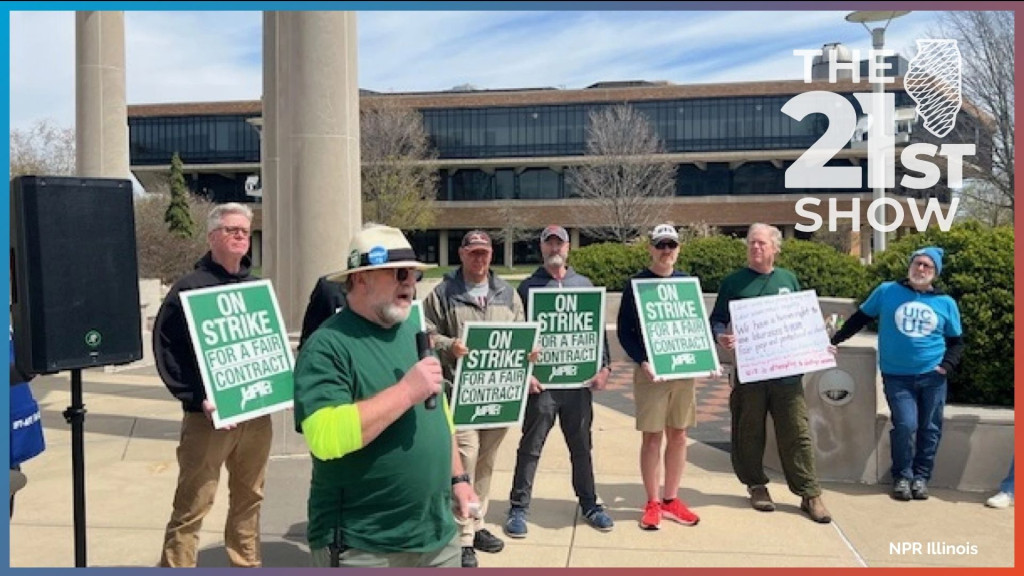
Brian Mackey: From Illinois Public Media, this is the 21st Show. I'm Brian Mackey. It's been 10 days since faculty at the University of Illinois Springfield went on strike. It's the first work stoppage at UIS since 2017 and the first by a public university in Illinois in at least three years. The union, which represents tenured and tenure-track faculty, has been negotiating a new contract since last summer. At issue are pay raises, salary minimums and protections against the use of artificial intelligence in the classroom, among other topics. Officials from the University of Illinois Springfield declined our invitation to appear on the show today, but they have published their bargaining positions on the university's website, and we'll draw on that as we go. I should also mention, more than 300 buildings, grounds and dining workers at Illinois State University in Normal are also on strike over pay, but that's beyond the scope of what we are talking about today. Joining me now is Dathan Powell. He's president of UIS United Faculty, the local chapter of the University Professionals of Illinois. He's also an associate professor in theater at UIS. [David], welcome to the 21st Show.

[00:01:21]
Dathan Powell: Hi, Brian. Thanks for having me.

[00:01:23]
Brian Mackey: Listeners, you can join us today at 800-222-9455. Whether you're a student, a faculty or staff member or just someone who cares about public higher education in Illinois, we wanna know what you think. What's your reaction to the strike? Do you think faculty are asking for too much, not enough? Is the university not doing enough to meet them? And here's a broader question. As more workers across different fields join unions and go on strike to get what they want, how do you feel about that trend? 800-222-9455 is the number. 800-222-9455. All right, Dathan Powell, how did it come to this?

[00:02:03]
Dathan Powell: Well, as you mentioned before, Brian, we have been negotiating with the university since July of last year, knowing that our contract would expire in August. We actually issued a demand to bargain back in April, but they did not meet with us until July. And after months and months of stonewalling on their part, they forced our unit and our staff unit on campus, which is a separate chapter of the UPI Local 4100 — they forced both units to take a strike authorization vote back on March 19th, and negotiations we hoped would ramp up and, you know, good faith bargaining would occur after that, but we were still met with the same kinds of stonewalling and just a refusal to hear what it is our faculty and staff need, and that prompted the strike on the faculty's part.

[00:02:56]
Brian Mackey: So let's talk about the last contract, the one that expired last year. What were some of the good things in it and some of the things that you feel might have been missing from that?

[00:03:06]
Dathan Powell: Our last contract was continuing off of the first one that we won in 2017 after having to strike then as well, so we were formally recognized as a union a couple of years prior to that, but it took a strike in 2017 to get our first contract. So in terms of what we won last time in 2022, we're guaranteed increases to salary that our faculty can look to, you know, as a way of budgeting for what the coming years will bring. It also established a couple pools of money that were designated for helping out faculty who had been hurt through compression issues or equity issues, but it also saw some good increases to what we think faculty should be paid when it comes to promotion and what happens after you receive tenure. Where it maybe didn't go far enough was that our salary minima that were established in 2017 stayed at the same level. So even while inflation and the Consumer Price Index increased, those salary minima that we hire faculty in at remained the same as they were in 2017 levels. So currently our current status quo of that last contract has minima that date back to 2017.

[00:04:28]
Brian Mackey: And my understanding is, correct me if I'm wrong on any of this, that's $55,000. So this is for somebody coming in, presumably they have, if not a PhD, then a terminal degree in their field, right? That could be a master's degree depending on what it is. And the minimum they're going to make is $55,000. Is that right?

[00:04:46]
Dathan Powell: Yes, that is the current minimum.

[00:04:48]
Brian Mackey: So what does the union want to see that change to?

[00:04:51]
Dathan Powell: Our proposal has not gone up to the level that it should be if you were to track inflation. Our current level for salary minima that the union is requesting is $64,500.

[00:05:08]
Brian Mackey: So, one of the things the university says, and you know maybe we should talk about pay as well. So before we get into what the university is saying here, talk about what the union is also asking for in terms of pay beyond the sort of minimum salaries.

[00:05:23]
Dathan Powell: So we believe that the faculty should be — as the heart of the institution and the reason that our students come seeking an education at UIS — we believe that faculty should be paid something that recognizes the work that they do and that should not decrease their purchasing power. Over the last 20 years, our faculty have actually seen their purchasing power decrease because our increases to salary have not kept up with inflation. So the starting point for the union was to say that — was to recognize the reality of the world that we live in and the cost of, you know, a tank of gas or a bag of groceries and to say our faculty have fallen too far behind and we need to get them back up. So the union started from a place that we thought was very reasonable and we have come off of our original proposals by significant dollar amounts, but the university continues to maintain that the faculty should not be paid more than a half percentage point increase in the year that is — the academic year that is almost over. So we've been working without a new contract in place since August 16th of 2025, and the university's position is that faculty do not deserve more than a 0.5 percentage point increase even as all of our non-unionized workers on the campus received at least a 1% increase this year.

[00:06:52]
Brian Mackey: Yeah, I was gonna ask you about that because the university is saying that its salary offer is the same program, they call it a program, that covers essentially everyone else at the U of I system, which, you know, full disclosure, the people — myself and the people I work with at Illinois Public Media — are part of the University of Illinois system. We get a letter every year where they say, oh, this year there's not gonna be a salary program or there's a 1% salary program or something. What is the union's argument for a different outcome there?

[00:07:21]
Dathan Powell: Well, when you just run the simple numbers, a 1% increase to our highest paid administrators is a huge chunk of change that the people of Illinois are paying for. And when you then put that against our lowest paid faculty, it's just not comparable that — to pay a faculty member who comes in at $55,000 a year, a 1% increase is a pretty small ask on our part compared to a chancellor or a CFO of our institution taking a 1% increase on top of their salaries that are already north of $200,000 in the case of the CFO, north of $300,000 in the case of the chancellor. So we think it's very reasonable that at an institution that claims it is a teaching institution as opposed to like a research one at UIUC, that it should rely on the people who do that work of teaching and should value them and their students by paying them appropriately.

[00:08:27]
Brian Mackey: Let me take a moment to remind listeners this is the 21st Show. I'm Brian Mackey. We are talking today with Dathan Powell, who is a professor at the University of Illinois Springfield and associate professor in theater. He's also the president of the union of tenure and tenure-track faculty there, UIS United Faculty. We are talking about the work stoppage, the strike that the faculty at UIS have been engaged in for 10 days now since April 3rd. I should say we invited the administration of the University of Illinois Springfield to join us today. They declined. They pointed us to a website where they've been sort of listing out their policy positions and their perspective on what's been happening here. I'm gonna read just one sentence from that. It says, from the university's perspective, a strike does not change the fiscal constraints that limit what the university can ultimately provide in a new contract. Nathan, one of the things the university says is that there's a $19 million structural deficit. How do you square that with what the union is asking for?

[00:09:31]
Dathan Powell: Well, Brian, we have heard claims of a structural deficit for years and years now, but the fact of the matter is UIS is one of the campuses in the U of I system which has a budget of $8.3 billion. It is the best funded system, public higher ed system in the state, and the reality of how they allocate money to our campus is what causes the so-called structural deficit. They have underfunded our campus for years. If I — I am not a budget person. You mentioned I have a degree in theater, and I just don't know how they can budget for their expenses and look at the cost that it takes to run a university and say that what the system is providing UIS is adequate right now. We feel that the priorities have been misaligned, that UIS is a great place for our students. The kinds of students who come to UIS oftentimes are paying a higher percentage of their household incomes than the students who go to UIUC. So they are here to get a real education, to engage with the faculty. And we believe that if the administration on the UIS campus and the system really valued those students and the faculty who provide those educations, they would look at what they are calling a structural deficit and recognize that they need to change their funding mechanism. That not supplying this campus with what it takes to engender, you know, excellent world-class teaching that they want from our faculty means that they continue to stonewall us when it comes to negotiating what we believe is a fair wage for our faculty who do that work.

[00:11:30]
Brian Mackey: All right, let's go to the phones at 800-222-9455. We have Adam calling from Springfield, I guess on the picket line this morning at UIS. Adam, thanks for calling in.

[00:11:40]
Adam: Hi, yeah, thank you.

[00:11:43]
Brian Mackey: So, tell me, I take it you are part of the union. What are you seeing out there?

[00:11:49]
Adam: So, no, I'm not actually part of the union. I am a former student. Many of my former teachers were part of the union or are part of the union, and I wanted to come out and support them.

[00:12:00]
Brian Mackey: OK, so it sounds like you are in support. What do you think about the, you know, the university's argument that a lot of students are seeing their education disrupted right now? They're missing classes, exams, that sort of thing.

[00:12:12]
Adam: I mean I would say that that's largely the university's fault. If anyone's gonna be disrupting classes it tends to be the faculty and university. The teachers have been heavily supportive of student growth, student careers. I personally have been helped in my career post-college by my university professors, but the faculty — and the school itself has only really hindered my advancement post-college. These teachers are on strike for a fair contract which is owed to them. The administration keeps stuffing themselves with multi-thousand dollar raises. And it's upsetting to see the people who actually helped me during school get left out.

[00:13:01]
Brian Mackey: All right, Adam, thanks for the call. I appreciate you sharing your perspective. Nathan, let me come back to you. So I do want to, in the time we have remaining, I do wanna talk about one of the other sticking points I understand in these negotiations is artificial intelligence. Can you talk about what the union is asking for there?

[00:13:19]
Dathan Powell: Artificial intelligence is something that we had no way of foreseeing in negotiations the last time around. And so since its advent, we are just seeking protections for faculty where this new technology occurs. So simply put, we just want to make sure that the AI tools that the university might adopt will not replace faculty work, should only be, you know, meant to enhance it. But that faculty should have the right of refusal when it comes to adopting AI tools in their work. There are lots of different disciplines represented by our faculty who, you know, have reasons to incorporate it or not, and we think that faculty should just be given the right to say when and how it gets deployed in their classes. And then finally, we believe that faculty should be offered the chance to give consent and be compensated if they agree to have their work be scraped by AI tools. So it's a pretty simple ask and it actually costs the university nothing, but they continue to push back against that, and it's a real shame. Their position is that the technology is too new and ever evolving, but that's not a reason not to bargain around it. But it's one of many components that we feel will protect and enhance the quality of education that we can give our students, and we just ask that the administration recognize our expertise in what happens in the classroom and negotiate with us around those items that affect our day-to-day teaching. By deferring to our expertise and if they're not going to defer to it, at least working with us collaboratively, but they refuse to do that so far.

[00:15:01]
Brian Mackey: Just about 30 seconds until we need to take a break. What is it going to take to end this strike?

[00:15:06]
Dathan Powell: It's going to take the administration bargaining in good faith with us and recognizing the value that faculty bring to this campus for their students, and they need to recognize that through these kinds of protections like I mentioned and also through a fair compensation package.

[00:15:23]
Brian Mackey: Do you have a sense of how much longer this is gonna go on? I mean, what are you seeing from the university?

[00:15:28]
Dathan Powell: We bargain again at one today and it's my sincerest hope and my team is ready to go all night and get this contract settled. We want to be back in the classroom with our students. We miss them.

[00:15:38]
Brian Mackey: All right. Dathan Powell is president of UIS United Faculty. Thank you for being with us today on the 21st Show.

[00:15:47]
Dathan Powell: Thank you for having me, Brian.

[00:15:49]
Brian Mackey: And I'll just read here what the university says about this. Again, they declined to join us, but on their website, "We are eager to reach an agreement and have our faculty and students back in the classroom as soon as possible. The university remains committed to good faith negotiations and believes there is still a path forward through continued dialogue." End quote. All right, we're gonna continue on this topic. We're gonna get a little bit broader perspective with a national reporter who covers these issues across the country. This is the 21st Show. Stay with us. It's the 21st Show. I'm Brian Mackey. We have been talking about the faculty strike at the University of Illinois Springfield. Before the break, we spoke with union president Dathan Powell. I also wanna mention, as I did at the top of the show, there are more than 300 buildings, grounds and dining workers striking at Illinois State University in Normal as well. But that is beyond the scope of what we are talking about here today. I wanna zoom out now for the bigger picture on what is happening here. And joining me for that is Emma Whitford, who covers faculty issues for Inside Higher Ed, the national publication focused on colleges and universities. Emma, welcome to the 21st Show.

[00:17:15]
Emma Whitford: Hi, Brian. Thanks for having me.

[00:17:17]
Brian Mackey: Listeners, you can still join us 800-222-9455. If you've been part of a union, maybe as a faculty member, student or staff member or in some other field. How did that experience shape your view of collective bargaining? And as more white-collar and professional workers organize, teachers, journalists, tech workers, do you see that as a sign of something changing in how Americans think about work and wages? You can give us a call 800-222-9455. That's 800-222-9455. All right, Emma, you cover faculty labor issues across the country. Where does the situation at the University of Illinois Springfield fit in with what you're seeing these days?

[00:18:01]
Emma Whitford: So, we've recently seen a pretty big wave of faculty labor actions in recent months. So, UIS fits right into that trend. Right now, the nationwide momentum is on union side. There's been a couple of high-profile strikes that resulted in contract wins for faculty. For example, at New York University, non-tenure-track faculty struck for two days in March, before they won some of the highest salary minimums in the country for non-tenure-track faculty. Their salaries are now starting at $91,000 for the lowest level faculty members. And then also Portland Community College faculty were on strike for 20 days last month. It was the first ever strike at an Oregon community college, and they won a 2% increase in the first year of their contract and a 3% salary increase in the second year of their contract.

[00:18:56]
Brian Mackey: So what are some of the common threads running through these strikes and organizing drives that you've been tracking? I gather pay is obviously a big one.

[00:19:05]
Emma Whitford: Yes, pay is almost always the sticking point. That's pretty typical. Strikes are seen as a last resort for labor actions, and economic proposals like pay and minimums are typically discussed at the end of negotiations. So it's usually sort of the last thing that both faculty and administrators are addressing. A lot of the arguments for pay increases are framed around high inflation that we've seen in recent years and the cost-of-living increases that we've seen, which faculty salaries really have not kept up with at all. And then the unions have also been, in some cases, calling for guarantees related to things we're seeing in the current political moment. So for example, the University of California system — they want a guarantee that the university won't cooperate with ICE. And then like UIS, other unions are calling for guardrails around AI use.

[00:20:03]
Brian Mackey: Interesting. So, OK, pay is obviously central at what's happening at UIS. When you look at faculty compensation nationally, you mentioned inflation. What has the trend line been?

[00:20:15]
Emma Whitford: It's been pretty bad. Faculty salaries have not been keeping up with inflation at all. Just to give you a sense, according to recent data from the American Association of University Professors, if you adjust for inflation, faculty salaries fell by about 0.4% over the past year, and they still have not recovered from a 7.5% decline that we saw during the COVID-19 pandemic. Data from the College and University Professional Association for Human Resources have shown similar trends, and they also highlighted something interesting in their recent report which is that administrators and staff compensation has been outpacing inflation and they have been receiving raises over the rate of inflation for the past several years.

[00:21:08]
Brian Mackey: All right, let's go back to the phones at 800-222-9455. We've got Charles calling on line two. Charles, thanks for calling in.

[00:21:18]
Charles: Hi. [I'm] here at UIS and I just wanted to talk a little bit about what's going on here and just say really what the situation has felt like from a student's perspective.

[00:21:30]
Brian Mackey: Sure, go ahead.

[00:21:32]
Charles: Really, it's just, this is day 11 but the strike has been ongoing and I know educators who've been out here picketing almost every single [day]. Disheartening to see that there's been so little movement from administration, especially when these faculty are the ones who've, you know, created this place of education, they've created really the curriculum, really the things that matter, have made it a place that people can depend upon to get skills and that kind of thing, and

[00:22:05]
Brian Mackey: All right, Charles, we're getting a lot of wind noise with your call, so I'm gonna say thank you for calling in from the picket line again. I appreciate that. Let's also see we have Amy calling from Springfield on line one. Amy, thank you for calling in.

[00:22:19]
Amy: Yeah, absolutely. Thanks for taking my call.

[00:22:21]
Brian Mackey: So, are you, you're a faculty member?

[00:22:25]
Amy: I am. I'm a full professor of biology at UIS and I'm currently on strike and have therefore been out of class for 10 days now.

[00:22:34]
Brian Mackey: How do you think of the way the university has, you know, responded and handled these, these negotiations and this whole situation?

[00:22:42]
Amy: Well, it's been very frustrating. This is the last place we wanna be on strike. I wanna be teaching my students in the classroom. I really, I'm shocked that they won't negotiate with us, in terms of, I find it very interesting your previous caller talking about the administrative salaries keeping pace and faculty not cause that's definitely what I've seen in my 20 years here at UIS and it's, it's frustrating.

[00:23:10]
Brian Mackey: When you say they won't negotiate with you, I mean, just to be fair, the university says it's held many bargaining sessions, 26 of them so far. What do you mean when you say that?

[00:23:21]
Amy: Well, they come to the session with the same thing they had the previous session, so I don't really call that negotiating. I actually was on the first bargaining team when we got our initial contract and at that point I kind of saw a little behind the curtain and I saw our chancellor going back and forth with the system at large, and we got, it was a much shorter strike, and I think that's because that chancellor was willing to go up at the table and actually, you know, do the work of getting the contract done.

[00:23:51]
Brian Mackey: All right. Amy in Springfield, appreciate you calling in. Thank you.

[00:23:56]
Amy: Oh absolutely thanks for taking my call.

[00:23:58]
Brian Mackey: And let me remind listeners, this is the 21st Show. We are talking about the strike at the University of Illinois Springfield among faculty there. And we've been sort of taking a bigger picture for this part of the program today. We're talking with Emma Whitford who covers faculty issues for Inside Higher Ed, the national publication. If you want to join us, 800-222-9455 is the number, 800-222-9455. So, Emma, I don't know if you want to respond to anything in particular that the caller said there, but I mean, you did mention earlier some of the significant contract victories, right? NYU, Portland Community College, I think the University of Kansas. What is driving those wins among faculty members?

[00:24:42]
Emma Whitford: Yeah, I don't have a ton of details on what's being said at the bargaining tables, but I can speculate a little bit. Obviously strikes are the most effective labor action tool that unions have in their back pocket. It puts a lot of pressure on administrators to reach a deal quickly, um, because students are not getting what they paid for during that time. We're in the middle of the spring semester and everyone wants to keep class in session. And then, like I said earlier, momentum is on the union side right now. We've seen a lot of these contract victories across the country, and that tends to snowball.

[00:25:21]
Brian Mackey: I wonder, it's interesting, the, so the University of Illinois Springfield, the union points to the fact that it's part of the broader University of Illinois system, which has a budget of $8.3 billion and says that the University of Illinois Springfield gets a very small share of that. I wonder if you hear that argument in other places, right? The institution can afford more than it's offering in some of these other negotiations.

[00:25:46]
Emma Whitford: Yeah, I would say that probably comes up in almost every dispute over pay is arguing that the university can't afford to pay faculty more. And often they're pointing to the statistics I mentioned earlier, which is that administrator salaries and staff salaries, executive leadership, all of that has been keeping up with inflation while faculty pay lags. So they'll often cite high pay at the top that administrators should take less and they should allocate some of that money to faculty salaries.

[00:26:21]
Brian Mackey: All right, let's, I think we have another caller on the line, 800-222-9455. We have Richard calling from Springfield. I think somebody must have told some of the union members that we're gonna be talking about this today. Richard, thank you for calling in.

[00:26:35]
Richard: Hi, thanks for taking my call. Yeah, I've been here for 20 years and I've never felt so disrespected and insulted by the administration of this university. You know, this, we are out here on strike. We are feeling a lot of pain and heartbreak for our students. The movement is essentially no movement at all. And so we just need this strike to end, but they're talking about us with nothing but contempt, and I just want to say that. You know, it's really shocking for me, having been here for 20 years to see the administration trying to characterize us as enemies of the students and trying to generate a student animosity, even contemptuous hatred for striking faculty when there's nothing we want to do more than get back in the classroom.

[00:27:39]
Brian Mackey: Richard, can you give me a for instance of that? What are you hearing that makes you feel, or that you perceive as contemptuous?

[00:27:47]
Richard: Well, they're sending, they're sending emails out to the university community in which they're saying we only work for nine months. We only work 20 days out of the year, out of the month, out of each month. We only work for nine months. One-third of us are paid, you know, too much. The other two-thirds of us they don't mention. And basically they're telling students that we are, you know, unreasonable. But what we're asking for is way beneath basic cost-of-living adjustments in our salary that we've been denied year after year after year. You know, and they want students to think that we're asking for more than what would keep up with inflation when actually what we're asking for amounts to less.

[00:28:35]
Brian Mackey: You know, Richard, I don't know if you're willing to say what area you're in, but I mean, I wonder, is there any sort of dissension among, you know, you have your computer science, business professors probably on the higher end of the salary scale, the humanities on the lower end. Is there, you know, any conflict there?

[00:28:53]
Richard: That is absolutely an important question because, you know, the market value for professors in different programs and disciplines is not the same. And so, you know, most of the faculty who are out here on the picket line are those of us who have a lower market value. So I'm a professor in the School of [Polis] and International Affairs, and I teach political theory and philosophy. I also have an appointment at UIUC, and the reality of it is that humanities and social science professors are generally devalued in the market, and so we, and it's telling, I think that we're the ones who are out here the most. You know, so, and also, of course, you know, oftentimes in the business school there is, you know, an anti-union curriculum, you know, talking about the dangers of labor unions. So we don't see, you know, representation across all of the campus. It's mostly, I mean, some, my department is very well represented. It's here on the line. It's essentially fully out [unclear] every single day. And it's exhausting, and we have other things and better things to do.

[00:30:12]
Brian Mackey: Richard, thanks so much for calling in to share your perspective. I appreciate it.

[00:30:15]
Richard: Thanks, thank you so much for giving me the time. Thank you. Bye-bye.

[00:30:19]
Brian Mackey: All right, just a few minutes left, wrapping up with Emma Whitford who covers faculty issues for Inside Higher Ed, sort of looking at the broader trends here. Emma, I do want to also ask you this idea of artificial intelligence. This is something that, you know, as our previous guest said, was not on anyone's sort of bingo card, you know, a few years ago, and now it's something that people are concerned a lot about in higher education. Can you talk about how you're seeing this play out in some of these negotiations across the country.

[00:30:48]
Emma Whitford: Yeah, I'm really curious to see what happens with the UIS provision because AI-related provisions and contracts are still relatively new. We're kind of in a wild west for that right now, but we have seen it come up in a few ways over the past year or so. For example, Oregon State University in their contract, they cemented a committee to at least discuss AI going forward. There are others that have included a provision to make sure that leadership would run any AI-related decisions by the union before they're implemented. And then maybe one of the most concrete examples we've seen so far is the University of Michigan's Librarians, Archivists and Curators Union included a provision that said they can't, the university can't use AI to reproduce the voice or likeness of an employee without their written consent. So curious to see what happens with the UIS because it will probably be one of the first public contracts that includes provisions on AI.

[00:31:51]
Brian Mackey: Looking even bigger picture here at, you know, this is the University of Illinois Springfield, as we said, it's, it's a relatively small part of the U of I system. We have seen a lot of financial pressure on regional public universities, right? Declining enrollment, flat state funding in a lot of places, federal uncertainty in the past year or so. When you talk to people who look at this sort of thing, what do they say about the long-term sustainability of this model of higher education?

[00:32:20]
Emma Whitford: Yeah, it's pretty well addressed that regional publics are struggling financially. I don't think anyone has a magic bullet. There's a lot of concerns out there. They're facing enrollment declines that are likely to continue, especially in the Midwest and the Northeast. And then their ability to enroll international students is now limited. This was especially an issue for UIS this year, which ran into visa processing issues, and they lost a lot of international students due to federal policy. So any institution that's maybe hoping to make up for those enrollment drops by enrolling more international students, that's no longer an option. And if this continues, it can lead to program cuts like we're seeing at Portland State University, which is cutting 19 programs or at very worst case scenario closure. Last year we saw at least 16 nonprofit colleges announced plans to close and seven of those [were] regional publics like UIS and they were all part of the Pennsylvania State University system. So I will note though that UIS is not close to that cliff edge, but these are worst cases.

[00:33:30]
Brian Mackey: All right, Emma Whitford, with Inside Higher Ed, thanks so much for sharing your reporting and knowledge with us today on the 21st Show.

[00:33:37]
Emma Whitford: Thanks for having me, Brian.

[00:33:39]
Brian Mackey: And that is it for us on this topic. We'd love to hear what you think. Talk at 21stshow.org is our email address. Talk@21stshow.org. After the break, we're gonna be talking about two films showing at Ebertfest. This is the 21st Show. Stay with us.
It’s been 10 days since faculty at the University of Illinois Springfield went on strike. It’s the first work stoppage at UIS since 2017, and the first by a public university in Illinois at least three years. The union, which represents tenured and tenure-track faculty, has been negotiating a new contract since last summer. At issue are pay raises, salary minimums, protections against the use of artificial intelligence in the classroom, and more.
Officials from UIS declined the 21st Show's invitation to appear on the show today, but their bargaining positions are published on the university's website. The head of the union, which many faculty members are a part of joins the program today as well as a reporter, who covers colleges and universities across the country.
GUESTS
Dathan Powell
President, UIS United Faculty
Associate professor of theatre, University of Illinois Springfield
Emma Whitford
Reporter, Inside Higher Ed