New video game provides virtual drive to cities across Illinois
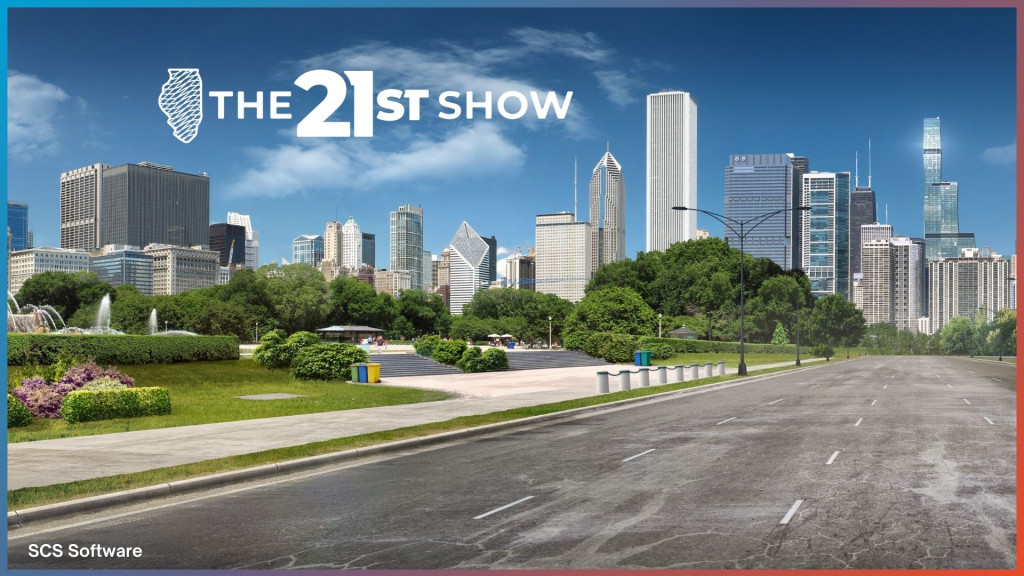
The video game American Truck Simulator will soon expand its playable area to Illinois, where drivers can pass Buckingham Fountain on Lake Shore Drive in Chicago. Courtesy of SCS Software
// This is a machine generated transcript. Please report any transcription errors to will-help@illinois.edu.

[00:00:00]
Speaker 0: When I pulled out of Pittsburgh, rolling down that eastern seaboard. I got my diesel lined up and she's running like never before. There's a speed I don't see a cop in sight. Six days on the road and I'm not gonna make it home tonight.

[00:00:23]
Brian Mackey: It's the 21st show. I'm Brian Mackey. Have you ever dreamed about what it would be like to drive a semi truck? Be your own boss, see the country, sleep in that little RV box at the back of the cab. Truckers say they're the backbone of the American economy, working long hours, rolling day and night to make sure we can buy just about anything we want, whenever we want it. It can take months to get a commercial driver's license, and beyond that, you often have to leave your everyday life to take to the open road, which is a heavy lift for a lot of us.

But as with so many experiences nowadays, you can get a taste of what it would be like through a video game. American Truck Simulator allows players to drive big rigs across America, visiting different cities and landmarks, including later this week, our home state of Illinois. SCS Software, the company behind American Truck Simulator, is set to release an expansion for the game that includes several Illinois cities — Chicago, Rockford, Peoria, Champaign, Quincy, and the Quad Cities of Moline and Davenport, Iowa. The expansion is coming out this Thursday.

Last year in December, we talked about the upcoming Illinois expansion with Daniel Nemec. He goes by Nemiro. He's SCS Software's head of PR and marketing. Daniel connected with us all the way from the Czech Republic, where SCS is based. We're revisiting that conversation for the rest of the hour today. In a moment, you'll hear him mention next year — in this case, that's 2026. Because we're on tape, we cannot take your calls live, but you can always let us know what you think about this or anything else we've been talking about. Our voicemail line is 217-[321-21 — review: incomplete phone number in original audio].

All right, Daniel, take me back in time. Where did the idea for American Truck Simulator come from?

[00:02:16]
Daniel Nemec: Well, I think that's more than 10 years now. Actually, next year — in February — American Truck Simulator is gonna celebrate its 10-year anniversary. And so yeah, that time back, the studio of SCS Software already had a game of [Euro Truck Simulator] 2 on the market, and we thought that it would be nice to, you know, keep — stick to what the studio already was doing, what we thought we can do, what we know how to do well. And we decided to create a second kind of a brother to our European game of American Truck Simulator, and the idea was to basically bring a game about trucking within the U.S. at the beginning. And yeah, so that's how the idea started.

[00:03:09]
Brian Mackey: I have played Euro Truck Simulator. The trucks — you typically have those like flat fronts. I don't know if there — there's probably a — yeah, OK, yeah, yeah, cab over. Thank you. Like, what sort of changes do you have to make when you are bringing — you know, you're a European company, you're designing a game focused on America. How do you go about approaching that?

[00:03:28]
Daniel Nemec: Well, then of course most of the trucks, as you said, are a little bit different, which comes with a little bit different behavior of the vehicles. You guys have also a little bit different traffic rules. You know, for example, you guys have way more wide roads and highways, more wide parking lots, and you know, everything is a little bit bigger in America. So you know, the game is kind of a — I don't, I don't even want — I don't want to say like the same as Euro Truck Simulator 2, but the core is pretty much the same. It's about trucking, it's about logistics, hauling a cargo, building your profile in the game. But there are some differences — not difficulties, but differences — between those two games, just as there are some differences in the real world, you know, between trucking and logistics in Europe and in America.

[00:04:22]
Brian Mackey: So how did this Illinois expansion come about?

[00:04:27]
Daniel Nemec: Oh, yeah, so you know, 10 years ago, as we said — which next year is gonna be the 10-year anniversary of American Truck Simulator — the original game was released with the state of California, and Nevada and Arizona. And then we moved by, you know, producing these map DLCs, these extra expansions that everyone can buy and unlock another chunk of map, of the in-game world where they can travel and explore and haul cargoes. We started from west to east, state by state. And now we are basically at the point in production where Illinois lies, so that's how Illinois came to our mind — because it was, you know, the next state we wanted to build for the whole universe of American Truck Simulator.

[00:05:20]
Brian Mackey: Yeah, so what do you do when you're going to expand to a state? Do you actually have to visit it? Are you buying data online from mapping companies? How does that work?

[00:05:31]
Daniel Nemec: Well, a little bit of everything. You know, we do send small teams for what we call research trips, because for the designers — or for the map designers, as we call them internally — those are guys that are building the in-game world from assets, from 3D models. It showed up that it really helps them if they can actually go and see at least a piece of the state, you know, because each of the states might have a different, you know, shape or coloring of traffic signs, or I don't know, maybe lines on the road, or you know, different approach to buildings or to truck stops or to gas stations. So it's nice when they can actually feel the state, you know — feel the atmosphere, feel the vibe.

But of course they are not really visiting each, you know, mile of the roads that's gonna be recreated for the game. It's more like about, you know, breathing in the atmosphere. And then they work also with, you know, satellite images, applications such as Google Street View. Quite often we are also in touch with, for example, truck drivers who help us by sending us their dashcam videos.

[00:06:44]
Brian Mackey: So I'm gonna have to ask you to pause because we need to take a break. This is the 21st show. We'll be right back.

[00:07:00]
Speaker 3: I got a sweet little thing — I'm in Nashville. I stopped at a roadhouse in Texas. It was a little place. [unclear] playing truck driver.

[00:07:35]
Brian Mackey: It's the 21st show. I'm Brian Mackey. You could be that truck driving man in the video game from SCS Software called American Truck Simulator. It lets players drive semi trucks across America, and this Thursday they're putting out an expansion featuring Illinois locations. We talked about this back in December 2025 with Daniel Nemec, head of PR and marketing for SCS, which is the creator of the game. Daniel connected with us all the way from their base in the Czech Republic.

Again, our program today is on tape, so no live calls, but you will hear a caller we took when this originally aired — it was actually the second time she had called in that day; you'll hear us mention that. You can, however, let us know what you think about the show anytime. Our email address is talk@[21stshow.org — review: original transcript reads "2firstshow.org"].

Before the break, we were talking about sort of getting the vibe, and I do love that. Because I enjoy going to visit — like, you know, you drive in California or Seattle or something, they have these little reflectors that stick up off the road, and I'm like, oh, those are really good — why don't we have those in Illinois? And then you drive on a day like this, where it's like snowy and icy everywhere, and you see, oh, the plows would just scrape those things right off. So I guess that's the kind of detail you're looking into maybe when you're talking about the vibe of a state.

[00:08:50]
Daniel Nemec: Exactly, yeah, exactly — it's like, exactly like that, you know. The more details we can gather before we, you know, start producing a new state, the better for us.

[00:09:01]
Brian Mackey: Is there weather in the game, right? Like, the photos are beautiful, as I mentioned on the website, that show the cities on, you know, beautiful spring or summer days. Do people have to — can you deal with snow and ice and rain and that sort of thing?

[00:09:17]
Daniel Nemec: Not yet, not yet. The game is based in summer, but of course we do have different weather such as rain, fog, day and night cycles, you know, these kind of things. But no seasons yet, so you cannot encounter snow or, you know, fallen leaves in autumn on the road.

[00:09:35]
Brian Mackey: [I was spared] the pleasure of being boxed in by two semis on Interstate 72 while going over a patch of ice, as I was this very morning. So tell me a little bit more about how do you decide what cities to add? I mentioned Rockford, some of the Quad Cities, Champaign, Peoria. How does that work from your process standpoint?

[00:09:53]
Daniel Nemec: Well, it's a really, you know, kind of complex decision always, and sometimes quite difficult. But you know, the in-game world is not made 1-to-1 scale — it's a 1-to-19, or something like that — so we always cannot put all the cities of a state in the game. They would basically not fit — you know, the performance of the game would be too demanding on hardware, and such, and many reasons like that. So the team always goes and checks what cities are kind of super important for the reason of the game, or for the purpose of the game — you know, logistics, or where some big industrial complex lies, or you know, where maybe some of the most popular or famous landmarks are, or [which is] the most beautiful city of that state. So there's always a decision about which cities are going to make it and which are not, based on such reasoning.

[00:10:48]
Brian Mackey: So you mentioned that America has bigger parking lots, bigger roads. Is American Truck Simulator easier than the Euro version of the game for that reason, because you're not doing, you know, sort of the narrow streets of Prague or something like that?

[00:11:01]
Daniel Nemec: Maybe for some people they might — yes. But on the other side, you know, you guys have those trucks with a long nose, which makes turning a little bit more challenging sometimes than, you know, trying to maneuver with the cab-over — you know, the shorter truck — in Europe.

[00:11:23]
Brian Mackey: So how does the game actually work? Because, you know, it's not just you're driving from place to place, right? You mentioned building reputation. I know there's all these different designs you can sort of earn your way or buy your way into, depending on the game mechanics. Talk about the actual objectives of the game.

[00:11:40]
Daniel Nemec: Well, so the new player in the game starts as a truck driver for hire with no truck, no company. And as you build your progress in the game, you're doing those — as we call them in the game — quick jobs, which means that you're just hired to transport goods from city to city or from state to state. And you earn in-game currency, in-game money. And then later, with the money and with the experience and new levels that you reach, you can buy your first truck.

And you know, later you can buy more of them, you can hire virtual drivers that will work for you, you can start a company and, you know, buy headquarters, buy new garages in the cities, and explore the map. And those levels can unlock special cargoes — you can unlock with those skill points in the game, for example, a possibility to transport explosives or, you know, acid and these kind of dangerous goods. Or, you know, oversized transport with those escort vehicles in front of you and stuff like that. So there is a kind of a career mode in the game.

And then of course you can also spend your in-game money on tuning up your truck. You know, you can put chrome, you can choose from different cabins, different chassis, different paint jobs, you know, interior options, exterior options, bull bars — you name it.

[00:13:02]
Brian Mackey: And you mentioned different customizations of the trucks. I wonder what you hear from players when they find out that their city is going to be added.

[00:13:13]
Daniel Nemec: Yes, well, sometimes we hear stories that, you know, we just released a new DLC, a new state, and people are reaching us saying, hey, I just [drove] around my house — you know, I live in that place. You know, but sometimes it might happen because, you know, when we decide to build one road and that guy lives there, you know, his house is there. But at the same time, we sometimes hear desires or wishes from people like, please, can you put my, you know, hometown city in the game? And we often have to tell them, sorry, it doesn't really fit into the plans. And that's it.

[00:13:54]
Brian Mackey: Yeah. How close is the game to driving a semi truck in real life?

[00:14:00]
Daniel Nemec: Well, I don't have a CDL license, so maybe I'm not the correct person [to ask].

[00:14:04]
Brian Mackey: I wondered if you or any of your teammates have ever had that experience.

[00:14:10]
Daniel Nemec: Some of them, some of them they do, because we are a multinational company. But I sat in many trucks in the U.S. through our business trips, and I had the opportunity to even drive them. And I think that to some extent, the game is very similar to how you feel in a truck. The game can teach you some basics of how big your truck — in combination with the trailer — is, how much space you might need to maneuver, how to proceed to reversing and maneuvering. Because it's quite difficult to reverse with a trailer, you know — you need to teach your brain to think the opposite way, to some extent.

So even though we know that our game is not like an officially recognized educational tool, we do hear from people in our community that many of them used our game to prepare for their CDL license final exams, for example. And what we think is even better — they found a passion and love for big vehicles and trucking and the automotive industry in general, thanks to our game, and many of them actually decided to pursue that love through a career. So that's awesome to hear, always.

[00:15:27]
Brian Mackey: Oh, it's fascinating. You know, when you mentioned you're a multinational company — I think that is something that people who maybe aren't as into video games don't appreciate, how international these — you know, you can really develop communities of players, especially if they get together on apps like Discord or things like that. Can you talk about what it's like at SCS Software — and I don't know how long you've been in the field, if you were there before we had all this remote work technology that makes this so much easier today — but how that works day to day in your company.

[00:15:58]
Daniel Nemec: Well, we're based in Prague, you know — quite a small, even though quite popular and famous city in the Czech Republic, in Europe, in central Europe. And at the beginning it was quite hard for us to build American Truck Simulator, and especially for getting licenses. You know, because the trucks in our game, they are 1-to-1 recreations of real trucks. So we didn't want to bring players those no-name recreations of our idea of how American trucks should look — we wanted to bring them their favorite Kenworth W900, you know, or Peterbilts or Western Star trucks, or Volvo VNL, and you know, these kind of trucks.

So it was kind of hard for us to pursue these manufacturers or brands to give us their trust and their products at the beginning. But then over 10 years — and now, thanks to how big the community of our game is and the awesome numbers we have and can present to these companies — the relationships got to a super, super good stage. And now, nowadays, sometimes those companies can even realize that through games and through gaming, they can actually talk to audiences that they would have a hard time reaching through their own marketing communication. And they can use our game as a marketing tool — you know, how to show their newest truck, how to communicate their brand awareness, or how to spread passion for trucks and their brands. So it's awesome now that people at these brands recognize and realize this, but 10 years back it was not that easy.

[00:17:46]
Brian Mackey: All right, let's go to the phones. Nancy, I think we talked earlier, didn't we? Nancy, thanks for calling back in.

[00:17:52]
Nancy: Hi, Brian. Hi, Mr. — I'm sorry, I don't know your first name.

[00:17:56]
Brian Mackey: Daniel.

[00:17:58]
Daniel Nemec: Nancy.

[00:18:00]
Nancy: You sound — you sound so much like Arnold Schwarzenegger.

[00:18:05]
Daniel Nemec: OK, well, I don't have that much muscle though.

[00:18:11]
Nancy: But you sure sound like him anyway. That's wonderful, what you've talked about. I've been listening to every word you've said. Absolutely. I went on a semi with my husband in northern Illinois. We went all over to seven states. He was a CDL driver, of course, and I learned a lot about the CDL industry, and I think what you're doing is fantastic.

[00:18:35]
Daniel Nemec: Oh, thank you so much for that. You know, this is exactly what I was talking about. Every time we hear such an amazing story like this, it motivates us through the next days and years. So thank you so much, Nancy.

[00:18:48]
Brian Mackey: Thanks for the call, Nancy, that's great. You know, let me ask you — there's this term out there, "cozy games," right? People play these games to — you know, life can be difficult, the job, not getting along with their colleagues sometimes or something. People just want to sort of tune out and relax. Do you think of this as a cozy game?

[00:19:05]
Daniel Nemec: Absolutely. And you know, without me wanting to sound like we are boasting or flexing, our game is sometimes called a Zen experience, and I think that's kind of fitting. Because in other games — you know, with racing games or first-person shooter games — there is always some aspect of adrenaline, some aspect of competition, and people find themselves a bit stressed because they need to perform even in the games. But in our game, you can just, you know, hop in your favorite big vehicle, take a cargo of your preference and haul it, you know, through day and night, admire the nature, the landscapes, and just have fun and chill.

[00:19:47]
Brian Mackey: And if you're as talented as I am in the video game, you knock over a couple of stop signs — no hard feelings.

[00:19:54]
Daniel Nemec: Yeah.

[00:19:55]
Brian Mackey: All right, Daniel Nemec is the head of PR and marketing for SCS Software. The game is American Truck Simulator. Illinois is coming soon. Thank you so much for joining us today from all the way in the Czech Republic. Appreciate your time.

[00:20:08]
Daniel Nemec: Thank you so much for having us. Roll on — cruise.

[00:20:23]
Brian Mackey: [Mama, like I asked you —] We originally spoke with Daniel in December 2025. Again, the expansion for American Truck Simulator featuring Illinois is coming out this Thursday. We'll have details at our website, 21stshow.org. You can also find more of our past programs there, plus links to subscribe to our podcasts. Again, it's all at our website, 21stshow.org. You can also look us up on Apple, Spotify, YouTube, or wherever you listen.

That's it for us today. The 21st show is produced by Christine Hatfield and Jose Zepeda. Our digital producer is Kulsoom Khan. Technical direction and engineering comes from Jason Croft and Steve Morck. Reginald Hardwick is our news director. The 21st show is a production of Illinois Public Media. I'm Brian Mackey. Thanks for listening. We'll talk with you again tomorrow.
Today's show included a rebroadcast of the following "best of" segment first aired December 15, 2025: New video game provides virtual drive to cities across Illinois.
Learn more about American Truck Simulator's Illinois expansion here.