








What happens when fluoride is removed from the water supply?
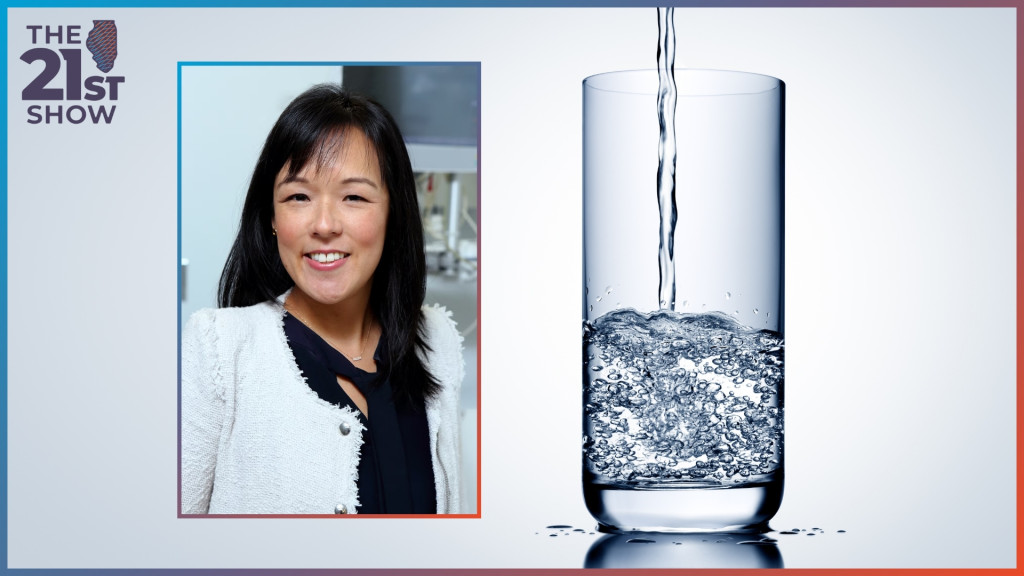
Dr. Helen Lee knows what happens when we remove fluoride from drinking water. Portrait: Jenny Fontaine/UIC • Water: Adobe Stock
// This is a machine generated transcript. Please report any transcription errors to will-help@illinois.edu.

[00:00:00]
Brian Mackey: It's the 21st Show. I'm Brian Mackey. There's a long-running fight over whether the fluoride in our drinking water is good for us. Health and Human Services Secretary Robert F. Kennedy Jr. has called it an industrial waste — that was on the campaign trail in 2024. And the EPA administrator, Lee Zeldin, has fast-tracked a review of the chemical's safety for drinking water. Florida and Utah are not waiting — they've already banned it from water supplies. Meanwhile, the American Dental Association is sticking by its recommendation in favor of fluoridated water. And worth noting, 98% of Illinois residents have that.

Now, we're not gonna settle that debate in the next 15 minutes of the show, and that's fine because my next guest wants to move the conversation somewhere else. Her question is not whether fluoride is safe. Her question is, if Illinois was to take fluoride out of the water supply, is the state ready for what comes next? Dr. Helen Lee is a pediatric anesthesiologist at the University of Illinois Chicago, and she's the author of a new policy brief from the Institute of Government and Public Affairs, the University of Illinois system's in-house think tank. Dr. Lee, thanks for being with us.

[00:01:12]
Dr. Helen Lee: Thanks for inviting me, Brian. Happy to be here.

[00:01:15]
Brian Mackey: I should say we tape this conversation ahead of time, so no phone calls live today, but you can always let us know what you thought. Our email address is talk@[21stshow.org]. All right, for someone who's maybe never thought much about why there's fluoride in tap water, what's it doing there?

[00:01:31]
Dr. Helen Lee: Well, it was a result of some observations on a population level that when people have access and are exposed to fluoridated drinking water systems, they have a tendency to have really good, healthy teeth. And so that recognition led to local governments and municipalities adding fluoride, or regulating and monitoring the level of fluoride in community water systems. And it has become such an effective population-level intervention to maintain good teeth that it was voted and recognized as a top 10 public health intervention of the 20th century. And from a cost-effective analysis, it's the most cost-effective intervention to keep everybody's teeth healthy. We save — for every $1 invested in water fluoridation, we save $32 in dental treatments. So if you expanded that out on a national level, we're saving $6.7 billion in avoided dental treatments, and that's in 2013 dollars. So it's much more now. And we also save as a society on things like missed school attendance for kids — for those caregivers, missed lost hours of work. For working adults who suffer from poor oral health, they're not in the dentist's office or the emergency department — they're also able to be present at their own work. And on a global perspective, children who have cavities — it's the most common chronic disease of childhood, more prevalent than asthma or hay fever.

[00:03:21]
Brian Mackey: I can't remember who said it, but there's a quote out there that's something along the lines of like [50% or 1/3] of all human suffering throughout history has been toothache. And it really is quite a change that we've had in the last century, as you say, and as the CDC has said. So can you just briefly recap what is the sort of debate? I mean, that's not the main thing we're talking about today, but in terms of the scientific argument happening right now?

[00:03:45]
Dr. Helen Lee: Sure. There have been — you know, there's more than 100 years of experience and observational data that demonstrates that when you expose people to fluoride in the water systems, they have better teeth. However, there have not been randomized controlled trials that have tested this in controlled settings where you can attribute directly that this level of fluoride through this water source will contribute and cause delayed cavities. So it's not practical at these large levels. We do have our natural experiments where we've had communities like Juneau, Alaska, or the country of Israel — they have arbitrarily deregulated fluoride in their drinking water. And so we see the opposite — what happens when you remove it. And what we see is a near doubling of the rate of dental treatments due to cavities for populations, particularly in children, after they've removed fluoridated water from their systems.

So the debate has been a lot of back and forth over the years over the known benefits to our teeth. But in recent years, there have been advocacy groups that have brought forth evidence that associates exposure to fluoride through all sources — not just drinking water — and possible effects on neurodevelopment, on developing brains in children. And so there have been meta-analyses that were reviewed from countries all over the world, reported and summarized in the National Toxicology [Program] report. And as a basis of that summary, a federal judge has ruled that the known benefits might not outweigh possible harms. And so that was the basis for the CDC recusing themselves from regulating fluoride in water systems, and it's now become open to states to determine how they're going to handle that.

[00:05:57]
Brian Mackey: So you said the judge mentioned this idea of possible harms, but what — as you've said, we know what happened in Juneau, Alaska, we know what happened in Israel. Say more about that. How confident are we that what happened there is specifically attributable to the water supply change?

[00:06:16]
Dr. Helen Lee: So we can't do a randomized control trial with the whole country. So these represent natural experiments where you can get pretty close to causal inference. So from a scientific basis, we know that these policies were changed, and we can see in the time before and the time afterwards what the rate was of dental treatments for cavities. And we can attribute that to these kind of large, arbitrary changes in whatever the intervention was — in this case, it would be fluoridating water and then removing fluoridation of water. So pretty close, when we are working with observational data.

[00:07:02]
Brian Mackey: So Illinois — as I mentioned, the vast majority of Illinoisans have fluoride in their drinking water. I think it was 1967 when that went into effect here. So what's driving the debate in this state?

[00:07:15]
Dr. Helen Lee: You know, I'm gonna guess — because I haven't met with all the counties that are proposing removing it — that it's a reflection of what's happening nationally. The advocates for removing fluoride versus the advocates for keeping fluoride in the water systems, they're all touting their own evidence. But we know that from the clinical perspective — I've been watching this debate and have read the science around all of that. But I know with certainty the downstream effect: if we have kids with cavities, some of them are gonna need extensive care, and because they're young, they're gonna need an anesthesiologist to facilitate that care.

And I know, being at UIC, that the dental public health infrastructure is not that robust. If you look at the state of Illinois and all of the counties where there's a Medicaid-participating dentist downstate, it's a desert. And the families that come and find UIC for their care are driving three or four hours because there's no one else around them — where they can find the combination of a dentist that accepts them, that will treat their child's extensive decay, and has access to an anesthesiologist and a facility to provide that care.

So from my perspective, I know what's going to happen. We don't have a ton of places to provide dental general anesthesia for kids. And if we remove that entire environmental layer that protects a swath of the population from developing cavities — even if it's a minor change — say, in Alaska, they saw a 111% increase. Oh, sorry — yes. Even if it was a modest increase — 10% — I'm not sure where they would go, and I don't know if we have the capacity. We just don't have that many people around. We don't have those facilities. Because I talk to these families — how long does it take for you to find your place of care? How long did it take for you to get here to see me? — and it takes these families a year. They're calling around in larger and larger circles of providers who can take care of their child in that specific circumstance. So I cannot imagine how the system would adjust for even a 10 to 20% increase in the number of kids who need care with me and another dentist.

So this is highlighting the fact that when you have a policy that impacts environmental exposures and how people live and promote their own health, it has these downstream health impacts that affect the teeth. But the teeth are part of the body. So it highlights that dental care and medical care in this scenario will both be affected, because we're affecting young children. And the care of these young children requires a holistic approach to health — not just dentists, not just physicians, but the two parts of the healthcare system working together to care for these children. So this is sort of a tip-of-the-iceberg situation, where if we uncover it, there are many layers of contributing factors to get to a point where a child gets dental surgery under general anesthesia.

[00:11:05]
Brian Mackey: In Illinois, 3rd graders are more likely to have untreated tooth decay problems than the national average — it's higher here. Look, if Illinois lawmakers did want to move to take fluoride out, or a community did — although maybe there has to be a statewide solution — what would it look like to do that responsibly?

[00:11:25]
Dr. Helen Lee: I think there's got to be a long-term recognition of those downstream consequences. I think there should be more funding and support for places where people could get care, when we know that there's going to be an uptick. So things like your federally qualified health centers, where you have a dentist and a pediatrician in the same location — so there could be these warm handoffs between the two providers. Specific safety-net locations like the University of Illinois Health System, where you have places of care. And then the dentists who are already participating in Medicaid, particularly downstate Illinois — some sort of mechanism to recognize that they need a little bit more infrastructural support. So ways to communicate — reporting systems, electronic recordkeeping — so that there can be a bit greater connection. So if you're way downstate and you are seen by a dentist and they don't have the facilities to provide general anesthesia, that it's easier for them to connect their patient to somewhere closer, like UIC or Rockford, where there are these facilities that are available.

[00:12:46]
Brian Mackey: We're almost out of time. What would you want a policymaker — a local city official, county official, state legislator — what would you want them to understand before voting on this issue?

[00:12:57]
Dr. Helen Lee: I would want them to sit down with their public health stakeholders — the people who know exactly where the stress points are, where there are collaborations that exist between entities. Ask them: How would you handle a 10 to 20% increase in Medicaid-enrolled children who have cavities? What do you need from me? I'm about to consider this policy intervention — how could we support you in anticipation of what's to come?

[00:13:32]
Brian Mackey: Helen Lee is a pediatric anesthesiologist at the University of Illinois Chicago. Her most recent brief for the Institute of Government and Public Affairs looked at this issue of the downstream consequences of removing fluoride from the water supply. We will have a link to that at our website, [21stshow.org]. Dr. Lee, thanks so much for taking the time to share some of your work with us today on the 21st Show. Thank you so much, Brian.

That's all we have time for today. Coming up on tomorrow's show: Schools in Illinois discipline Black students at much higher rates than their white peers. We'll talk with a pair of reporters who looked into the figures and are trying to answer the question of why. Plus, technology developed by an Illinois engineering professor has been incorporated into the cleats worn by some of the world's best soccer players at this year's World Cup. We'll talk with him about the technology.

Before we go, I want to mention our texting group. We love sending questions out before our conversations and inviting your responses to incorporate into the show. You can join that by sending the word talk — T-A-L-K — to 217-803-0730. Again, text the word talk to 217-803-0730.

The 21st Show is produced by Christine Hatfield and Jose Zepeda. Our digital producer is Kulsoom Kahn. Technical direction and engineering comes from Jason Croft and Steve Morck. Reginald Hardwick is our news director. The 21st Show is a production of Illinois Public Media. I'm Brian Mackey. Thanks for listening. We'll talk with you again tomorrow.
There's a long-running fight over whether the fluoride in our drinking water is good for us. Health and Human Services Secretary Robert F. Kennedy Jr. has called it “an industrial waste” and EPA Administrator Lee Zeldin has fast-tracked a review of the chemical’s safety for drinking water. And Florida and Utah aren’t waiting — they’ve already banned it from water supplies.
Meanwhile, the American Dental Association is sticking by its recommendation in favor of fluoridated water — and worth noting 98 percent of Illinois residents have that.
We’re not going to settle that debate in the next 15 minutes of the show — and that’s fine, because my next guest wants to move the conversation somewhere else.
Her question is not whether fluoride is safe. Her question is: If Illinois was to take fluoride out of the water supply, is the state ready for what comes next?
Dr. Helen Lee is a pediatric anesthesiologist at the University of Illinois Chicago. And she’s the author of a new policy brief from the Institute of Government and Public Affairs — the University of Illinois System’s in-house think tank.
Discussed
- Institute of Government and Public Affairs: Report highlights oral health risks of removing fluoride from drinking water, urges stronger dental infrastructure and planning (PDF of the paper)
- ProPublica (2025): Amid Rise of RFK Jr., Officials Waver on Drinking Water Fluoridation — Even in the State Where It Started
- AP (2025): RFK Jr. will tell CDC to stop recommending fluoride in drinking water
- CNN (2024): RFK Jr. says fluoride is ‘an industrial waste’ linked to cancer, diseases and disorders. Here’s what the science says
- National Conference of State Legislatures: Policy Actions on Fluoride in Drinking Water
Guest
Dr. Helen Lee
Pediatric anesthesiologist, University of Illinois Chicago